OEM procurement guide · Bolanda Electronics
A useful custom battery charger RFQ connects the battery specification, the charging behavior, the physical interface and the acceptance test to the same product revision. Send those four things together. A supplier can then explain what its quotation covers, what remains conditional and what must be checked on a sample. Asking only for a voltage, current and price leaves too much room for two factories to quote different products under the same description.
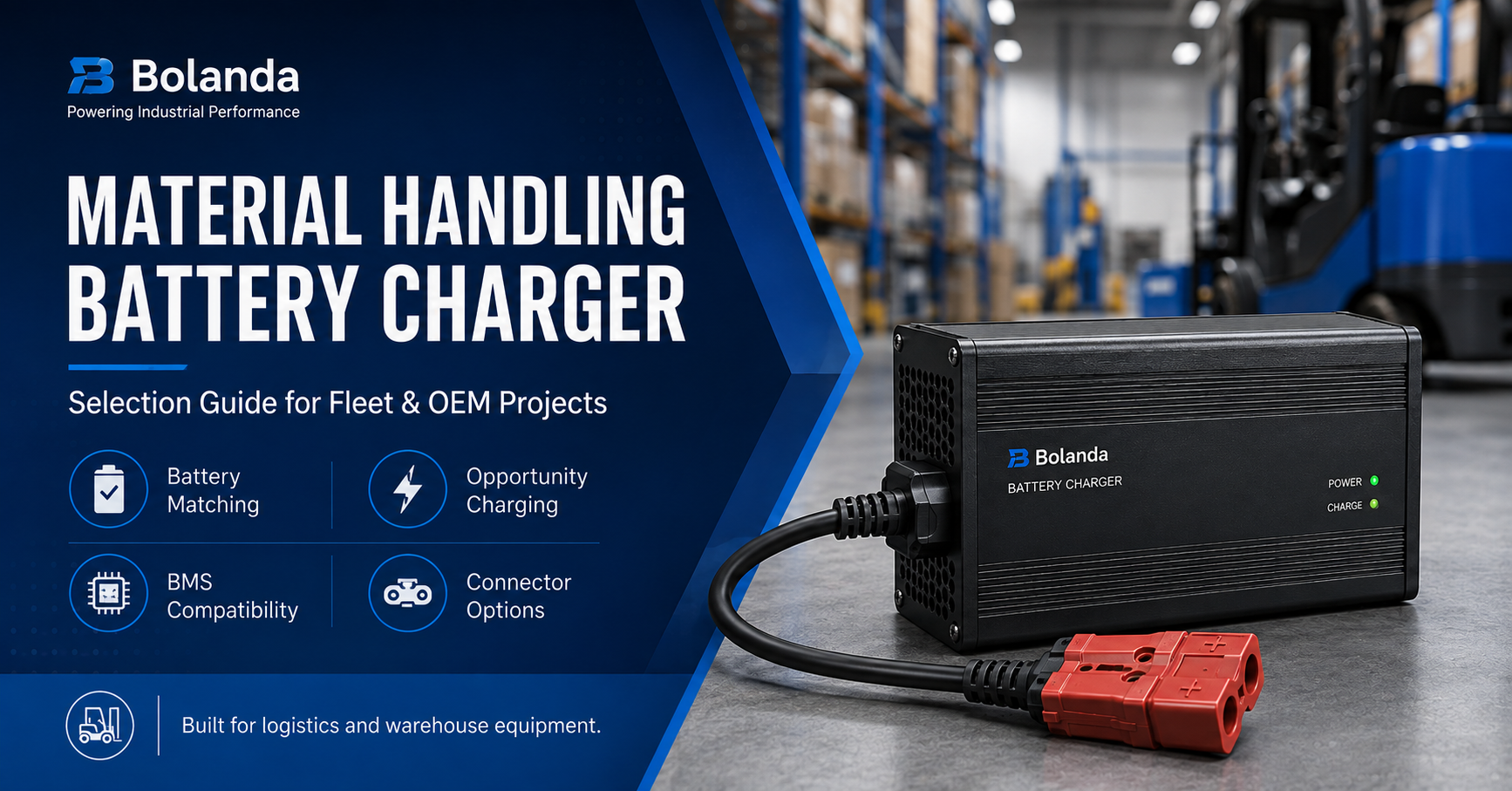
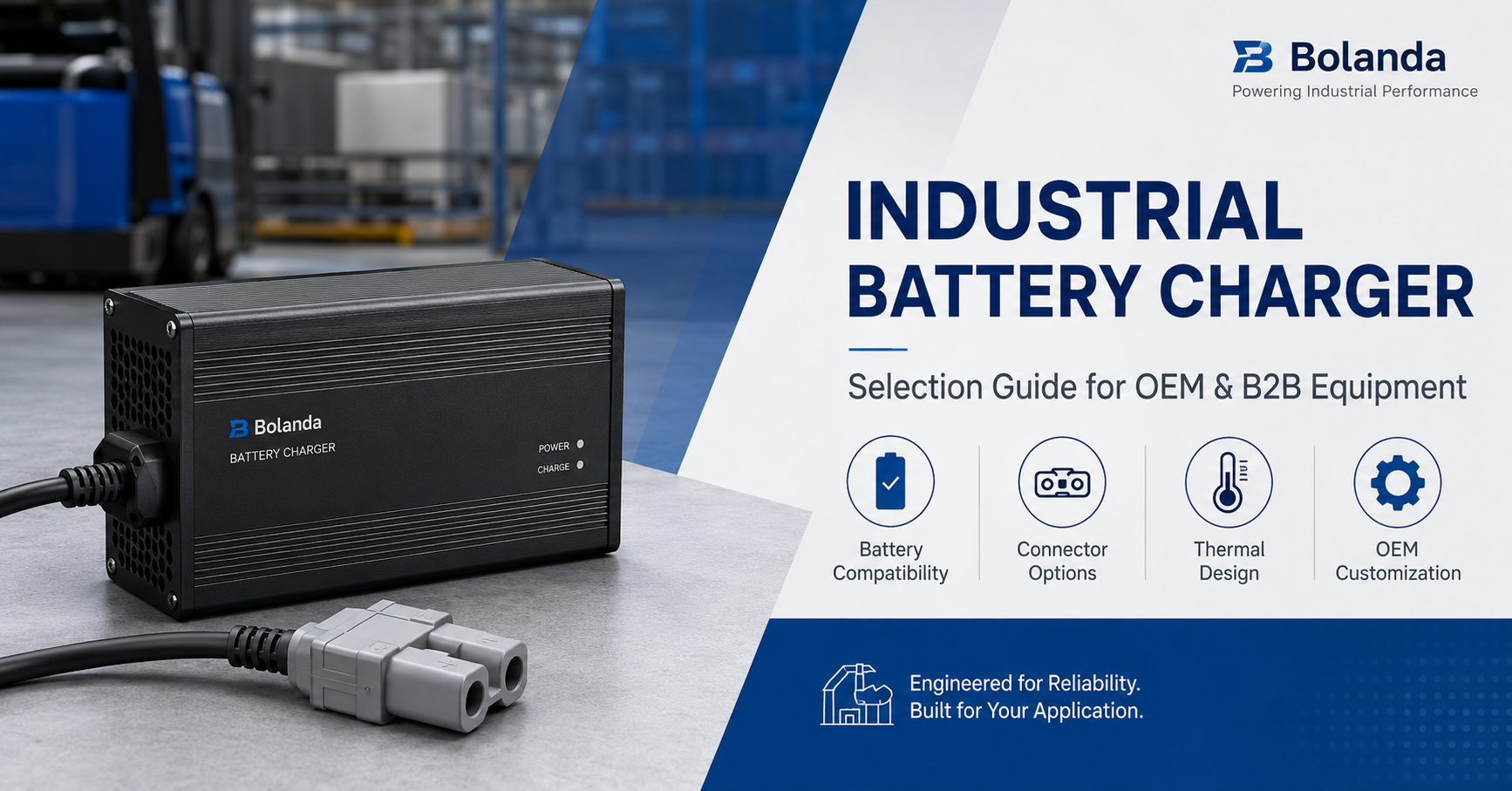
This guide is for equipment brands, battery pack businesses, importers and engineering buyers preparing a charger project. It follows one purchasing decision from the first enquiry to an approved production configuration. You will find a requirements table, a sample acceptance matrix, a quote comparison method and a practical enquiry checklist. The photographs supplied for this article show a grey charger enclosure, ventilation openings, cables and a latching connector. They are useful physical references, but they do not establish the electrical rating, battery chemistry or application compatibility of that model.
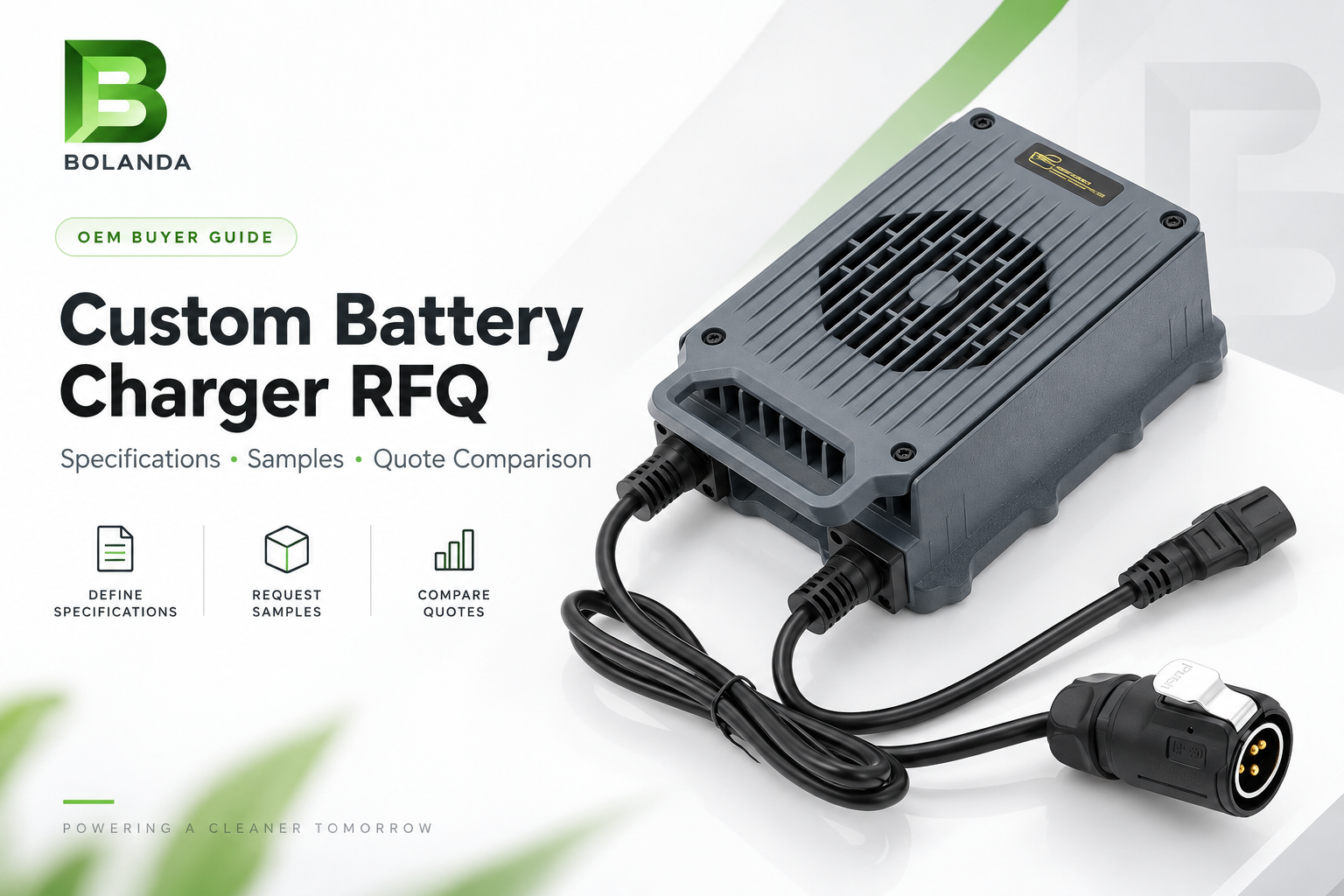
What belongs in a custom battery charger RFQ?
Start with the equipment and the battery, rather than a charger catalogue number. Describe what the machine does, where charging happens and who connects the cable. An indoor service bench, a delivery vehicle depot and a workshop battery station create different installation constraints. Even when their electrical requirements look similar, the acceptable noise, cable routing, connector handling and charging schedule may differ considerably.
Identify the battery manufacturer, pack model and document revision. Include chemistry, series configuration, rated capacity, permitted charging voltage, charging current limits and temperature restrictions. If you do not possess an approved battery specification, say so. An unresolved field gives the supplier a question to investigate. An assumed value can travel into a quotation, a label and a test instruction without anyone realizing where it came from.
Separate required functions from preferences. A mandatory mating connector is different from a preferred cable length. An approved charging limit is different from a desired recharge time. Mark requirements as confirmed, provisional or open. This small distinction helps both parties understand which changes need engineering approval and which are ordinary commercial choices.
The commercial part should describe the sample quantity, first purchase quantity, expected annual demand, delivery destination and planned project stages. A forecast is useful even if it remains uncertain; identify it as a forecast instead of presenting it as a committed purchase. Ask the supplier to state the assumptions used in its offer, including the proposed model, cable, plug, packaging and test scope.
| RFQ field | What the buyer should supply | What the supplier should confirm |
|---|---|---|
| Battery | Pack model, chemistry, configuration and approved charge limits | Matching charge profile and unresolved compatibility questions |
| Charging objective | Starting condition, target state and available charging window | Test conditions used to assess charging time |
| Electrical interface | Connector drawing, pin assignments, polarity and cable requirement | Exact mating parts and wiring revision |
| Controls | Enable signals, temperature feedback and any communication document | Supported behavior, fault response and version dependencies |
| Installation | Space, orientation, ventilation and environmental exposure | Applicable operating limits and mounting restrictions |
| Acceptance | Required tests, sample identification and approval owner | Evidence delivered with the samples and production units |
| Commercial scope | Quantities, market, delivery point and packaging | Unit price, development charges, lead-time assumptions and exclusions |
Why nominal battery voltage cannot define the charging specification
A nominal voltage label describes a battery system in a convenient way. It does not, by itself, specify the charger's regulation voltage. The approved charging conditions depend on the cells, their configuration, the pack design and the battery manufacturer's limits. Two packs marketed within the same nominal voltage category can therefore require different decisions during charger selection.
Request the permitted voltage and current at the battery charging interface, together with their tolerances. Also identify the conditions under which those limits apply. A room-temperature value does not automatically apply to a cold battery or a pack that has just finished a demanding operating cycle. The RFQ should direct the charger supplier to the battery specification rather than inviting it to infer the requirement from a marketing label.
Charging behavior extends beyond the maximum voltage. A project may need defined preparation, current regulation, voltage regulation, termination and restart behavior. As a technical reference, Texas Instruments describes preconditioning, constant-current and constant-voltage phases in its BQ24610 charger-controller documentation and linked Rev. D datasheet. That component example illustrates why a charging profile contains more information than two headline numbers. It does not mean the Bolanda product pictured here uses that controller.
Ask how the charger behaves when a battery starts outside the normal charging range. Who decides whether charging is allowed? What happens after a battery protection event? Can the charger restart automatically, or does the system require a deliberate reset? These questions belong in the written specification. They should not be left to an informal demonstration in which a single battery happened to charge successfully.
Set a realistic charging-time requirement
Buyers often begin with a sentence such as “We need it charged in three hours.” Keep the operational need, but define the starting and finishing conditions. Recharging from a partially used state is a different task from recovering the full usable capacity. A machine that must return to work during a short break also has a different requirement from one left overnight.
A simple capacity-over-current calculation can help compare early options. For example, replacing 12 ampere-hours at an assumed constant 4 amperes would take three hours in an idealized calculation. This is an arithmetic illustration, not a charger recommendation or a guaranteed recharge time. Current tapering, temperature limits, battery condition, system consumption and other restrictions can extend the actual result.
Specify whether the equipment remains powered while charging. A display, controller or auxiliary load can consume part of the available output. A test performed with the battery isolated from the machine might therefore produce a different result from the installed application. The acceptance plan should use the intended operating arrangement, or clearly explain why a bench arrangement is representative.
Ask for a measured charging trace on the agreed pack and configuration. The record should identify the battery, initial condition, ambient conditions, charger revision, elapsed time and completion criterion. If the requested time cannot be met within the battery's approved limits, the solution may involve the operating schedule or battery capacity rather than a larger charger. Treat this as a system decision that needs the battery supplier's input.
Review the connector as an electrical and mechanical assembly
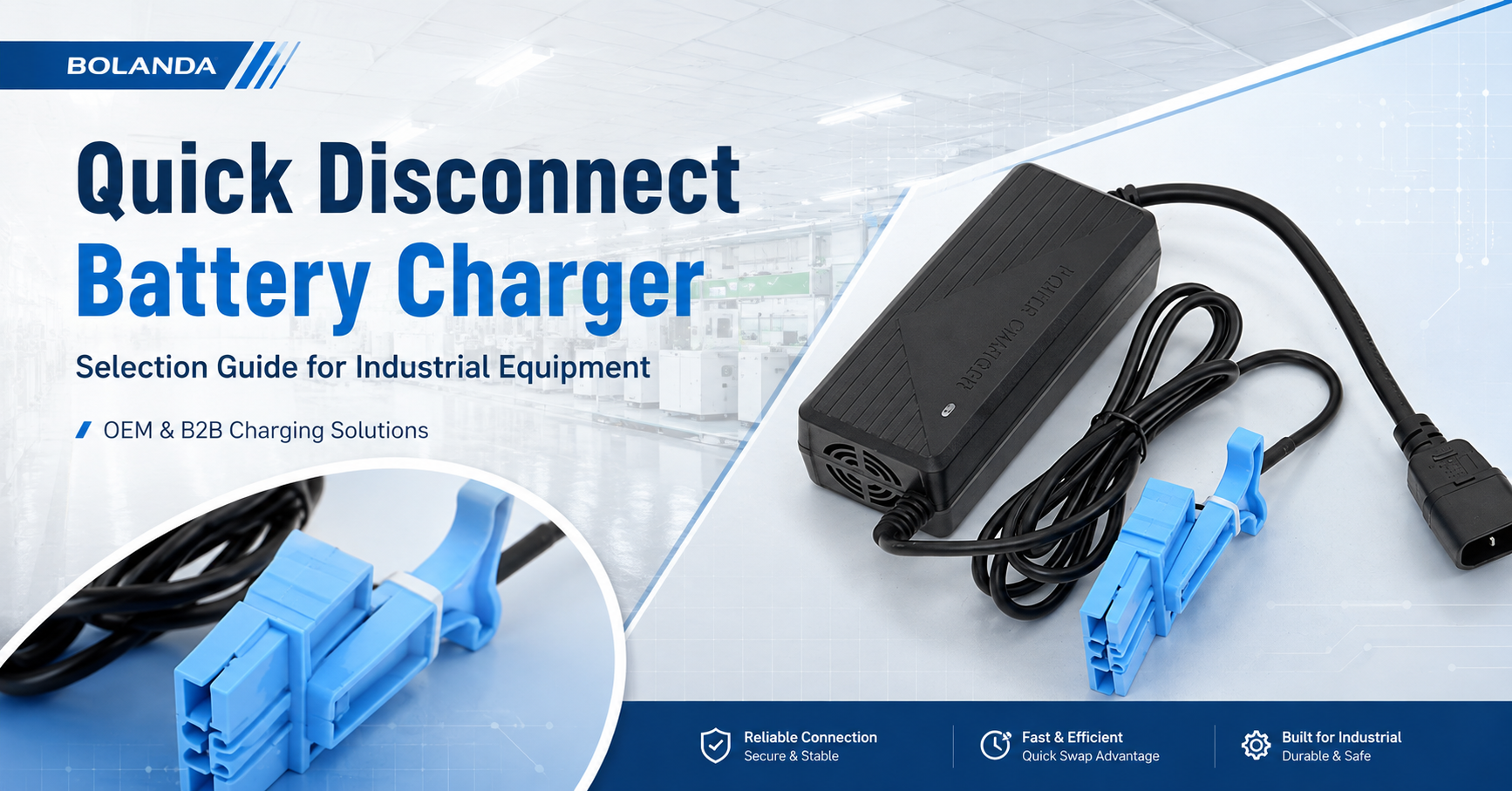
A connector photograph helps identify the shape and locking arrangement. It is not a wiring specification. The close-up supplied with this article shows a latching connector with visible contacts. Buyers still need the part identification, mating information and a controlled pin-assignment drawing. Similar housings may be wired differently, so physical fit alone is not an adequate acceptance test.
Include the view direction on the drawing. A diagram looking into the mating face can be confused with a diagram looking from the cable side. Identify power contacts, signal contacts, shield connections where applicable and any unused positions. Agree who owns the drawing and how its revision is linked to the sample label. A photograph of both approved mating parts is a useful addition to the drawing.
The cable deserves the same attention as the connector. Length, conductor specification, strain relief, bending during use and routing near hot surfaces affect the assembly. Request the supplier's proposed cable construction instead of choosing by outer diameter alone. If a longer cable is required for the installation, confirm it before sample testing rather than extending the cable afterward and assuming the test still applies.
Electrical loss can be illustrated without pretending to know the pictured product's performance. At an assumed current of 5 amperes and a total outgoing-and-return path resistance of 0.10 ohm, the voltage drop is 0.50 volt and the resistive loss is 2.5 watts. Both numbers follow from elementary circuit relationships. They are not measurements of this charger. Ask where regulation voltage is measured and whether the quoted configuration accounts for its actual cable assembly.
Analog Devices discusses wiring and connector voltage drops in Tom Hack's Design Note 1029 on supply regulation. Its USB circuit is a different application, but the underlying point is relevant: load current and connection resistance affect the voltage delivered at the load. Do not assume the compensation method described there exists in a proposed charger. Ask the supplier to document its own method and limits.
Confirm what the BMS and charger each control
The battery management system and the charger have related responsibilities, but their names do not define a complete interface. Some systems charge through a straightforward power connection. Others include enable signals, temperature information or digital communication. Establish which arrangement your project actually uses before requesting features that may be unnecessary or assuming features that have not been confirmed.
If communication is required, provide the protocol document and version. Describing an interface simply as CAN or another bus name does not explain the message content, timing, addressing or required fault behavior. Identify which device initiates the exchange, what permission is needed before power delivery and what happens when messages stop. The supplier should identify any remaining development work in its quotation.
Make a short event list for engineering review: normal connection, normal completion, temperature outside the approved range, communication interruption, battery disconnection and restoration of input power. For each event, state the expected system response and the evidence needed during testing. This is more useful than a long marketing list of protection acronyms without agreed behavior.
A protection trip should not become the normal way to finish every charge cycle. If the demonstration ends only because the battery disconnects unexpectedly, investigate whether the settings and interfaces are correct. Tests involving abnormal electrical conditions should be designed and performed by qualified personnel with suitable equipment. A purchasing checklist should define the evidence required, not encourage an untrained buyer to improvise fault tests.
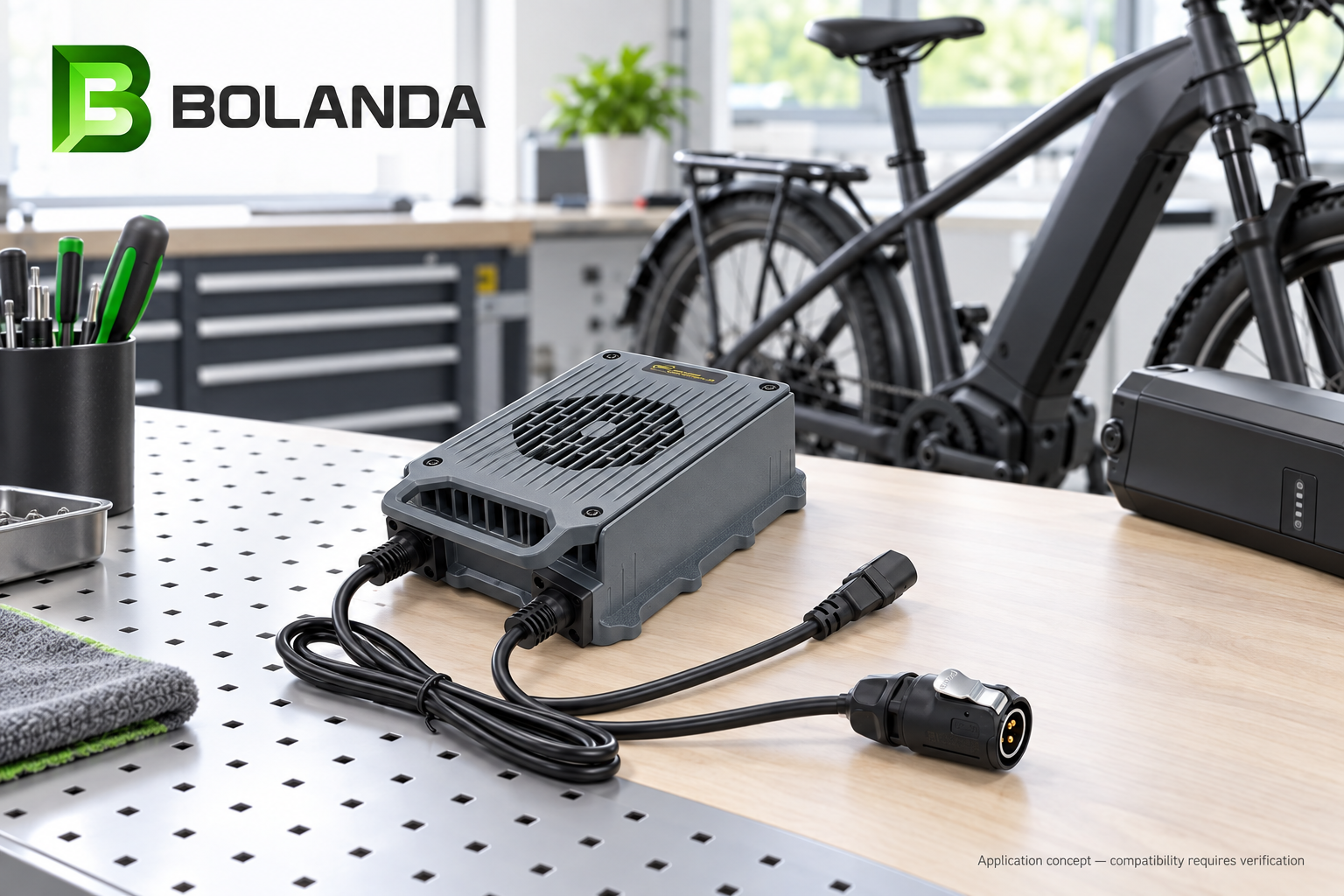
Use the enclosure photographs to ask better installation questions
The supplied product views show a carry handle and a prominent grille. Those visible features suggest questions worth putting in an RFQ: how is the charger positioned during operation, which openings must remain clear and how is the cable stored between uses? A useful photograph starts a technical discussion. It cannot establish an ingress-protection rating, acoustic level or temperature limit.
Provide an installation drawing or a photograph of the intended space. Show nearby surfaces, expected obstructions and the cable exit direction. A charger evaluated on an open bench may behave differently inside a restricted compartment. If a compartment is unavoidable, describe it before requesting the thermal evaluation. Allow the supplier to identify the conditions under which its proposed model can operate.
Noise can matter even when the application is industrial. A charging station beside an office or in a small service area may have different requirements from a busy production hall. Define the expected use instead of assuming a fan is either acceptable or unacceptable. Similarly, a handle helps people move a product, but it does not establish that the product is suitable for every portable or outdoor application.
Separate operating conditions from transport and storage conditions. State the intended environment and request model-specific documentation for any claimed resistance to dust, moisture, vibration or impact. The product image should never be used as a substitute for those records. When two suppliers propose different enclosure arrangements, compare the complete installation requirements as part of the commercial decision.
Build the sample acceptance plan before paying for samples
A sample order is more productive when the buyer already knows what would count as approval. Otherwise, the sample may arrive, charge a battery once and sit on a desk while the purchasing team waits for an undefined engineering decision. Agree the evaluation scope, responsible people and expected records before dispatch.
Give every sample an identifier and record the proposed product revision. Link that identifier to the electrical specification, cable drawing, label artwork and any software or configuration version. If a supplier changes a setting during evaluation, record the change. A sample that has been adjusted repeatedly without a clear final record is difficult to reproduce in production.
The following matrix is a planning template. The buyer and supplier must fill in the numerical limits and test conditions for the actual project. Leaving the limits open here is intentional: applying an arbitrary voltage tolerance, temperature threshold or test duration to an unidentified charger would create false precision.
| Evaluation area | Evidence to retain | Approval question |
|---|---|---|
| Sample identity | Model, serial identifier, label and revision photographs | Is this the configuration described in the offer? |
| Battery interface | Approved pack record, pin drawing and matching connector identification | Are the electrical and mechanical interfaces confirmed? |
| Charging behavior | Voltage, current and time record under agreed conditions | Does the system follow the approved battery requirements? |
| Installed operation | Installation arrangement and thermal evaluation record | Are restrictions compatible with the intended equipment? |
| Defined abnormal events | Qualified test report with expected and observed responses | Do the agreed protective responses occur? |
| Documentation | Specifications, operating instructions and applicable model evidence | Can purchasing and service teams identify the approved product? |
| Release decision | Signed acceptance record and unresolved-item list | What is approved, conditional or still rejected? |
Keep qualification and routine production checks separate. Qualification evaluates whether a design and configuration meet the agreed project needs. Production checks look for manufacturing variation and confirm required characteristics on subsequent units or batches. Ask the supplier which activities fall into each category and what records accompany delivery. A single sample report does not establish that every future unit has been checked in the same way.
✉ Request a Sample Evaluation Discussion
Compare charger quotations on the same scope
Two prices are comparable only when they describe sufficiently similar deliverables. One offer may include the final cable and plug, while another excludes them. One may cover an existing configuration, while another assumes new development. Before negotiating the unit price, ask each supplier to mark included items, exclusions and unresolved technical conditions.
Separate non-recurring charges from recurring unit costs. Development, tooling, fixtures and project-specific evaluation can be priced independently from production units. Ask who owns any dedicated tooling or design deliverables, what maintenance is included and what happens if the project changes.These are commercial questions that should be settled in the project documents, not inferred from the words OEM or ODM.
State the purchase quantity associated with every quoted price. A forecasted annual volume and an actual shipment quantity are not interchangeable. Also align packaging, delivery point, currency, payment terms and quote validity. If a quotation relies on a component substitution or an alternative connector, flag that difference before adding its price to a comparison table.
| Comparison line | Offer A | Offer B | Buyer action |
|---|---|---|---|
| Approved electrical configuration | Record model and revision | Record model and revision | Resolve differences before price comparison |
| Cable, connector and regional plug | Included or excluded | Included or excluded | Match exact assembly scope |
| Sample and evaluation charges | Itemized quotation | Itemized quotation | Identify evidence supplied with samples |
| Development and dedicated tooling | Itemized quotation | Itemized quotation | Clarify ownership and change conditions |
| Production unit price | Price at stated quantity | Price at stated quantity | Use the same order quantity and packaging |
| Lead time | Starting event and assumptions | Starting event and assumptions | Distinguish samples from production delivery |
This template deliberately contains no invented prices. Use current written quotations for the actual project. A low number with unresolved scope can be more expensive to manage than a higher, clearly defined offer, but that conclusion should come from the comparison rather than a sales slogan. Record the cost of known additional work separately and leave uncertain items visible.
A worked purchasing example without assumed product compatibility
Consider a hypothetical equipment buyer preparing a charger replacement programme. The existing unit is inconvenient to handle, and the buyer wants a more practical enclosure and a revised cable. The battery itself is intended to remain unchanged. This is an illustrative procurement scenario, not a Bolanda customer case or a claim about the charger shown.
The buyer first records the existing pack identification and obtains its approved charging requirements. A photograph of the old charger label is retained as a reference, but the battery document remains the authority for the charging limits. The buyer then supplies the mating connector part and a drawing of the cable routing in the equipment.
Next, the team splits the request into fixed and negotiable items. Battery compatibility and pin assignments are fixed. Cable length, handle arrangement and packaging are open to discussion. The supplier can now propose a configuration without treating every item as new development. Any alternative is recorded beside the original requirement so the buyer can see what changed.
The sample evaluation uses the intended battery and the revised cable. It records charging behavior, the installed arrangement and the agreed handling checks. If the cable routing changes during the trial, the final drawing is updated before approval. Purchasing then compares the production quotation against that final configuration, rather than against the first informal enquiry.
The value of this sequence is traceability. It does not promise a particular cost reduction or faster certification. It gives both parties a common record when they answer a practical question: is the product being delivered the product we evaluated? That same sequence works for a new charger project, although a new design may require a broader development and qualification plan.
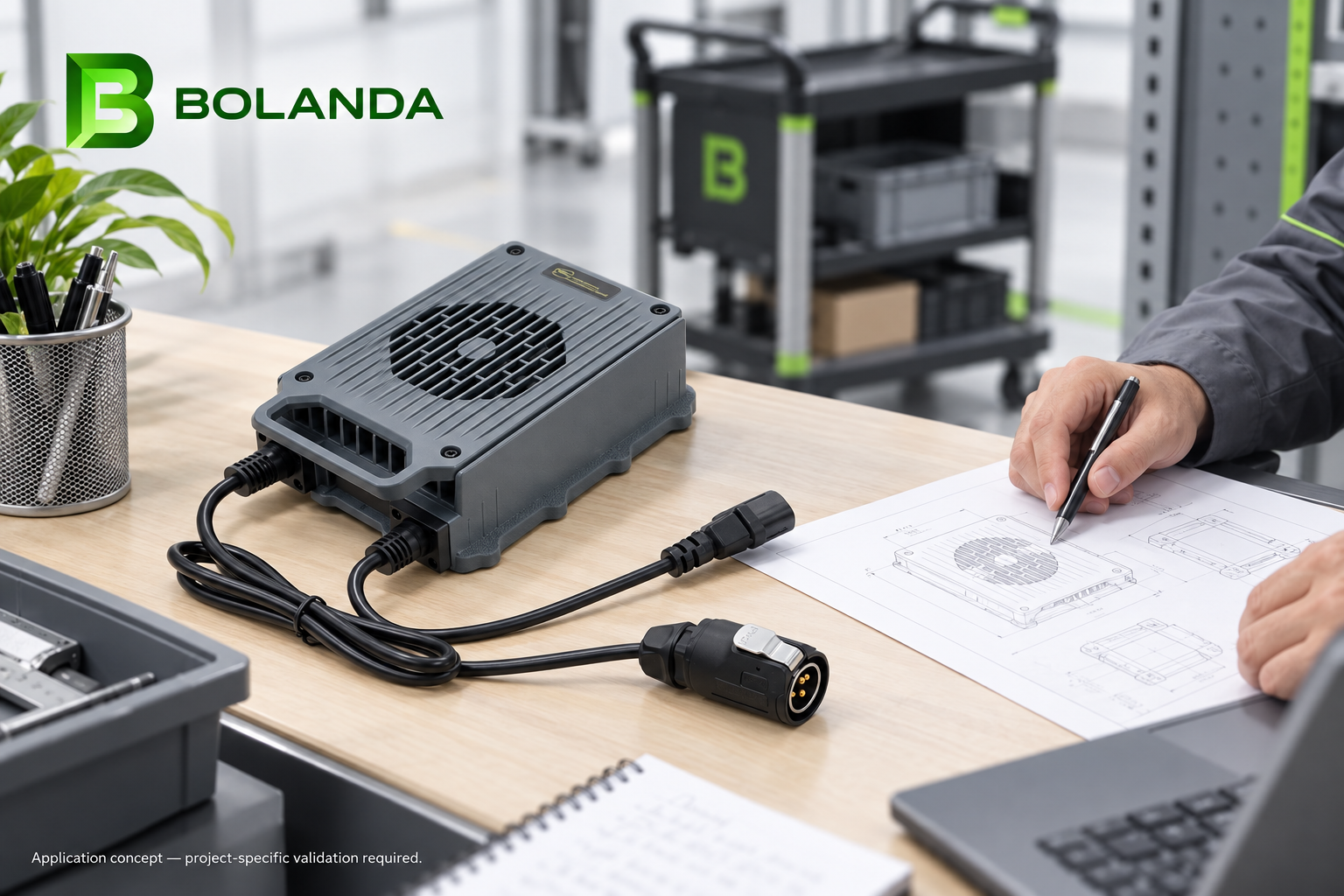
Product video and visual reference
Use the accompanying product video together with the photographs when describing the physical configuration you want the supplier to review. Refer to a clear moment or visible detail when asking about the enclosure, cable exit or connector. A visual reference can remove ambiguity about appearance while the specification controls the electrical requirements.
A demonstration or product view does not establish an electrical rating, certification or compatibility with a particular battery. Request the matching model data and approval evidence separately. Keep the visual reference and the accepted specification together in the project folder so that a later purchasing or service colleague can identify the same configuration.
Choose the relevant product route for your enquiry
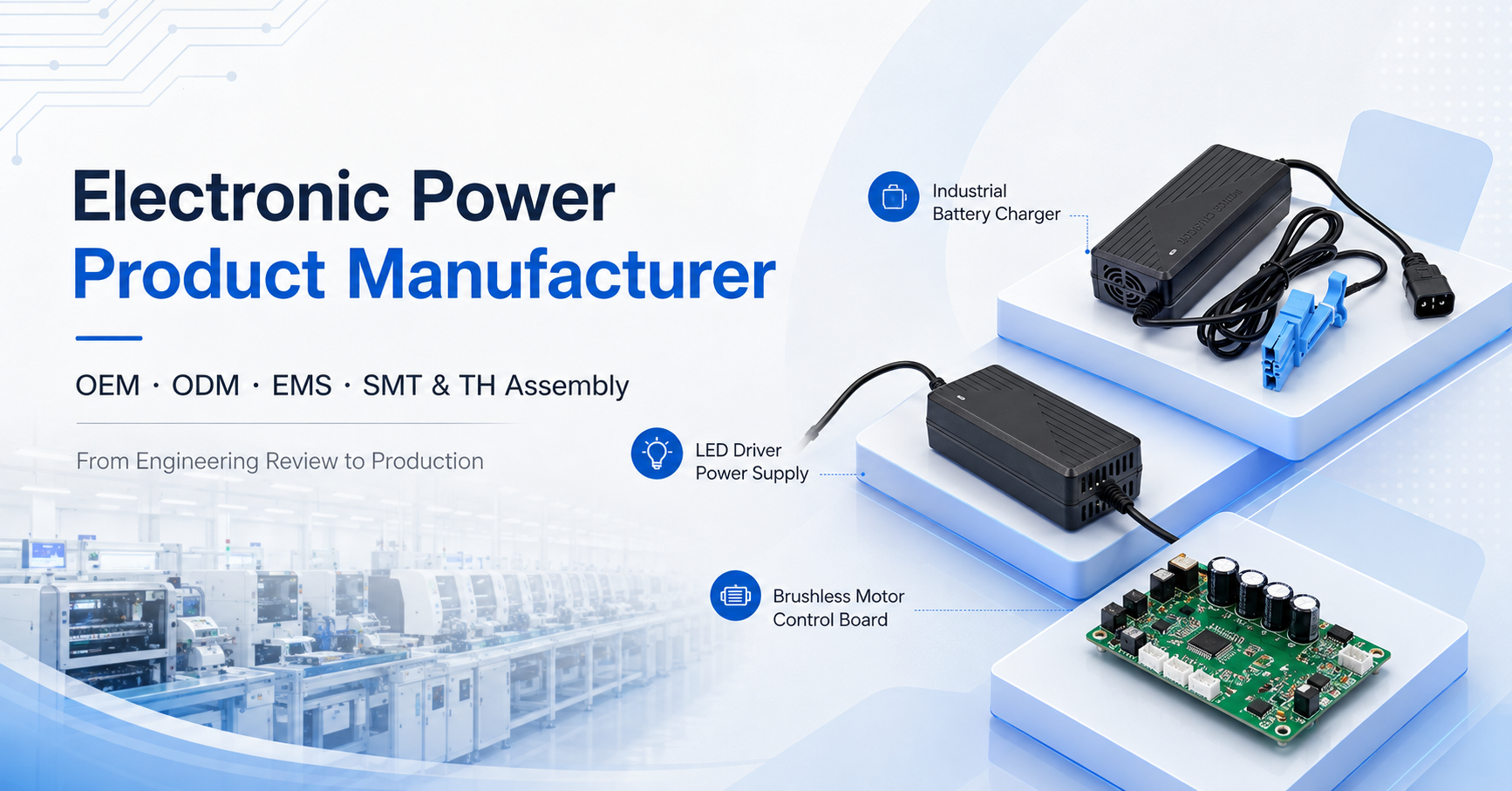
A charger RFQ can reveal that the project belongs to a different product or manufacturing route. An equipment team may need a complete charger, a power adapter feeding an internal charging circuit, or an assembled board built to its own design. Describe the responsibility boundary before selecting a category. The routes below connect related purchasing needs to Bolanda's catalogue or manufacturing-service pages; individual model capabilities remain subject to review.
| Procurement route | When it is relevant | Information to provide first |
|---|---|---|
| power tool battery charger manufacturer | A tool-platform or workshop charging project | Battery platform, contacts, temperature feedback and charging objective |
| custom lithium battery charger manufacturer | A battery-specific OEM or ODM charger project | Approved pack specification, interface and customization scope |
| e bike charger manufacturer | An electric-bicycle brand or importer programme | Battery configuration, mating connector and destination market |
| electric motorcycle charger manufacturer | An electric-motorcycle charging requirement | Pack data, installation arrangement and any control interface |
| industrial lithium battery charger manufacturer | A logistics-equipment or industrial battery project | Duty cycle, charging window, battery limits and installation |
| LED driver manufacturer | A lighting load that needs a driver rather than a battery charger | LED load, output mode, dimming requirement and thermal conditions |
| brushless motor controller manufacturer | A motor-drive or control-board requirement within the equipment | Motor information, feedback arrangement and operating cycle |
| AC DC power adapter manufacturer | An external power supply for equipment with its own charging control | Load profile, output limits, connector and protection requirements |
| power supply PCB assembly | A manufacturing project based on controlled electronic design files | BOM, board files, assembly information and test specification |
| mobility scooter battery charger supplier | A mobility-equipment or replacement-product sourcing project | Equipment and battery model, chemistry and verified connector pinout |
The LED, motor-control and adapter routes are distinct electrical functions, not interchangeable names for a charger. Likewise, an assembly service is not automatically a complete product-development contract. Clarifying that distinction prevents the RFQ from being sent with missing design responsibilities. For custom development and board assembly, the links lead to the relevant OEM/ODM service page because the scope must be defined for the project.
Protect the approved configuration when production starts
Sample approval should create a production baseline. Keep the accepted specification, cable drawing, label, packaging information, test requirements and relevant configuration files under revision control. The purchase order should identify that baseline. Otherwise, an order description such as “same as sample” can become ambiguous when several samples or cable options have circulated.
Agree how changes are proposed. A component substitute, connector change, firmware adjustment or enclosure revision may require a different level of review. Some changes are administrative; others affect electrical behavior, mechanical fit or existing test evidence. The project documents should state who reviews the change and which checks must be repeated before shipment.
Ask for a practical traceability arrangement that matches your service needs. This may include model identification, batch references and the manufacturing records agreed for the project. Do not request a large data package merely because it looks impressive. Identify the information needed to investigate a field issue and confirm that the supplier can retain and retrieve it.
Include a process for reporting a suspected problem. Record the unit identification, battery model, observed symptom, operating conditions and any relevant installation change. A description such as “charger failed” offers little diagnostic value. A precise record helps engineering distinguish a charger issue from a cable, battery, equipment or application mismatch without prematurely assigning a cause.
Questions buyers ask before requesting a quote
Can I request a quote before every specification is final?
Yes. Send the confirmed information and mark open items clearly. Ask for a preliminary offer with stated assumptions rather than treating it as a production-ready quotation. A useful early enquiry identifies the application, battery, desired schedule and the decisions still outstanding. The supplier can then explain what additional information is needed before proposing samples or committing to the final scope.
Does a matching connector mean the charger is compatible?
No. Mechanical fit does not establish polarity, pin assignment, charging limits, control behavior or battery compatibility. Supply the mating-part identification and approved wiring drawing, then evaluate the agreed configuration with the actual battery system. Do not rely on a photograph, connector colour or a “universal” description as approval evidence. Compatibility is a model-and-configuration question.
Should I choose the highest charging current available?
Choose current according to the battery's approved limits and the required operating schedule. A larger headline rating does not automatically produce the best system. Thermal conditions, available input power, connector capacity and the battery's charging behavior also matter. Ask for an evaluation against your actual charging objective instead of selecting current in isolation.
What determines the minimum order quantity and lead time?
The selected platform, customization, component availability, packaging and evaluation work can affect both. Request separate timing for technical review, samples, approval and production. Ask when each timing estimate starts and which buyer decisions it depends on. Bolanda confirms quantities, prices and delivery arrangements for the specific project; this guide does not establish a universal minimum or guaranteed turnaround.
Can I use my own logo and packaging?
Provide the intended artwork, model naming, label information and packaging requirements for review. Private labeling still needs accurate electrical information and documentation that matches the approved configuration. Confirm responsibility for artwork approval and any market-specific review. A logo change should not obscure which manufacturer, model or revision is associated with the product records.
Which certification documents should I request?
State the destination market, product application and required assessment scope, then ask for documents tied to the proposed model and configuration. Have the appropriate compliance specialist or laboratory confirm what applies. A certificate for a different model or an unrelated component is not sufficient evidence for the final product. Do not infer certification from a photograph or a catalogue heading.
How should confidential design files be shared?
Start by describing the project and the type of information available. Agree the confidentiality arrangements, authorized recipients and file-transfer method before sharing sensitive design material. For an assembly project, identify the files needed for quotation and those required later for production. Also clarify design ownership and the permitted use of any project-specific engineering work.
What makes an enquiry easier to answer?
A named application, a real battery specification, a quantity range and a clear question are more useful than a long list of unrelated product terms. Explain whether you need a standard configuration, a revised interface, development support or manufacturing to your files. Include your company and role so the discussion can involve the right commercial and technical people.
Send a charger enquiry that can move to the next decision
Before contacting Bolanda, assemble the information you already have. You do not need to invent missing details or write a lengthy technical report. A short, organized enquiry can state the application, identify the battery and explain the next decision you want help with. Mark unknown items openly so that they become part of the review.
- Your company and project: equipment type, your role and the intended application.
- Battery information: manufacturer, pack model, chemistry and approved charging specification.
- Charging objective: starting condition, desired completion condition and available charging window.
- Interface: connector identification, pin drawing, cable length and any control or communication requirement.
- Installation: location, available space, ventilation and expected operating conditions.
- Commercial needs: sample quantity, first order estimate, annual forecast and destination market.
- Required next step: configuration review, sample discussion, quotation comparison or manufacturing assessment.
Bolanda's website describes electronic power product manufacturing and OEM/ODM support, including assembly, testing coordination and supply-chain support. The practical next step is to connect those services to your documented requirement. Ask which existing model or project route is appropriate, what evidence can be provided and which points need further engineering review.
A clear RFQ does not remove every uncertainty before development starts. It makes the remaining uncertainty visible and assigns it a place in the project. That is how the initial enquiry becomes a comparable quotation, a useful sample evaluation and a production order that refers to an agreed product.