

When a customer asks for a small electric vehicle charger, the first request is usually simple: "Will it charge my battery?" The honest answer depends on more than the number printed on the housing. Branda 321200006 is a useful 29.6V reference for that conversation. The supplied specification shows 5A output, 120W rated power, 200-240Vac input and a 200mm EU cord. The red battery-side clip is easy to recognize in a workshop, but the battery and its BMS still decide whether the combination is approved.
This article uses the supplied reference for Branda 321200006. Confirm the battery and destination-market requirements before purchase.
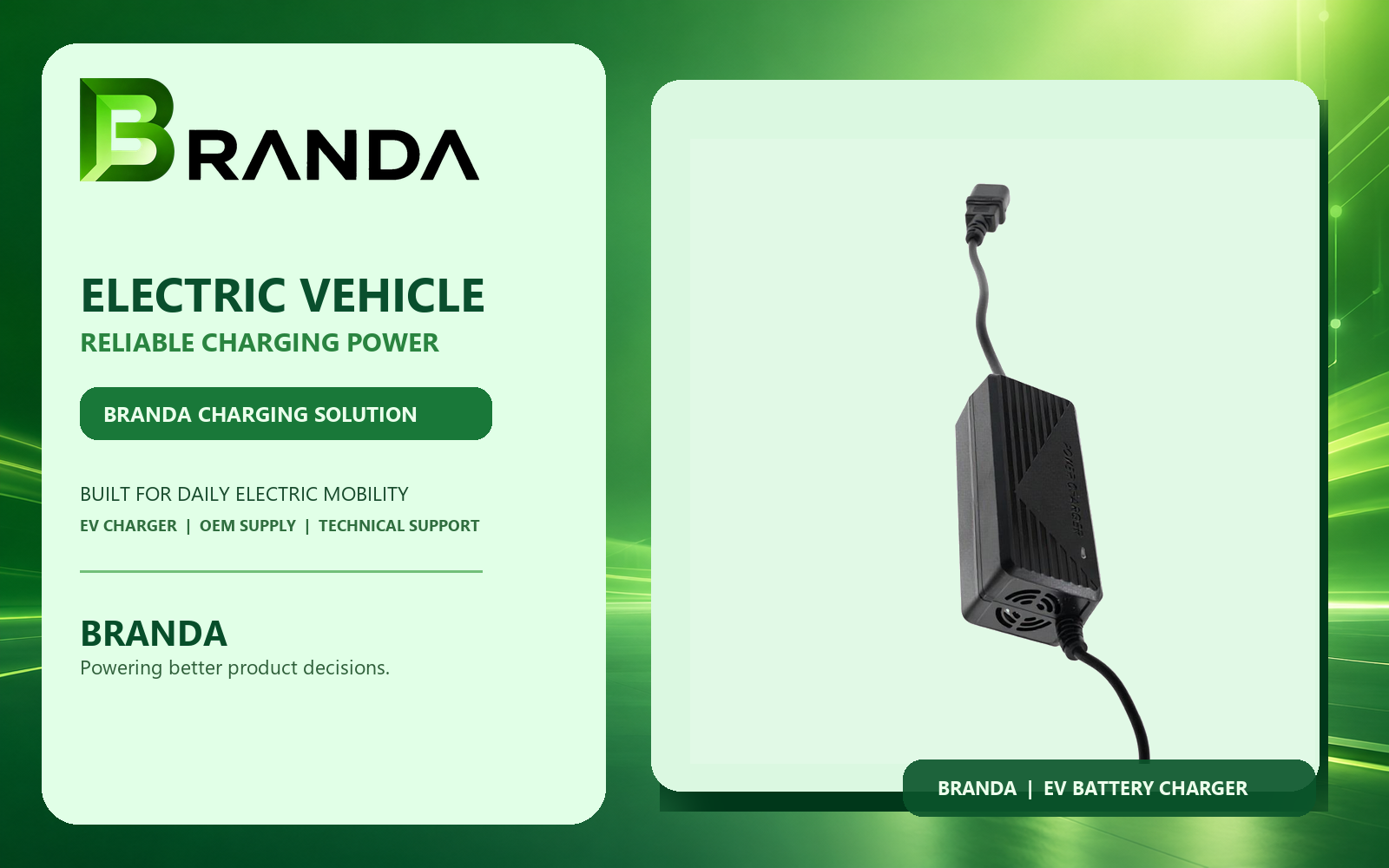
Quick specification record
| Field | Supplied reference | What the buyer should confirm |
|---|---|---|
| Model reference | Branda 321200006 | Keep the Branda prefix and label revision together. |
| Product family | Electric vehicle battery charger / power adapter | Match the battery and vehicle application. |
| Output | 29.6Vdc, 5A | Confirm the battery charge voltage and current limit. |
| Rated power | 120W | Use the approved test condition. |
| AC input | 200-240Vac, 50-60Hz | Confirm the site supply and market cord. |
| Cord | 200mm EU cord | Measure the installed route. |
| Battery connector | Red battery-side clip shown in the supplied product set | Approve the mating pair and polarity. |
The useful part of the specification
I would put the output and input on the same line when preparing a quotation. For Branda 321200006, that line is 29.6Vdc, 5A and 120W on the battery side, with 200-240Vac, 50-60Hz on the AC side. The supplied reference also shows a 200mm EU cord.
That format prevents a common mix-up. A buyer may remember "29.6V charger" and forget the AC version. The cord, label and input range then become a surprise at the sample stage. It is much easier to close the question before the order than after the charger is packed.
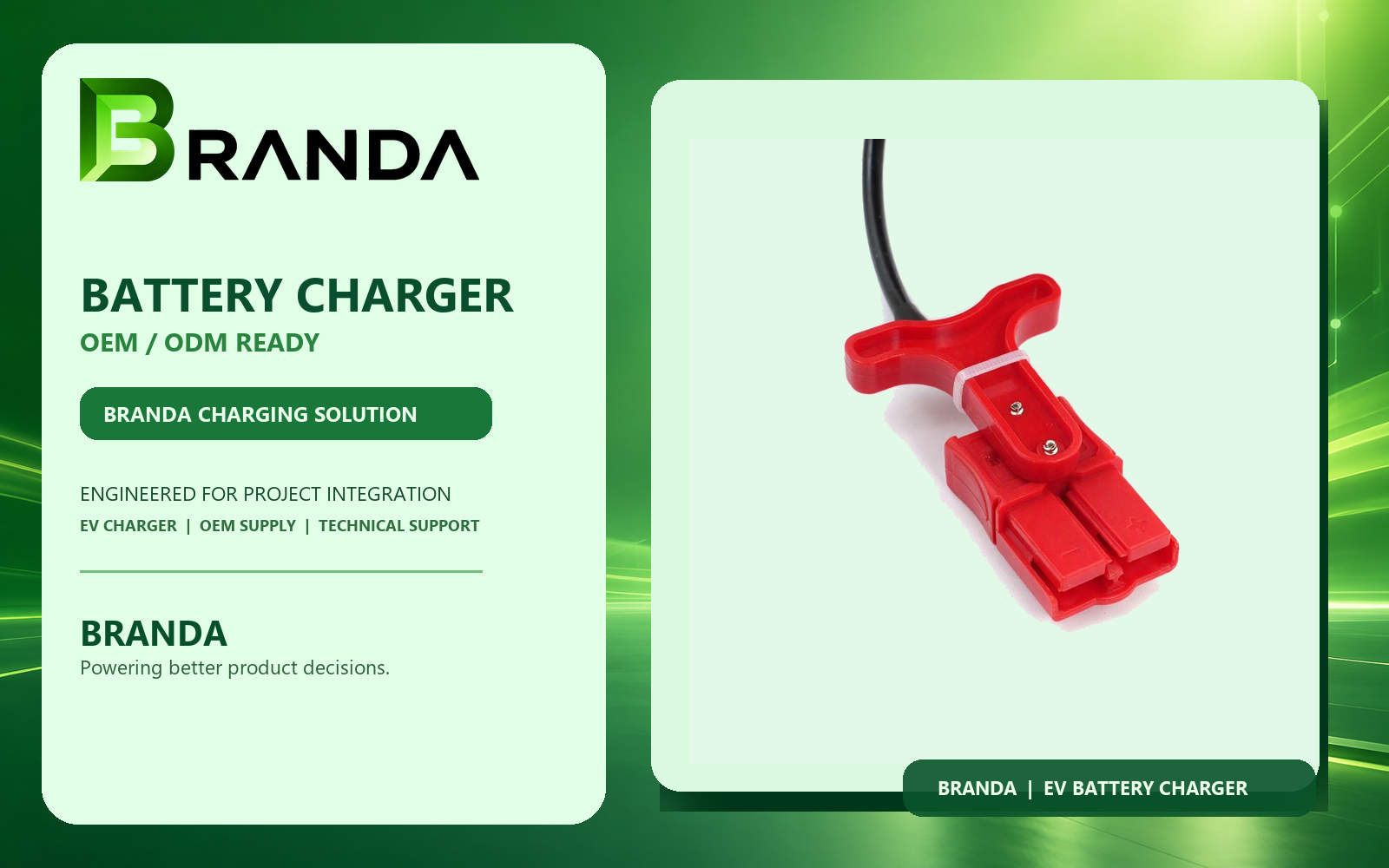
The red clip needs a real fit check
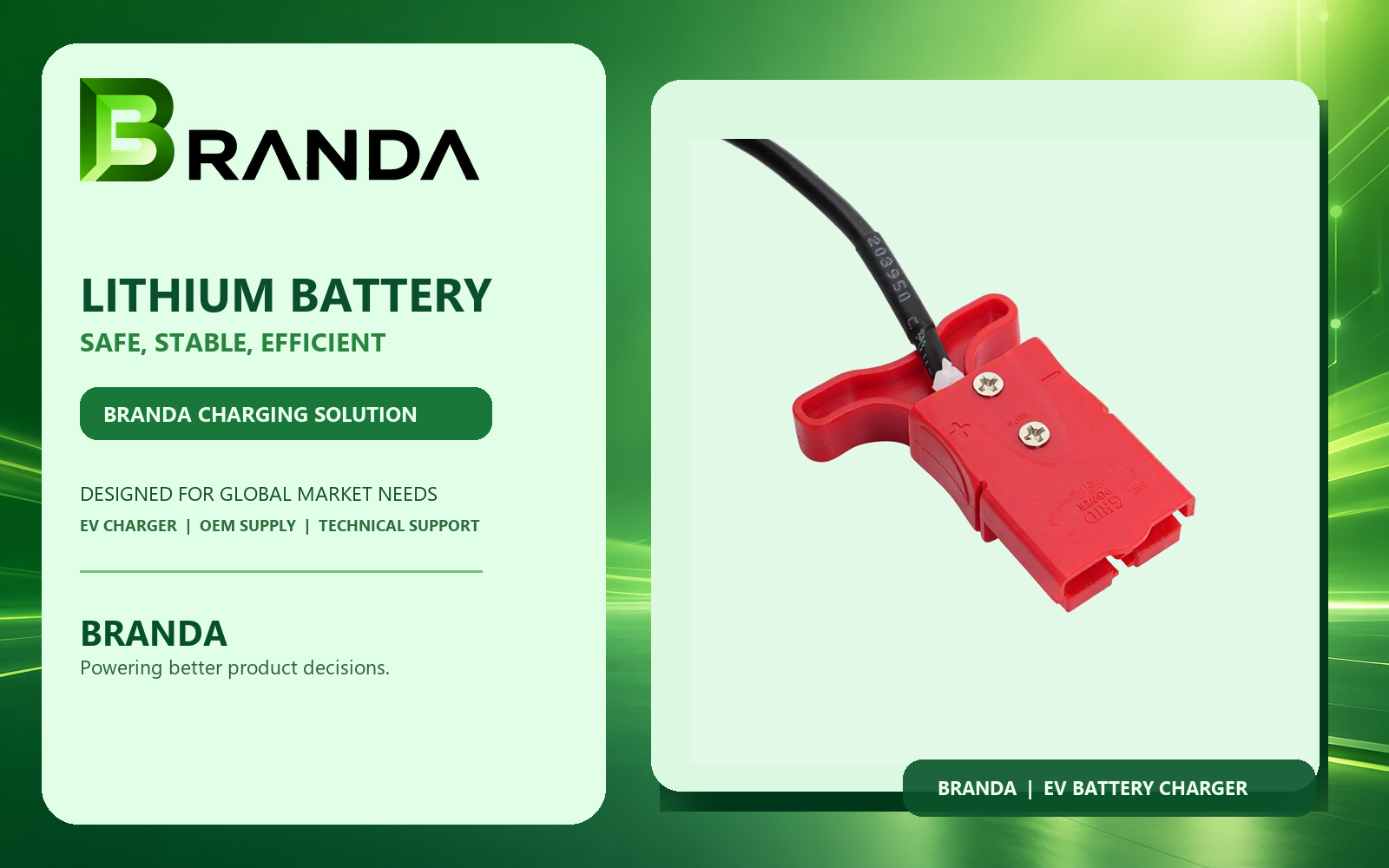
The red connector is helpful for day-to-day identification. If several electric vehicle chargers sit on one shelf, an operator can find the intended unit without reading every label. Color is only a visual aid, though. It does not confirm polarity, contact layout or keying.
Before release, I would ask for the mating connector drawing or an approved battery sample. Then I would repeat the connection while wearing the gloves used in the charging area. A connector that feels fine on a clean bench can be awkward when the battery is inside a vehicle.
Do not turn 120W into a charging-time promise
The 120W rating tells us how to describe the charger electrically. It does not tell us how long every battery will take to charge. Capacity, starting state of charge, temperature, current taper and BMS limits all change the result.
For an overnight electric mobility routine, 5A may be a comfortable fit. For short opportunity charging, the same current needs a closer look. Use the real battery for the sample run and write down the test condition. That is better evidence than a broad "fast charger" claim.
The charging bay matters as much as the adapter
A 200mm EU cord may be convenient in a compact bay and inconvenient if the socket is behind a cabinet. Measure the actual route to the place where the red connector rests. Include the bend at the charger, the service loop and the operator's reach.
I would also check where the charger sits between uses. If it is left on the floor, the cable and connector see a different kind of wear. A small wall hook or shelf can make the routine cleaner without changing the electronics.
A practical Branda project brief
For an OEM or ODM enquiry, send Branda the battery part number, chemistry, full-charge voltage, maximum current, BMS limits, connector drawing, site voltage, plug, cable route and target market. Mention that the starting reference is Branda 321200006.
Branda's battery charger manufacturer service is most useful when the request separates fixed requirements from open choices. The output may stay at 29.6V and 5A while the connector, label, cord or packaging is reviewed for the vehicle.
Buyer worksheet before the purchase order
| Review item | Buyer provides | Supplier returns |
|---|---|---|
| Battery | Part number, chemistry, nominal voltage and full-charge voltage | Compatibility assumption and approved charging profile |
| BMS | Maximum current, temperature limits and communication requirement | Charging behavior and fault handling |
| Connector | Mating part, polarity, keying and photos or drawing | Connector code, cable exit and sample result |
| Input | Site voltage, frequency, plug and target market | Controlled input variant and label artwork |
| Cable | Route, storage point and traffic constraints | Released cord length and strain-relief note |
| Testing | Battery condition, duty cycle and acceptance criteria | Test record and open-item list |
How buyers compare the best electric vehicle charger options
For a buyer searching for the best electric vehicle charger, the shortest route to a sound decision is a written comparison rather than a product photo. Put the battery chemistry, full-charge voltage, maximum charging current, BMS limits, connector, input supply and target market on one sheet. Then compare each electric vehicle battery charger against the same fields. This method makes an EV charger quotation easier to audit and reduces the chance of mixing a 100-120Vac model with a 200-240Vac model.
Cost matters, but EV charger cost is not only the unit price. A practical comparison also includes the approved cord, connector, sample testing, label artwork, packaging, compliance review, minimum order quantity and expected lead time. When an OEM electric vehicle charger project is quoted, these details should be separated into confirmed requirements and open choices. That gives purchasing a clean comparison and gives engineering a clear list of questions.
Application checklist before requesting a quotation
- Battery: chemistry, nominal voltage, full-charge voltage and capacity.
- Charging profile: maximum current, BMS limits, temperature range and fault response.
- Mechanical fit: connector family, polarity, keying, cable exit and operator clearance.
- Site: input voltage, frequency, plug, charging-bay conditions and storage location.
- Commercial scope: sample quantity, target market, private-label needs, MOQ and delivery window.
For Branda 321200006, the supplied reference is 29.6Vdc, 5A, 120W rated power and 200-240Vac, 50-60Hz, with a red battery-side connector. These are useful starting points for a technical review, not a universal compatibility statement. The final choice should be released only after the battery and connector have been checked together.
Related Branda resources for the next project step
Buyers can continue the review through the Branda website, the Branda product center, the related battery charger product page, the Branda OEM and ODM support page, the battery charger manufacturer service and the Branda technical enquiry page. These are all Branda website resources for moving from a general electric vehicle charger search to a product comparison, battery-specific quotation, sample review or private-label discussion.
Branda project review and product-reference path
A responsible electric vehicle charger review should keep the battery, connector, input supply, charging routine and target market in one controlled record. The Branda product reference gives buyers a concrete page to compare fitment and enquiry information, while the Branda charger manufacturer resource explains how a battery charger project can move into technical review. For Branda 321200006, the supplied starting point is 29.6Vdc, 5A, 120W rated power and 200-240Vac, 50-60Hz; final compatibility still requires a project-specific check.
For OEM electric vehicle charger sourcing, use the Branda OEM/ODM service page to prepare input and output requirements, battery details, connector drawings, target market, sample needs and estimated order quantity. Then use the Branda contact page for a project-specific response. These internal references keep product information, technical questions and commercial follow-up connected on the same domain.
Frequently asked questions
What is the output of Branda 321200006?
The supplied specification lists 29.6Vdc output, 5A output current and 120W rated power.
What input does Branda 321200006 use?
The supplied material lists 200-240Vac and 50-60Hz, with a 200mm EU cord reference.
Is it compatible with every 29.6V battery?
No. The battery chemistry, BMS limits, connector and approved charge profile must be checked before use.
Talk to Branda about the application
If you are comparing an electric vehicle charger supplier, send Branda the battery part number, chemistry, charge voltage, maximum current, BMS limits, connector drawing or photos, site input, plug, cable route, target market and expected quantity. These details let the engineering team review Branda 321200006 against the real vehicle application rather than a generic catalogue description.
Review Branda OEM/ODM support Send a technical enquiry
The electrical references in this article come from the supplied product information. Final compatibility, certification, pricing, MOQ, lead time and delivery terms require project-specific confirmation.


