

The correct selection order for power tool chargers is "Scenario → Number of charging ports → Battery platform → Power and interface," not wattage first. Construction sites require dust and vibration resistance and uninterrupted power during shift changes; workshops require multiple ports simultaneously and centralized management; outdoor mobile construction requires wide voltage input and portability; and home DIY requires a single machine to cover all available batteries. The table below condenses the differences between these five scenarios into a comparison table, which will be elaborated on later.
Key points summary (can be directly quoted)
- The selection of a power tool charger should be based on the usage scenario and shift schedule, not the charger's rated power.
- Multi-port chargers are divided into two categories: "simultaneous charging" and "alternating/rotating charging". The number of slots does not equal the simultaneous charging capacity.
- The number of charging slots can be estimated by "number of battery blocks depleted per day × time to fully charge a single block ÷ available charging time window", with an additional spare slot reserved.
- 18V and 20V MAX usually refer to the same five-cell lithium battery platform. What really needs to be aligned are the full-charge voltage, mechanical interface, and temperature signal.
- Wireless charging is a niche solution for power tools, requiring a matching battery and charging pad, and cannot be considered a universal upgrade path.
I. Five Typical Scenarios: Comparison of Requirement Differences
Clearly stating "who is charging and when" is more useful than comparing parameter tables. The table below lists the battery consumption characteristics, recommended charging methods, and most common mistakes for five common scenarios.
| Scene | Battery consumption characteristics | Recommended charging form | Priority indicators | Most common mistakes |
|---|---|---|---|---|
| construction site | Shared by multiple work teams, returned collectively at the end of the workday, with significant peak usage. | 4–8 port multi-port device or centralized charging cabinet | Simultaneous charging, dustproof and vibration-resistant, and cable fixing. | Chargers were purchased based on the number of tools used, without factoring in peak shift changes. |
| Workshop/Garage | Fixed workstations, intermittent consumption throughout the day | Simultaneous charging of 2–4 outlets, wall-mounted or shelf-mounted. | Simultaneity, heat dissipation spacing, and secure installation. | Multiple single-port devices connected in series on a single power strip |
| Outdoor and mobile construction | No fixed power source; powered by vehicle or generator. | Single-port or dual-port portable devices | 100–240V wide voltage input, size and weight, cable length | Powered by a modified sine wave inverter |
| Home DIY | Low frequency, 1-2 batteries, single platform | Single-port or dual-port, versatility preferred. | Voltage coverage, interface compatibility, standby power consumption | Hard charging with a cross-brand adapter |
| Multi-brand use/centralized management | Two or more platforms, shared by multiple users | By platform zone + number and ledger | Compatibility verification, traceability | One charger and one adapter box are all you need. |
1. Construction site: Arrange the charging area as a workstation.
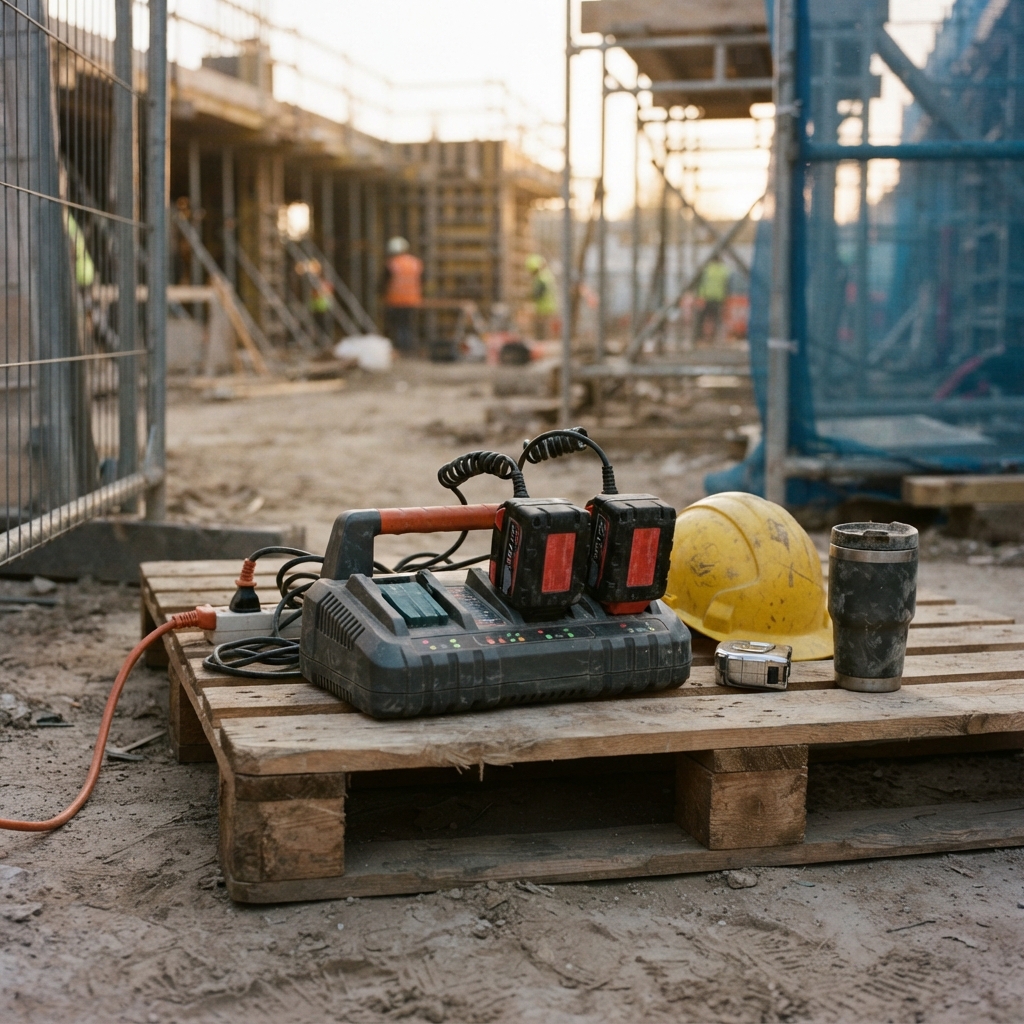
On construction sites, batteries aren't charged on a "whoever's battery it is, that person charges it" basis. Instead, they're all returned at the end of the workday and picked up again the next morning. This means that charging demand is highly concentrated in time: most charging occurs within a few hours after work. Therefore, the key metric for construction sites isn't the charging speed per unit, but rather the total number of charging slots simultaneously and the total throughput during that period .
There are four key points to keep in mind regarding battery placement. First, assign a fixed location to the charging area, using shelves or charging cabinets to create tiers, with each tier labeled with a slot number to prevent batteries from being mixed up. Second, ensure that chargers have their own dedicated circuits and do not share power strips with welding machines, air compressors, or cutting machines. Third, leave adequate ventilation gaps between chargers, and avoid stacking high-power models. Fourth, secure the power inlet cables, and use locking or anti-detachment plugs to reduce poor contact caused by vibration.
Dust and vibration are two variables unique to construction sites. Dust accumulates near heat dissipation holes and contacts, while vibration causes the battery to shift slightly within its slot. When selecting a battery, prioritize structures with fewer gaps in the casing, sufficient contact spring pressure, and a clear, tactile feel for the slot's positioning. Also, incorporate "weekly contact cleaning" into the work team's daily routine.
2. Workshop and garage: Simultaneity is more important than peak power.
Charging in the workshop is done "as needed," and it's rare for a dozen batteries to run out of power at the same time, but the total number of times per day is high. The worst scenario in this type of situation is plugging six single-port fast chargers into one power strip: one charger is fine, but the surge and continuous load from six chargers running simultaneously will push a 15A branch circuit to near its limit.
A more reliable approach is to choose a multi-port charging unit and install it securely on a wall or shelf, planning the cable routing from the start. The benefits of a multi-port unit go beyond saving on sockets; it consolidates six wires into one input line and six slots, making the load predictable and facilitating the installation of independent switches or timed power-off mechanisms.
If there is more than one battery platform in the workshop, it is recommended to divide it into sections: place platform A in the left section, platform B in the right section, and leave a testing space in the middle. After dividing the area, the probability of misconnecting batteries across platforms will be significantly reduced, and it will be easier for newcomers to get started. For the conversion between input power and circuit load, please refer to our article on power supply planning for power tool chargers and construction site power supply .
3. Outdoor and mobile construction: Wide voltage input and portability are preferred.
Outdoor power typically comes from three sources: temporary distribution boxes, vehicle inverters, and generators. These three sources share the common characteristics of unstable voltage and high harmonic content. A charger rated "100–240V" means it can maintain output even when the voltage is too low or too high; this wide-voltage model is more suitable for outdoor use than models rated "only 198–264V".
Portability isn't about the weight figure, but rather whether "one person can carry it along with the batteries." A dual-port device with four batteries typically weighs around ten kilograms, while a single-port device with two batteries is lighter, but requires an extra trip during shift changes. Cable length is also often overlooked: a 1.5-meter cable is sufficient inside the vehicle, but insufficient under scaffolding. When selecting a device, you can directly ask the supplier if they can provide a version with a longer cable.
Inverters are a common source of problems. Some chargers, when using a modified sine wave output, may experience starting difficulties, unusual noises, or repeated restarts, even if the power output is sufficient. For outdoor use, it is recommended to use a pure sine wave inverter with a 20%–30% power margin.
4. Home DIY: Sufficient power, easy to manage, and don't pay for power you don't need.
In home use, the number of batteries is usually in the single digits, and the charging frequency is low. The most common requirement is "automatic shutdown after one battery is fully charged, so it doesn't have to be plugged in all the time." This kind of requirement can be met by a single-port or dual-port device, without the need for a high-power multi-port device.
For home use, the most important thing to consider is voltage coverage. Many households have both 12V small power tools and 18V/20V main tools. If the charger's output window only covers one of them, you'll end up with "two chargers, two sockets, and two sets of cords." The easiest way is to take pictures of the labels on all the batteries in your home before buying them and compare them with the charger's output voltage range.
Additionally, the standby power consumption of household chargers left plugged in all the time is worth noting. A single charger consuming 0.3–1W may seem insignificant, but stored in a closed storage room, it adds up to several kilowatt-hours over a year and can also cause slight heat buildup. Developing the habit of unplugging chargers when fully charged is more effective than buying more expensive ones.
5. Multi-brand usage and centralized charging management: manage the platform first, then the charging slots.
When a team uses more than two battery platforms simultaneously, the problem shifts from "how fast the charging is" to "who put which battery in which slot." Management can be simple, but it needs to be standardized: color-code the charging areas according to the platform, label each battery with a number, create a record sheet for issuance and return, and conduct a monthly spot check on the battery appearance and contact status.
It's important to emphasize that cross-brand compatibility isn't something that can be solved simply by "buying an adapter." Compatibility depends on whether the mechanical interface, voltage range, charging control scheme, and temperature sensing are all compatible. Adapters typically only handle the positive and negative terminals, and each of these has already been addressed in the seven compatibility checks before cross-brand use . For teams with centralized management, a more practical solution is to "provide chargers for different platforms with unified numbering," rather than "one charger + one adapter box."
II. Number of charging stations: Calculated using three numbers.
Buying too few charging stations will result in long queues during shift changes; buying too many will take up space and exceed the budget. A simple formula can be used to calculate the lower limit:
Required charging slots ≈ Number of battery cells depleted daily × Average charging time per cell (hours) ÷ Daily available charging window (hours) + 1 spare slot
Example: A 6-person work team, each person uses 3 5.0Ah batteries per day, totaling 18 batteries; a single battery on a 4A output charger, the constant current phase takes approximately 1.25 hours, and considering the end of the constant voltage phase, we estimate 1.5 hours; after work, there are 6 hours to charge. Substituting into the formula: 18 × 1.5 ÷ 6 = 4.5, rounded up to 5 charging slots, plus 1 spare slot, the actual configuration is 6 charging slots.
This formula has two premises that need clarification. First, it assumes that all batteries can be charged at the charger's rated current. In reality, due to limitations imposed by the battery management system, charging times for larger capacity batteries will be longer. Second, it assumes that the charging time window is continuous; if there is a power outage at night or the vehicle is to be used for other purposes, the time window will shorten, and the calculated number of charging slots will need to be adjusted accordingly.
Another often overlooked variable is whether the multi-port unit charges simultaneously or alternately . If four slots use alternate charging, only one slot will be operating at full power at any given time, resulting in a total throughput roughly equivalent to one-quarter to one-half that of a single-port unit. Including "simultaneous charging" in the technical requirements during procurement is more reliable than simply counting the number of slots.
III. Fast Charging, Multi-Port, and Wireless Charging: How to Utilize These Three Trends
1. Fast charging: The upper limit is determined by the battery, not the charger.
High-power chargers can indeed significantly shorten shift change waiting times. Taking DeWalt's DCB104 four-port simultaneous charger as an example, official data shows that each port outputs 8A, fully charging four DCB204 batteries in approximately 40 minutes and four DCB606 batteries in approximately 60 minutes ( DeWalt, DCB104 product page ). These models address the issue of "fully charging four large batteries within a single shift window."
However, the ceiling for fast charging lies with the battery. It's generally recommended to keep the charging current of lithium batteries between 0.5C and 1C. Exceeding the battery pack's nominal maximum charging current won't make the charger faster; it will only trigger the battery management system to limit the current. Therefore, when purchasing, you should ask "What is the maximum allowable charging current for this battery?" rather than "What is the maximum output amp of this charger?"
2. Multiple points: Distinguish between simultaneous, alternating, and sequential actions.
There are three implementations of "four-port chargers" on the market, with significant differences in user experience. Simultaneous charging involves each of the four slots outputting power independently, resulting in the highest total power and the most stringent requirements for the incoming cable. Alternating charging distributes current to each slot in turn, which is low-cost and generates less heat, but the total charging time is extended. Sequential charging fully charges one slot before charging the next, which is suitable for slow charging at night but not for shift work scenarios.
The 20V 2A alternating charger in this website's catalog is a typical alternating solution: 40W output, 20V/2A, 100–240V input, with four slots charging in rotation. It's suitable for a "plug it in at night, use it the next day" schedule, but if used for shift work on a construction site, the actual throughput will be lower than four independent single-port chargers. Asking about the charging mode and comparing the number of slots will help you avoid buying the wrong charger.
3. USB-C PD and wireless charging: The direction is right, but don't make them your primary method.
USB-C PD charging kits, which have emerged in recent years, are designed to allow the utility battery to power laptops and mobile phones while simultaneously charging the battery using PD power. They address the charging needs of "in-car, outdoor, and temporary office" scenarios, with power typically ranging from tens to hundreds of watts. They are suitable for emergencies but not for replacing multi-port fast charging.
Wireless charging appeared in power tools much earlier. Bosch introduced an inductive charging system for 18V tools in 2014, with a charging pad used with a special battery ( Journal of Light Construction, 2014 ). Its value lies in "just place it on to charge, no need to plug or unplug," making it suitable for fixed workstations; its limitation is that it requires a special battery with an induction coil, as ordinary batteries will not charge when placed on it. Therefore, it remains a niche solution rather than a universal upgrade path.
IV. Key Selection Points: Translate Parameters into Questions
The parameter table itself doesn't answer the question. Translating each parameter into a "question to ask the supplier" will make the selection process much faster.
| parameter | Questions to ask | Judgment criteria |
|---|---|---|
| Output voltage range | Can it cover the full charge voltage of my battery? | Five batteries in series have a voltage of approximately 20.8–21.2V, three batteries in series have a voltage of approximately 12.6V, and ten batteries in series have a voltage of approximately 42V. |
| Output current | Is it within the battery's maximum allowable charging current? | The commonly recommended range is 0.5C–1C; rates exceeding this range will be throttled by the BMS. |
| Slot and Simultaneity | Should the four slots be charged simultaneously, alternately, or sequentially? | Shift changes require simultaneous charging, while alternating slow charging overnight is acceptable. |
| Input voltage | Is it necessary to cover both the 120V and 230V markets simultaneously? | Wide voltage range of 100–240V, making it more suitable for various markets and environments with unstable voltage. |
| Protection function | Does it have overvoltage, overcurrent, short circuit, and overtemperature protection? | It must have at least output overcurrent and short-circuit protection, and the triggering conditions must be specified. |
| Protection level | Will it get rained on, accumulate dust, or be placed in a semi-outdoor environment? | Choose the IP rating based on the actual environment; do not substitute it with "appears sealed". |
| Authentication documents | Is there a market report for this model and configuration? | CE, ETL, GS, etc., are confirmed by model number and do not cover the entire series. |
| Installation method | Wall-mounted, shelf-mounted, or portable in the vehicle? | Confirm the mounting hole location, screw specifications, and cable exit direction. |
The certification section is easily misunderstood. When a charger is classified as a household or similar battery charger, it is typically evaluated according to IEC 60335-2-29, which applies to chargers with an output of no more than 120V ripple-free DC ( IEC 60335-2-29:2016+A1:2019 ). This is the scope of the safety standard and does not mean that a specific model has passed, nor does it cover the combination of "charger + any battery". When purchasing, you should obtain the test report for "this model + this configuration".
V. Chargers compatible with this site
Branda (Brandapcba Electronics), located in Ningbo, has been manufacturing electronic power supply products and providing OEM/ODM project support since 2003. Its product line includes power tool chargers, garden tool chargers, industrial and AGV chargers, and electric bicycle chargers. The following two models in the catalog have more complete specifications and can be directly matched to your application needs.
HR18C Battery Charger : 18W output, output voltage 12.65–13.1V, output current 1.25–1.55A, input 90–264V AC, 47–63Hz, with output overcurrent and short circuit protection. It's important to note that although its model number includes "18," the output window shows three 12V battery packs—a classic example of "looking at the output voltage, not the model number." It's suitable for slow charging small household tools and garden tools overnight.
20V 2A Alternating Charger : 40W output, 20V/2A, input 100–240V AC, 47–63Hz, uses alternating charging mode, and has output overcurrent and short circuit protection. It is suitable for budget-sensitive home and garden scenarios where multiple batteries are rotated; if used for shift charging, the number of charging slots needs to be recalculated based on the actual throughput of alternating charging.
If the existing catalog models do not cover your battery specifications, you can proceed with the OEM/ODM process: provide the battery chemistry, nominal voltage, full-charge voltage, capacity, maximum charging current, connector model or pinout, and target market. Our team will review the configuration based on this information. Our company has supported B2B projects since 2003 and possesses collaborative capabilities in assembly, production testing, inspection, and certification support. Our website also showcases examples of CE EMC, CE LVD, ETL, and GS documents; the specific coverage needs to be confirmed for each model. See the Battery Charger OEM/ODM Procurement Guide for relevant procedures.
VI. Five common mistakes
- Buy chargers based on the number of tools. The number of tools, the number of batteries, and the peak shift are not the same thing. You should calculate the number of slots by working backwards from the "number of batteries used up per day".
- Treating multiple ports as if they are charging simultaneously. A four-port device that charges alternately may only have half the throughput of four single-port devices.
- Using an adapter for cross-brand charging. Adapters typically only connect the positive and negative terminals, resulting in the loss of temperature signals and platform identification.
- Ignoring the input side, with six high-power chargers sharing a single 15A circuit, tripping is only a matter of time.
- Do not place the charger in a closed vehicle or in a location exposed to direct sunlight. High temperatures can cause the charger to degrade and also put a recently used, hot battery into a protection mode.
VII. Frequently Asked Questions
Can I use different brands of power tool chargers?
Generally, it's not possible. Compatibility requires matching in four areas: mechanical interface, voltage range, charging control scheme, and temperature sensing. Most cross-brand adapters only connect the positive and negative terminals, resulting in the loss of temperature protection and platform recognition. Unless the charger manufacturer explicitly states that it supports the battery pack, do not mix and match them.
Do multi-port chargers charge all at the same time or in turn?
All three are available. Simultaneous charging means each slot outputs power independently, resulting in the highest total power; alternating charging distributes current to each slot in turn; sequential charging fully charges one slot before charging the next. When purchasing, "simultaneous charging" should be included in the technical requirements, not just the number of slots.
Will fast charging damage the battery?
It won't happen within the battery's allowed charging current range. Lithium batteries are generally recommended to be charged at 0.5C–1C. Beyond this range, the battery management system will limit the current, and even a larger charger won't charge them faster. What truly affects lifespan are high-temperature charging and prolonged storage at full charge.
How many charging stations are needed in the construction site's charging area?
Estimate using "number of batteries depleted daily × charging time per battery ÷ available charging time window", plus one spare. For example, with 18 batteries, a charging window of 1.5 hours per battery, and 6 hours per battery, the calculated number is approximately 4.5, but in practice, 5 are allocated plus 1 spare.
Are 18V and 20V chargers compatible?
If both are five-cell lithium battery platforms, with a full-charge voltage of approximately 21V, their voltage windows are compatible. Whether they are interchangeable depends on the interface and signal contacts. The "18" and "20" in the model names are marketing terms; the actual voltage range and number of battery cells must be considered.
Is wireless charging worth buying?
Consider the workstation layout. For fixed workstations, frequent access, and the willingness to use dedicated batteries, wireless charging eliminates the need for plugging and unplugging. However, when multiple brands need to be used, outdoor mobile operations are required, or budget is a concern, the benefits are limited, and ordinary batteries will not charge when placed on the surface.
Is it normal for the charger to get hot?
A certain degree of temperature rise is normal, as conversion losses are released as heat. However, if the casing is hot to the touch, has a strong plastic smell, or the fan is running at high speed continuously, it usually indicates insufficient heat dissipation, excessively high ambient temperature, or the charger being under constant full load. In such cases, the charger should be stopped and inspected.
What power charger is needed for home DIY projects?
For most home use scenarios, a single-port or dual-port device with around 40W power is sufficient, and a 5.0Ah battery takes about two hours to fully charge. Unless you need to use up multiple high-capacity batteries every day, there's no need to pay for a high-power multi-port device.
in conclusion
Choosing the right power tool charger essentially boils down to answering three key questions: "When, how many batteries, and how long to fully charge?" The charging scenario determines the charging method, shift schedules determine the number of charging slots, battery labels define voltage and current windows, and compatibility determines whether batteries can be used interchangeably. Only after completing these four steps should you consider power output and price to avoid ending up with a charger you can afford but can't use smoothly.
If you are configuring charging solutions for construction sites, workshops, or your own brand projects, you can send us the battery list, the number of charging points, and the on-site power supply conditions: submit your inquiry , or describe your application scenario through the contact page , and we will verify the available configurations according to the specifications you provide.


