

Power tool charger wattage is usually 50–400 W at the wall, and the number that matters for planning is the input rating on the charger label, not the output wattage in the model name. Output watts describe what the charger delivers to the battery; input watts include conversion losses and are usually 15–25% higher. Size circuits, extension leads and generators from the input rating, then add headroom for simultaneous charging.
That distinction is where many site power plans go wrong. A bench of eight compact 40 W chargers is a light load; two high-output fast chargers can draw more than a kettle. This guide explains power tool charger wattage in practical terms: what the two ratings mean, how to convert between them, how many chargers a circuit can carry, and how to size a generator without guessing.
Planning a charging bench for a crew, rental fleet or OEM tool kit? Send your battery list and site power details and our team can review the charger configuration with you.
Output watts vs input watts: why a charger has two ratings
A mains charger converts AC into a controlled DC output for the battery. That conversion is not free. Roughly 10–20% of the energy taken from the socket becomes heat in the switching devices, transformer, output rectifier and control circuit. The relationship is simple:
Input power ≈ output power ÷ conversion efficiency
A 40 W output charger running at 85% efficiency draws about 47 W during the bulk-charge stage. At 80% it draws 50 W. On a single charger the difference is trivial; across a 40-unit charging bench it changes the circuit calculation and the heat load in the room. For context, IEC 62841-1 covers tools with a rated input of up to 3,700 W, so a normal charger sits well inside the range of the standard (IECEE, IEC 62841-1:2014).
Why the input current on the label reads higher than expected
Compact chargers without active power factor correction often run at a power factor of 0.5–0.6. The nameplate input current multiplied by the input voltage gives apparent power in volt-amperes (VA), not real power in watts. Real power is VA multiplied by the power factor. That is why a label reading 1.5 A at 120 V can correspond to roughly 108 W of actual draw rather than 180 W.
Two practical rules follow. First, use the input current rating when checking plug, cable and connector capacity, because those parts care about current. Second, use measured or calculated real power when estimating generator load and energy cost.
Marketing voltage is not the same as battery voltage
An “18 V” and a “20 V MAX” tool battery are usually the same five-cell lithium platform at a nominal 18 V; the higher number is the fully charged peak. Output current and output voltage on the charger label, not the platform name, determine how fast energy actually moves into the pack.
How many watts does a power tool charger use? Typical ranges
The table below shows general industry ranges for common charger classes, not the specification of any one model. Treat it as a planning starting point and confirm the actual input rating on the product you intend to buy.
| Charger class | Typical output | Typical input draw | Current at 120 V |
|---|---|---|---|
| Compact 18 V / 20 V, 2 A | 36–42 W | 45–60 W | 0.4–0.5 A |
| Mid-size 18 V / 20 V, 4 A | 70–85 W | 90–115 W | 0.75–0.95 A |
| Fast 18 V / 20 V, 6–8 A | 110–170 W | 140–210 W | 1.2–1.75 A |
| High-output dual-port, 2 × 8 A | 250–320 W | 300–400 W | 2.5–3.3 A |
| Heavy-duty 36 V / 40 V fast charger | 200–300 W | 250–380 W | 2.1–3.2 A |
The spread matters more than any single figure. A 20 V 2 A garden tool charger is a 40 W-class device that can share a bench circuit with a dozen others. A dual-port fast charger for construction tools can approach the draw of a small space heater, and four of them on one circuit can consume most of a 15 A branch.
Reading the label: where power tool charger wattage is printed
A compliant label usually lists the input voltage range, input frequency, maximum input current, output voltage, output current and any protection ratings. Read it in this order:
- Input range. “100–240 V” means the charger is built for multiple markets. “198–264 V” means it is intended for 220–240 V regions and should not be used on a 120 V site.
- Maximum input current. This is a worst case, usually stated at the lowest rated input voltage. It sizes cables and breakers, not energy consumption.
- Output voltage and current. Multiply them for output watts. This is the energy delivered to the battery, before losses.
- Protection and environment ratings. Overcurrent, short-circuit and thermal protection, plus any IP rating if the charger will be used in a damp location.
Worked example: one label, three numbers
Suppose a charger is marked “Input 100–240 V~, 50/60 Hz, 1.5 A; Output 21 V ⋅ 2 A”. The output is 42 W. At 120 V the maximum input is 180 VA; at a power factor of 0.6 that is about 108 W, and at 0.95 it is about 171 W. The real draw during bulk charging will usually sit below both figures because the charger only pulls its rated maximum at the bottom of its input range and at full load. For circuit planning, however, the maximum is the safe number to use.
Power tool charger wattage and circuit load: how many chargers fit one circuit?
US wiring practice treats a continuous load as no more than 80% of the branch-circuit rating. Applying that rule gives a practical planning limit rather than a theoretical one:
| Circuit | Nominal capacity | 80% planning limit |
|---|---|---|
| 15 A, 120 V | 1,800 W | 1,440 W |
| 20 A, 120 V | 2,400 W | 1,920 W |
| 16 A, 230 V | 3,680 W | 2,944 W |
| 10 A, 230 V | 2,300 W | 1,840 W |
Now apply the charger figures. Eight compact chargers at 55 W each total 440 W, or about 3.7 A at 120 V — comfortable on a 15 A circuit. Four fast chargers at 180 W each total 720 W, about 6 A — still fine. Six high-output chargers at 350 W each total 2,100 W, which exceeds the 80% limit of a 15 A circuit and needs a 20 A circuit or a split across two branches. The power tool charger circuit load is therefore a simple sum of input watts, not of the numbers printed on the battery platform.
Diversity is real, but do not plan on it
Chargers do not draw their maximum for the whole cycle. A lithium pack charges at constant current until it approaches its voltage limit, then tapers; the last part of the cycle can draw a small fraction of the peak. A bench that is fully populated but rarely all at once will measure lower than the sum of the labels. The risk is the shift change, when every battery comes back empty at the same time. Plan the circuit for that moment, not for the average afternoon.
Inrush current and shared power strips
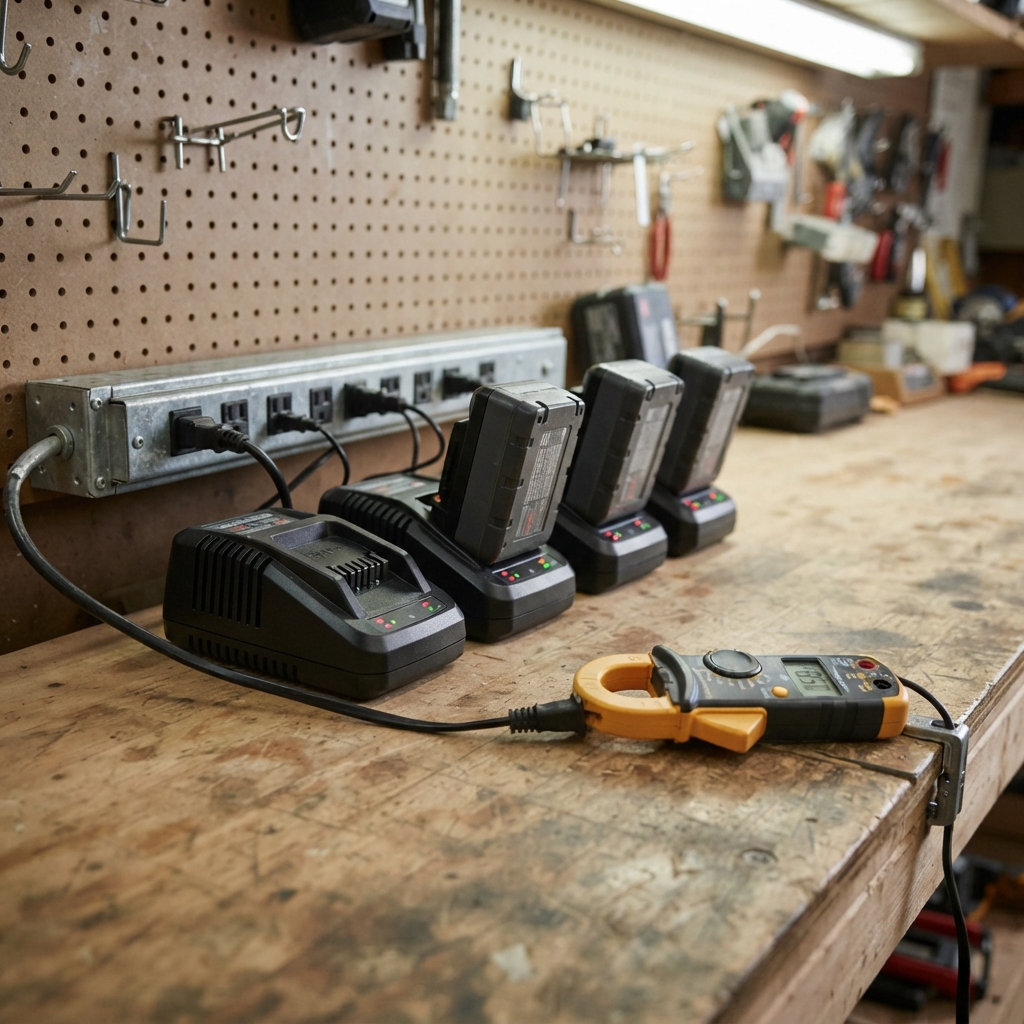
Plugging in several chargers at the same instant produces a short inrush surge while input capacitors charge. On a circuit already close to its limit, that surge can trip a breaker or protective device. Stagger start-up, avoid daisy-chaining multiple power strips, and keep chargers off circuits shared with compressors, welders or other high-inrush equipment.
Sizing a charging container or a workshop bench? Our OEM/ODM charger team can review your load list against the configurations in our catalogue; the inquiry form is the quickest way to start.
Generator sizing for battery chargers and inverter loads
Generator sizing uses running watts, starting or surge watts, and the power factor of the load. A charger is a relatively gentle load compared with a compressor, but a bench of them adds up. A workable method is:
- Add the input watts of every charger that can run at the same time.
- Add the other continuous loads on the same generator: lighting, laptop, radio, fan.
- Add 20–30% headroom so the generator is not running at its limit.
- Check the largest single starting surge, then sequence high-inrush tools rather than starting everything together.
For example, six chargers at 100 W, plus 100 W of lighting, total 700 W. Add a 1,500 W kettle and the simultaneous load reaches 2,200 W, which is beyond a 2,000 W running-rated generator. The answer is not a bigger generator by default; it is to keep the kettle on a separate circuit or accept that it cannot run while the bench is fully loaded.
For sensitive electronics, a pure sine wave inverter is the safer choice. Some lightweight chargers behave poorly on modified sine wave output, with noisy operation or refused start-up, even when the wattage is adequate.
Energy cost per charge: a five-line calculation
Power tool charger wattage also sets the running cost of a battery fleet. The energy needed is the battery's watt-hour capacity divided by charging efficiency:
kWh per charge = (battery voltage × battery Ah) ÷ 1,000 ÷ efficiency
An 18 V, 5.0 Ah pack holds 90 Wh. At 85% efficiency, the charger takes about 106 Wh from the wall, or 0.106 kWh. At a commercial rate of USD 0.15 per kWh, that is about 1.6 cents per full charge. Thirty charges a week comes to roughly 3.2 kWh and about USD 0.48; over a year, around USD 25. The numbers are small per battery but useful when comparing a 40 W charger with a 300 W fast charger across a large fleet.
Standby draw deserves a line of its own. A charger left plugged in may consume 0.3–1 W with no battery fitted. One watt continuous is 8.8 kWh a year. Unplugging a bench at the end of the shift is a trivial habit with a measurable effect across dozens of units.
Design details that change charger input power
- Wide-range input. A 90–264 V charger maintains a stable output across weak or high mains, but its input current rises at the low end of the range. That is why the maximum current is stated at the minimum voltage.
- Active power factor correction. PFC brings the power factor above 0.9, reducing the VA demand for the same real power. It matters on benches with many chargers on one distribution board.
- Standby and no-load behaviour. Good chargers drop to a low-power state when the battery is full or absent; cheap ones keep the primary side alive.
- Cooling method. Fan-cooled high-output chargers move more heat out of the case but add a small fan load and a dust path. Sealed low-power units rely on the housing surface.
- Charge profile. Constant-current then constant-voltage charging, with battery temperature and BMS limits, determines how long the charger stays near peak draw.
Chargers in this catalogue
Our garden and power tool charger range includes low-power external units where the input draw is a small fraction of a workshop circuit. The table uses the published catalogue ratings for three models:
| Model | Output power | Output voltage | Output current | Input voltage | Listed protection |
|---|---|---|---|---|---|
| HR40C | 40 W | 21–22 V | 1.8–2.2 A | 198–264 V AC | Output overcurrent and short-circuit protection |
| HR36C MCU | 36 W | 20.8–21.2 V | 1.8–2.2 A | 90–264 V AC | Output overcurrent and short-circuit protection |
| HR36C | 36 W | Confirm on the model datasheet | 1.8 A listed variant | 100–240 V AC | Request the model-specific datasheet |
At 36–40 W output, these chargers sit in the 45–60 W input class, so a bench of ten is still a modest load. The HR36C MCU's 90–264 V input range suits projects that must cover both 120 V and 230 V markets from one design; the HR40C's 198–264 V range is aimed at 220–240 V regions. Both are external chargers, and actual charge time depends on battery capacity, the current the BMS will accept and the starting state of charge, not on wattage alone. For matching a charger to a pack, see our power and battery matching guide; before mixing brands, run the compatibility checks.
Common mistakes in charger power planning
- Adding output watts and calling it load. Output is what the battery receives; the circuit sees input watts, which are higher.
- Ignoring the 80% rule. A 15 A circuit loaded to 1,700 W continuously will nuisance-trip even though the arithmetic says 1,800 W.
- Assuming chargers draw full power all cycle. They taper, but the shift-change peak is what the breaker sees.
- Using a lightweight extension lead. A long, thin lead adds voltage drop and heat; use a lead rated for the full current and keep it uncoiled.
- Daisy-chaining power strips. It hides the total load and defeats the protection design of the circuit.
- Buying a generator on charger watts alone. Starting surges and other site loads decide whether it copes.
- Forgetting standby. A plugged-in bench consumes energy around the clock and adds heat in a closed container.
Frequently asked questions
How many watts does a power tool charger use?
Most cordless tool chargers draw roughly 45–400 W from the wall. Compact 18 V / 20 V chargers sit near 45–60 W, mid-size units near 90–115 W, and high-output dual-port or heavy-duty fast chargers can reach 300–400 W. The exact figure is the input rating on the label.
How do I calculate power tool charger wattage from the output rating?
Divide the output watts by the conversion efficiency, then adjust for power factor if you are working in VA. A 40 W output at 85% efficiency needs about 47 W of input; a power factor of 0.6 raises the apparent power to roughly 78 VA.
Does a higher-wattage charger charge a battery faster?
Only up to the limit the battery and its BMS will accept. A 300 W charger cannot force current into a pack designed for 2 A. Above that limit the charger simply runs below its rating, and the pack's temperature and voltage limits govern the cycle.
Can I run six chargers on one 15 A circuit?
Usually yes if they are compact units. Six at 55 W is 330 W, well inside the 1,440 W planning limit. Six high-output chargers at 350 W is 2,100 W and needs a 20 A circuit or a split across two branches.
Why does the charger label show 1.5 A when the charger only uses 50 W?
The 1.5 A is a maximum input current, stated at the lowest rated voltage and including apparent power. Real draw is lower and depends on the load stage and power factor. The label is written for safe wiring, not for energy accounting.
Do chargers use power when no battery is fitted?
Many do, typically 0.3–1 W. That is under 9 kWh a year per unit, but across a large bench it adds up. Switch off or unplug the bench at the end of the day.
Can I charge from a modified sine wave inverter?
It is not the best match. Some chargers refuse to start or run noisily on a modified sine wave supply. A pure sine wave inverter is the safer choice for electronics, even when the wattage rating is sufficient.
How much does one full charge cost?
For an 18 V 5.0 Ah pack at 85% efficiency and USD 0.15 per kWh, about 1.6 cents. Larger packs and higher electricity rates scale the figure proportionally.
Conclusion
Power tool charger wattage is an input number before it is an output number. Read the label, convert output watts to input watts using efficiency and power factor, then plan circuits at 80% of their rating and generators with 20–30% headroom. That approach keeps a charging bench inside its breaker, avoids nuisance trips at shift change, and gives a realistic energy cost per battery rather than a guess.
If you are specifying chargers for a workshop, rental fleet or OEM tool program, send your battery list, site voltage and number of charging positions through our inquiry form, or contact our team with the details. We will confirm the available configurations against your requirements.


