

Key takeaway: When choosing a garden tool charger, the correct order is "first check the battery, then calculate the current, and finally check the wattage." The charger's output voltage must match the battery's voltage (18V/20V or 36V/40V). The charging current should ideally be between 0.5C and 1C. Estimate the full charge time using "capacity ÷ current." For most home gardeners, a 2A-rated 18V/20V garden tool charger is sufficient; higher wattage is not necessarily better.
Why can't a garden tool charger just be any old one?
Lawn mowers, hedge trimmers, hair dryers, and chainsaws may seem like "just plug in the battery and it works," but their battery management systems (BMS) operate according to a fixed charging curve: initially constant current (CC), then switching to constant voltage (CV) as the voltage approaches full charge, with the current gradually decreasing. If the charger outputs too much current, the battery will overheat during the constant current phase; if the output voltage does not match the number of batteries in series, it may trigger BMS protection, potentially causing irreversible damage.
In addition to the above, there are two easily overlooked interface details between the battery and charger: one is the location of the positive and negative contacts and the temperature detection contact (NTC); the other is the communication contact used by some platforms to identify the battery model. Similar-looking slots do not mean they are electrically interchangeable. This is the most easily skipped, yet most safety-critical step when discussing "how to choose a garden tool charger."
Step 1: Confirm the battery voltage plateau
The nominal voltage of lithium batteries for garden tools is determined by the number of cells connected in series. Before purchasing a charger, check the nominal voltage and "full charge voltage" on the battery nameplate, rather than just looking at "20V" or "40V" in the product title. Although lawnmower battery chargers and hedge trimmer chargers may differ in appearance and power, as long as the batteries are on the same series platform, the voltage rules are the same.
| platform | Number of battery cells | nominal voltage | Full voltage | Common uses |
|---|---|---|---|---|
| 12V | 3 strings | 10.8V / 12V | Approximately 12.6V | Small pruning shears, lightweight hedge trimmer |
| 18V / 20V | 5 strings | 18V | Approximately 21V | Lawn mower, hedge trimmer, hair dryer, chainsaw |
| 36V / 40V | 10 strings | 36V | Approximately 42V | High-powered lawnmowers and long-handled saws |
It should be noted that most manufacturers' advertised "20V" (20V Max) and "18V" refer to the same 5-cell platform: nominally 18V, with a full charge of approximately 21V. Therefore, chargers labeled with 21V output belong to the 18V/20V platform and cannot be used to charge 36V/40V batteries.
Step 2: Calculate battery charging time – divide capacity by current
Charging time can be roughly calculated using a simple formula: Charging time ≈ Battery capacity (Ah) ÷ Charging current (A) × 1.1~1.3 . The multiplication by 1.1~1.3 is because the current gradually decreases during the constant voltage stage, so the actual time is always longer than the theoretical value.
| Battery capacity | Charging current | Charging rate | Theoretical estimated time |
|---|---|---|---|
| 2.0Ah | 2A | 1C | Approximately 1.1–1.3 hours |
| 4.0Ah | 2A | 0.5C | Approximately 2.2–2.6 hours |
| 4.0Ah | 4A | 1C | Approximately 1.1–1.3 hours |
| 6.0Ah | 2A | 0.33C | Approximately 3.3–3.9 hours |
The "charging rate" in the table is the commonly known C value, which is the standard way to describe the charging rate of lithium batteries: charging current divided by battery capacity. 2A charging a 4.0Ah battery is 0.5C, while charging a 2.0Ah battery is 1C. The higher the C value, the faster the charging, but the more noticeable the heat generation.
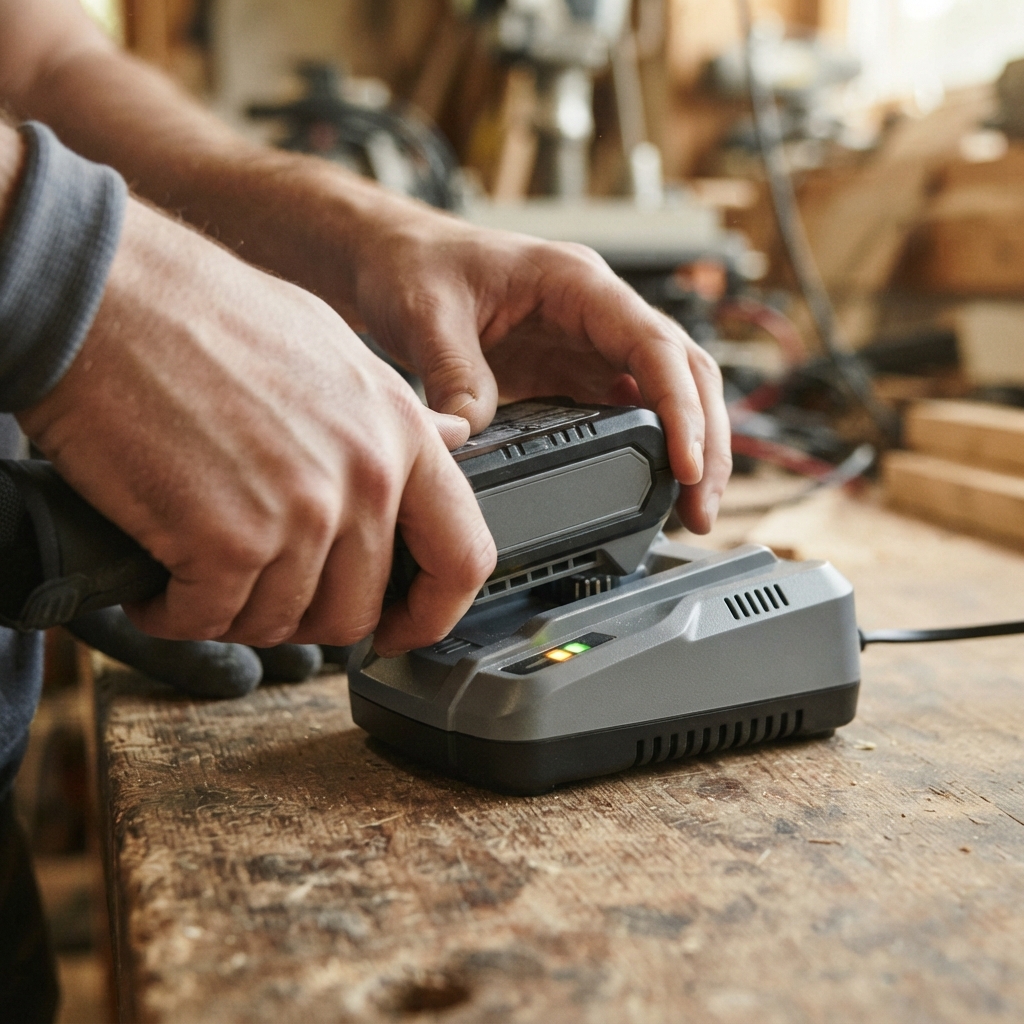
Step 3: What power level is considered a match?
Power equals voltage multiplied by current. Taking an 18V/20V platform as an example, 21V × 2A is approximately 42W, corresponding to a common 40W charger on the market, which is also the rated range for most 20V garden tool battery chargers. In other words, for 18V/20V garden tools, an output current of around 2A corresponds to a 36W–42W charger, which is the most practical range for home users .
If the battery capacity is above 4.0Ah and the battery is used continuously every day, a 4A (approximately 80W) fast charger can be considered; however, this is on the premise that the battery itself is labeled as supporting a higher charging rate. Charging currents exceeding 1C require both the battery cell specifications and the heat dissipation design to support them, and cannot be achieved simply by replacing the charger with a high-power one.
Fast charging and battery life: Is higher power always better?
No. The capacity degradation of lithium batteries mainly comes from high temperatures and prolonged periods of being fully charged, and high-current charging exacerbates both of these factors. For household users who use the battery once or twice a week, a charging speed of 0.5C–1C is sufficient to fully charge the battery during a lunch break, and there is no need to pay extra or incur additional heat risks.
Two other habits have a greater impact on battery life than "power output": First, do not charge the battery immediately after mowing the lawn when it is still hot; wait until the battery cools down to near room temperature before charging. Second, do not leave the battery plugged into the charger for extended periods to "float charge"; remove it promptly once fully charged.
Outdoor use: IP protection rating and storage
Garden tools often operate in damp, dusty environments, but chargers are devices connected to mains power, and their protection requirements differ from those of tools. IP ratings are defined by IEC 60529, with two digits indicating protection against solid foreign objects and water. For example, IPX4 indicates resistance to splashes from all directions, while IPX5 indicates resistance to low-pressure water jets (see the official IEC IP rating documentation ). When determining a charger's waterproof rating, pay close attention to the second digit after the slash.
In practical use, it is recommended to adhere to three bottom lines: do not charge outdoors in the rain or on wet grass; place the charger in a dry, well-ventilated location away from direct sunlight; and ensure that there is no water accumulation or condensation at the interface before long-term storage. Even if the charger is labeled with a high waterproof rating, it is not recommended to leave it outdoors overnight while it is still charged.
Charging safety: Overheat, overcurrent and protection functions
Safety requirements for household battery chargers typically refer to specific standards for battery chargers, such as IEC 60335-2-29. This standard applies to chargers with an output voltage not exceeding 120V DC for household and similar uses (see IEC 60335-2-29:2016+A1:2019 ). Garden tools, on the other hand, fall under the category of handheld power tools, and their safety requirements are detailed in the IEC 62841 series (see IEC 62841-1:2014 ).
When purchasing a charger, at least ensure it has output overcurrent protection and short-circuit protection. If the battery has temperature detection contacts, the charger's overheat protection should be able to read the signal and reduce current or stop charging when the temperature is abnormal. Products that do not list protection features in the instruction manual are usually unlikely to remain stable during long-term use.
Multi-brand battery and interface compatibility
"All are 20V" does not mean they can be used interchangeably. Different brands of 5-cell platforms differ in contact spacing, clip shape, temperature detection contacts, and identification signals. Forcing power on with a third-party adapter may result in three outcomes: failure to recognize and no charging, uncontrolled charging current, or direct locking of the battery BMS.
A more practical approach is to standardize across platforms: one tool should come with two batteries from the same platform and one charger, which is more economical and safer than providing a separate charger for each brand. If cross-brand use is absolutely necessary, confirm the interface definitions and charging parameters with the battery manufacturer first, rather than just comparing the appearance of the slots.
The garden tool charger models on this website
Our garden tool charger product line covers 18V/20V platform models ranging from 18W to 40W. The two models below are commonly used 2A-level configurations, which can be directly checked against the battery nameplate:
| model | Output power | Output voltage | Output current | Input voltage | List of protection features |
|---|---|---|---|---|---|
| HR36C MCU | 36W | 20.8–21.2V | 1.8–2.2A | 90–264V AC, 47–63Hz | Output overcurrent and short circuit protection |
| HR40C | 40W | 21–22V | 1.8–2.2A | 198–264V AC, 47–63Hz | Output overcurrent and short circuit protection |
Both are 2A-class chargers with an 18V/20V platform. The main differences lie in their output power and input voltage range: the HR36C MCU's 90–264V wide input is more suitable for areas with large voltage fluctuations, while the HR40C's 198–264V input corresponds to the common 220V AC mains environment. To determine which battery is compatible, you still need to check the battery platform, contact arrangement, and charging curve; certification documents should also be obtained separately for each model and configuration, and cannot be determined based on appearance. More models can be viewed on the garden tool battery charger product page .
Common Faults and Troubleshooting Sequence
| Phenomenon | Possible reasons | Recommended treatment |
|---|---|---|
| Indicator light not lit | The socket is not powered, the plug is loose, and the input cable is damaged. | Test with a different outlet and check the power cord and plug. |
| The red light remains unchanged for an extended period. | Overheating of the battery, poor contact at the contacts, battery aging | Cool down before charging, clean the battery and charger contacts, and compare the results with a different battery. |
| The light turns green immediately after inserting the battery. | The battery is full, or no battery was detected. | Reinsert it into place and confirm that the latch is secure. |
| The charger was noticeably hot. | Poor ventilation, high ambient temperature, internal abnormalities | Move to a cool, well-ventilated place; stop using if it becomes abnormally hot to the touch. |
| Repeated charging interruptions | Contact oxidation, internal cable breakage, BMS protection | Inspect the cables and contacts; send them for repair or testing if necessary. |
Five common purchasing mistakes
- Focusing only on wattage and ignoring voltage: A 40W 21V charger cannot be used with a 36V battery, even if the power rating is appropriate.
- Using an adapter across brands: Just because the interface can be plugged in doesn't mean the charging curve and temperature detection will match.
- Charging the battery immediately after it's completely empty: Charging at high temperatures will accelerate capacity decay; it's safer to wait until it cools to room temperature.
- Charging outdoors in a humid environment: The charger is an AC power device, and being splash-proof does not mean it can be rained on.
- Long-term storage at full or empty charge: Both extremes will accelerate aging. When not in use for a long time, retain about half of the charge.
Frequently Asked Questions
What wattage is suitable for a garden tool charger?
For home users with an 18V/20V platform, a 36W–42W (approximately 2A) charger is sufficient, which can fully charge a common capacity battery in 1–3 hours. Users with a capacity of 4.0Ah or higher and who work continuously every day should consider an 80W fast charger and ensure that the battery supports the corresponding charging rate.
How long does it take to fully charge a 20V 4.0Ah battery with a 2A charger?
The theoretical value is about 2 hours, but considering the constant voltage stage, the actual time is about 2.2–2.6 hours. This is at a charging rate of 0.5C, which falls within the range that balances speed and lifespan.
Does a higher charger power mean faster charging?
Provided the voltage is matched and the battery allows, the higher the power, the faster the charging; however, the power is limited by the maximum charging current that the battery can accept. If this limit is exceeded, the charger will reduce the current or even trigger protection, and the speed will not continue to increase.
Can garden tool chargers be exposed to rain?
Not recommended. The waterproof rating in the IP rating needs to be checked specifically, and most chargers are not designed for outdoor rain. In rainy weather or when grass is wet, move the charger indoors or to a sheltered, dry place.
Can 20V batteries from different brands share the same charger?
Generally not. Contact arrangements, temperature detection, and identification signals may differ; forcibly switching may result in no charging or BMS protection activation. Before using across brands, confirm the interface definition and charging parameters.
Is it normal for the charger to get hot?
It's normal for the device to get warm while charging, but it's not normal if it gets noticeably hot to the touch. First, check if it's covered by debris, near a heat source, or in direct sunlight. If it still gets abnormally hot after improving ventilation, stop using it and test it.
Does fast charging shorten battery life?
Prolonged high-rate charging will accelerate battery degradation, especially for battery packs with poor heat dissipation. Occasional use of 1C fast charging has limited impact, but it is still recommended to use 0.5C–1C for daily charging.
How should batteries be stored if they are not used for a long time?
Keep the battery level between 40% and 60%, store in a dry and cool place, and avoid storing it fully charged or completely discharged; recharge it every few months to prevent over-discharge.
Can a lawnmower and a hedge trimmer share a single charger?
As long as the two batteries belong to the same voltage platform and have the same interface, they can share the same charger. However, this is not possible if they are from different platforms; 18V/20V and 36V/40V batteries must be charged separately.
in conclusion
Choosing a charger for garden tools isn't complicated: first, determine the battery's voltage level and capacity; then, calculate the charging time using "capacity ÷ current," keeping the charging rate between 0.5C and 1C; finally, compare power and price. For most home gardening scenarios, a 2A-rated 18V/20V charger with two batteries is more practical and durable than pursuing high-power fast charging.
If you are sourcing chargers for lawnmowers, hedge trimmers, or hair dryers, you can send us photos of the battery nameplate and interface. We can then verify the platform and contact point configuration through our contact page . For bulk orders or private label projects, you can also refer to our Battery Charger OEM/ODM Procurement Guide for the necessary technical documentation.


