

How to Reduce Queue Time at a Warehouse Battery Charger Station
How to Reduce Queue Time at a Warehouse Battery Charger Station asks the team to look beyond the charger itself. The project starts with a warehouse battery charger station where trucks wait longer for a bay than for the charging event itself, where flow control, bay availability and charging-event repeatability determines whether each shift begins with ready vehicles or another recovery task.
Industrial forklift charger wholesaler is easier to specify when vehicle, battery, connector, bay and service data are reviewed together. Branda uses that operating picture to shape a charger family, while Brandapcba supports OEM requirements, samples and repeat production.
Start with a concise planning file: fleet and shift data, a marked-up layout, approved battery and connector references, and the service level the charging station must meet. That file gives suppliers comparable inputs and gives the site a clear basis for a pilot.
Measure the whole queue process
Record approach, waiting, parking, connector handling, charge start, disconnect and exit as separate steps. This subject deserves its own review because small assumptions become expensive after installation. Start with a warehouse battery charger station where trucks wait longer for a bay than for the charging event itself and describe how flow control, bay availability and charging-event repeatability is handled today, including the workarounds operators use when a bay, cable or status signal is unavailable. Those workarounds often reveal the true design requirement.
Turn the observations into measurable acceptance criteria. The station should demonstrate minutes between vehicle arrival and return to service, while the project team should confirm what prevents optimizing charge time while leaving connector and battery handling delays untouched. Ask the charger supplier to explain the reasoning behind the proposed industrial forklift charger wholesaler arrangement, not only the hardware list. Branda documents that reasoning for the site, and Brandapcba retains the approved production baseline.
| Planning input | What to record | Why it matters |
|---|---|---|
| Shift pattern | Start, break and finish windows | Defines when vehicles can leave service |
| Vehicle mix | Reach trucks, pallet jacks, AGVs or mixed equipment | Changes access and charging routines |
| Battery file | Approved chemistry, range and connector | Prevents charge-profile mismatch |
| Peak arrival | Busiest number of vehicles per period | Sets bay and queue capacity |
| Service level | Vehicles required at each operating period | Makes availability measurable |
| Site limits | Power, ventilation, clearance and access | Keeps the plan buildable |
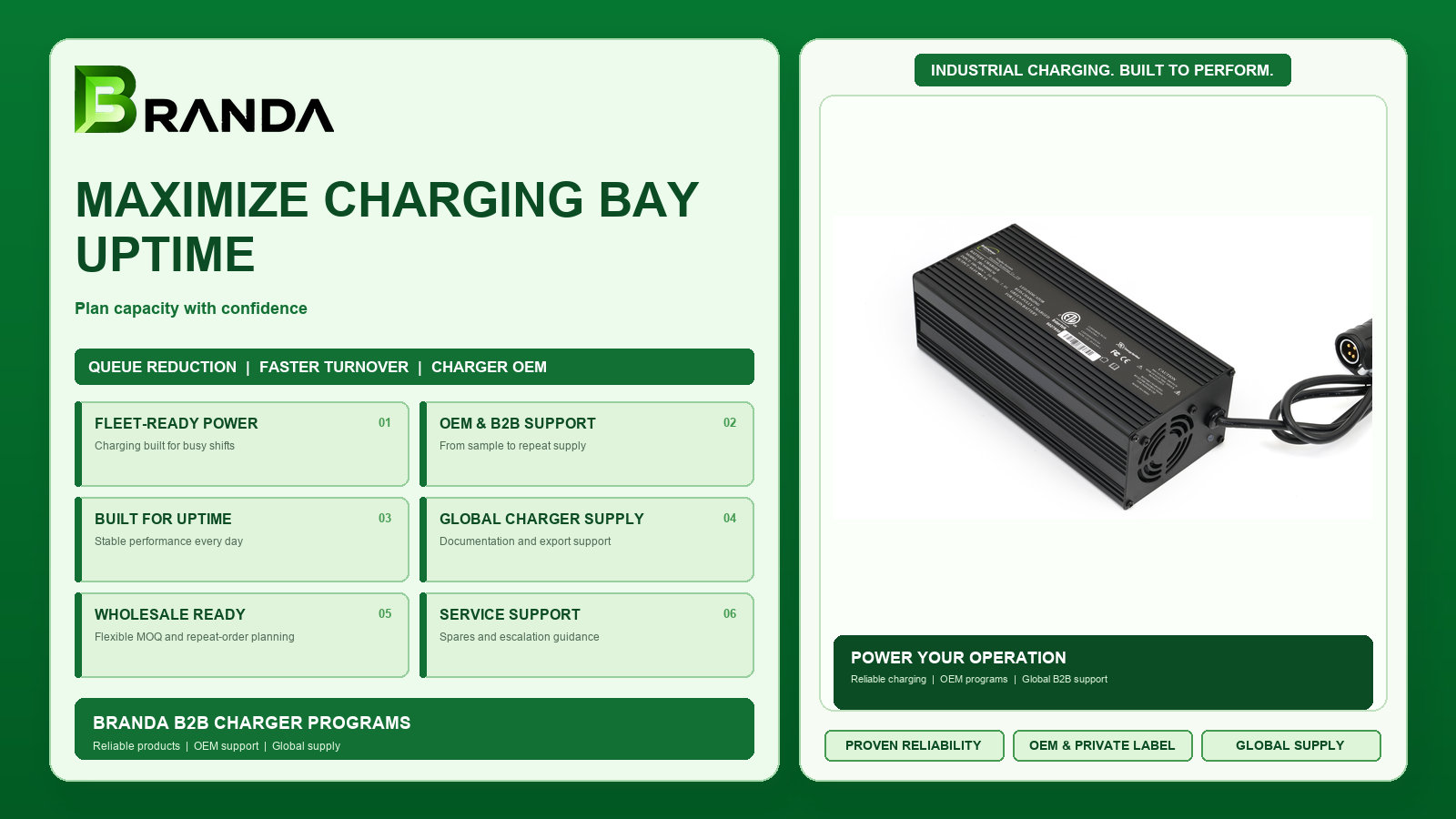
Find the real bottleneck
Treat "Find the real bottleneck" as a checkpoint for separating fixed site conditions from choices that can change later. A full bay, unavailable connector or delayed battery swap can create more delay than charger output. For a warehouse battery charger station where trucks wait longer for a bay than for the charging event itself, this distinction protects flow control, bay availability and charging-event repeatability without forcing the first phase to cover every possible future vehicle. Mark the items that need building work, electrical approval, operator training or spare-part planning before the layout is frozen.
A staged plan is easier to defend when each phase has its own pass condition. Agree how minutes between vehicle arrival and return to service will be measured, identify the first sign of optimizing charge time while leaving connector and battery handling delays untouched and keep the related evidence with the quotation. Branda can structure the industrial forklift charger wholesaler options by application, while Brandapcba connects sample approval and repeat supply to the same technical baseline.
Separate planned and opportunity events
Planned battery charging and shorter opportunity events should use clear rules so one routine does not interrupt the other. The review should involve operations, maintenance, safety and procurement because each group sees a different failure mode. In a warehouse battery charger station where trucks wait longer for a bay than for the charging event itself, the shared goal is flow control, bay availability and charging-event repeatability, and that goal needs one agreed source of truth. Use photographs, measured dimensions and actual shift data rather than broad statements about being busy or needing more power.
Score each option against the same evidence and record the reason for every exception. Use minutes between vehicle arrival and return to service to show whether the station performs as intended and review optimizing charge time while leaving connector and battery handling delays untouched whenever the vehicle plan changes. Branda can shape the final industrial forklift charger wholesaler recommendation, and Brandapcba can carry the approved sample, labeling and order record into production.
| Capacity area | Evidence to collect | Confidence check |
|---|---|---|
| Vehicle access | Largest vehicle turning path and queue space | No blocked aisle or exit |
| Charge positions | Approved parking envelope and cable route | Connection remains repeatable |
| Battery handling | Swap space and trained personnel | Battery movement is not hidden in charge time |
| Electrical supply | Site review and isolation plan | Installation scope is documented |
| Status response | Operator guide and alarm action | Exceptions have an owner |
| Expansion | Reserved positions and future demand | Growth does not require a redesign |
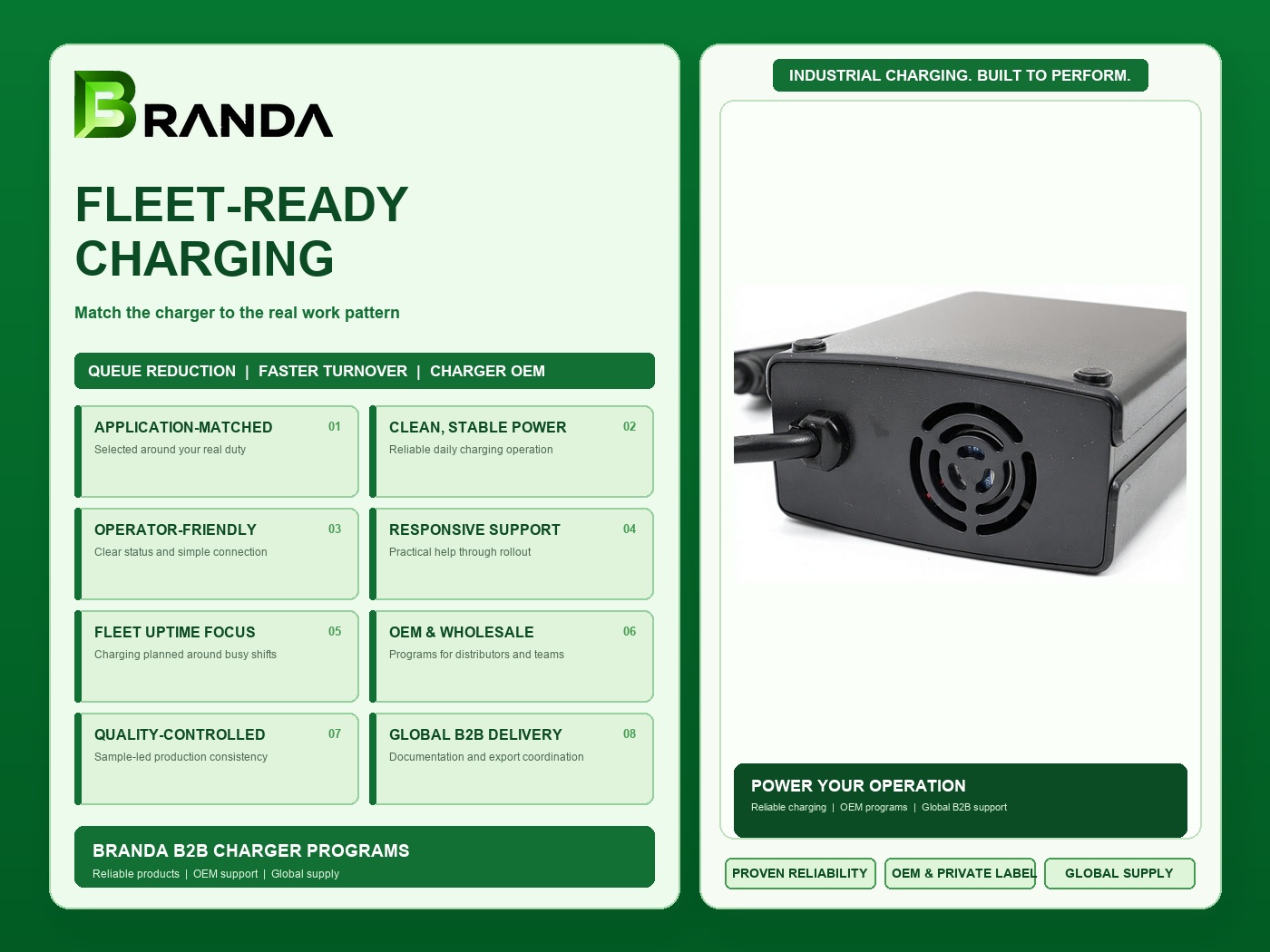
Improve charger access
A practical review of the topic "Improve charger access" starts with the work cycle, not a charger catalogue. Cable reach, connector position and status visibility should support a quick, repeatable operator movement. In a warehouse battery charger station where trucks wait longer for a bay than for the charging event itself, the design also has to protect flow control, bay availability and charging-event repeatability when the daily workload changes. Write each assumption into a shared planning file, assign an owner and state what evidence will close the item.
The benchmark should be minutes between vehicle arrival and return to service, supported by time studies or a short pilot. It makes optimizing charge time while leaving connector and battery handling delays untouched visible before the purchasing team compares quotations. Branda can translate the operating evidence into a proposed industrial forklift charger wholesaler configuration, while Brandapcba keeps the approved sample, labeling and repeat-order references under control.
Use multi-bay capacity carefully
Additional bays help only when vehicle access and electrical supply keep them productive during the peak. That sounds simple until the station is tested with mixed vehicle sizes, late arrivals and incomplete handovers. For a warehouse battery charger station where trucks wait longer for a bay than for the charging event itself, the important question is whether flow control, bay availability and charging-event repeatability can be repeated on every shift and by every trained operator. The site walk, vehicle route and charging routine should all be documented together.
Build a two-part evidence pack. Part one explains the current process and its loss points; part two records the proposed charger, cable, connector, bay and service arrangement. Measure the result through minutes between vehicle arrival and return to service and explicitly review optimizing charge time while leaving connector and battery handling delays untouched. A Branda application review can challenge the assumptions before a Brandapcba quotation fixes the commercial scope.
Train around exceptions
Before changing the layout or selecting hardware, document how "Train around exceptions" affects arrivals, connection time and vehicle release. Drivers need a standard response to alarms, damaged connectors and a bay that is already occupied. The plan has to fit a warehouse battery charger station where trucks wait longer for a bay than for the charging event itself, where flow control, bay availability and charging-event repeatability usually depends on several small handoffs working correctly. This is where photographs, measured clearances and operator interviews are more useful than a generic site description.
Review the normal day, the peak day and the disrupted day as separate cases. Compare minutes between vehicle arrival and return to service across those cases, then record the point at which optimizing charge time while leaving connector and battery handling delays untouched begins to affect service. Branda can use that threshold to guide the industrial forklift charger wholesaler scope, and Brandapcba can align sample approval, production records and future repeat orders with the approved configuration.
| Control | Evidence to request | Business result |
|---|---|---|
| Application review | Completed fleet and site questionnaire | Fewer assumptions |
| Sample approval | Test record for the selected battery and connector | Comparable reference |
| Production control | Inspection and change process | Repeatable supply |
| Spares | Recommended parts and identification | Faster recovery |
| Documentation | Labels, state guide and order record | Clear handover |
| Expansion | Repeat-order and future capacity path | Lower redesign risk |
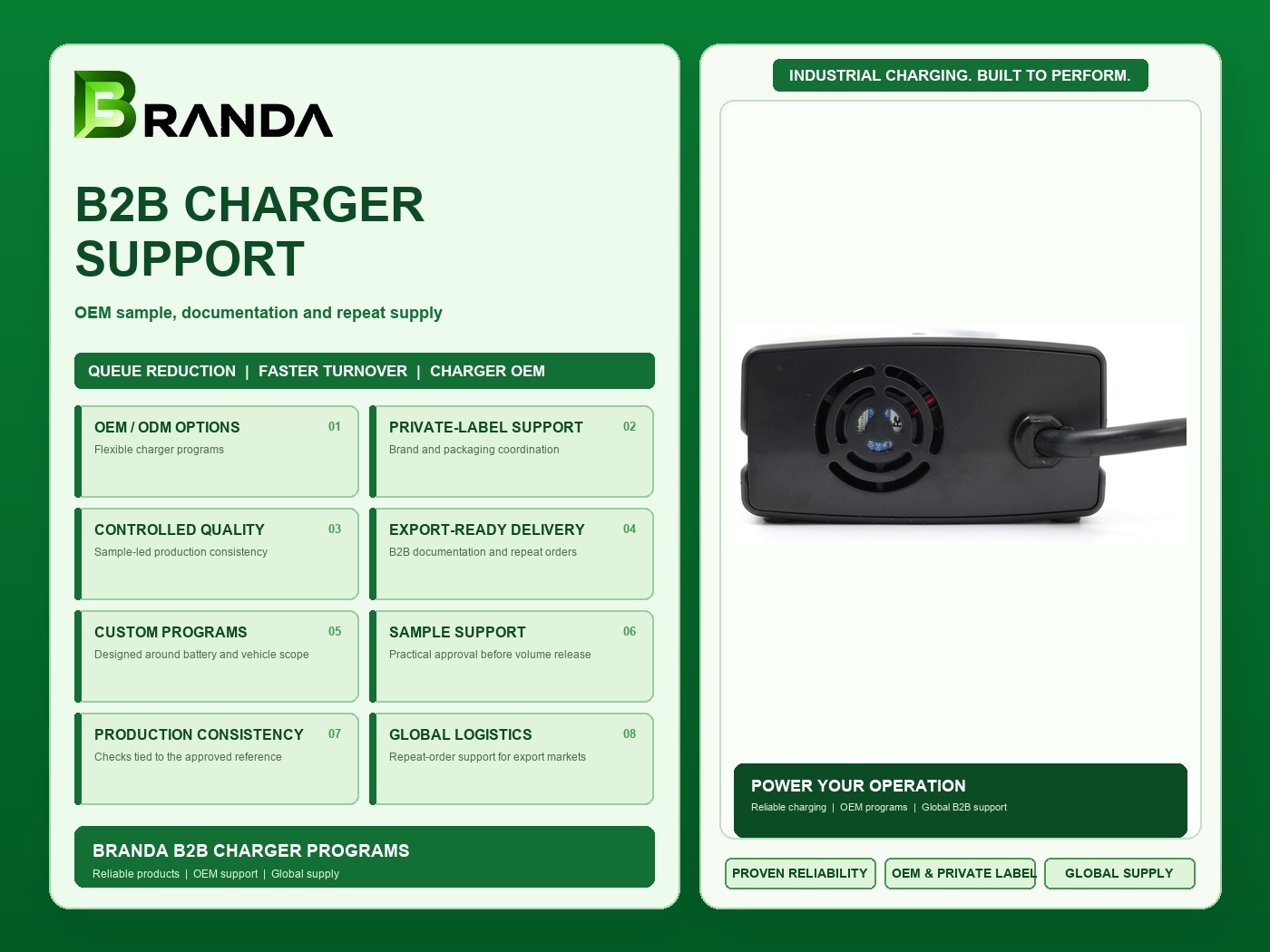
Track useful queue indicators
Arrival rate, bay occupancy, connection time and rework events show whether the station is improving. The requirement becomes much clearer when the team maps the physical sequence from approach to exit. For a warehouse battery charger station where trucks wait longer for a bay than for the charging event itself, every additional stop, waiting area or manual instruction can weaken flow control, bay availability and charging-event repeatability. Use a simple flow sketch and mark who acts at each step, how long the step takes and what happens when it fails.
A short site walk often reveals constraints that are missing from the drawing, from blocked isolation access to cables crossing a pedestrian route. Treat minutes between vehicle arrival and return to service as the acceptance measure and use optimizing charge time while leaving connector and battery handling delays untouched as a design warning, not a reason to postpone the review. Branda connects those field findings to charger selection, sample testing and documentation, with Brandapcba supporting OEM and volume production.
Verify the revised layout
When reviewing "Verify the revised layout", answer two questions: what must happen during a normal shift, and what must remain possible when the operation is under pressure? Test the new process with the busiest vehicle mix before treating the shorter queue as a permanent result. In a warehouse battery charger station where trucks wait longer for a bay than for the charging event itself, flow control, bay availability and charging-event repeatability cannot depend on ideal battery condition, perfect traffic flow or an operator remembering an exception rule. The design must make the correct action easy to repeat.
Create a checklist that links every operating assumption to a test, document or drawing. Track minutes between vehicle arrival and return to service and review optimizing charge time while leaving connector and battery handling delays untouched at the same gate. Branda can help convert the checklist into a practical industrial forklift charger wholesaler proposal; Brandapcba can then preserve the approved connector, label, packaging and production references for later shipments.
Turn the planning file into an approved purchase scope
The purchasing file should connect the approved charger, battery family, connector, cable, label, packaging, service contact and site record. Keep the sample approval separate from unverified brochure claims. Use the Branda AGV and forklift charger range and the forklift battery charger connector guide to move from fleet requirements into a reviewable commercial and technical scope.
For a repeat shipment, check that the production unit still matches the approved reference. Compare forklift charger sample test guide and forklift charger acceptance test with the site requirements, then record any local exception before commissioning.
Build a fleet charging plan with Branda
Ask Branda for a fleet charging layout review. Share the shift pattern, battery file, connector drawing and bay layout so Branda and Brandapcba can prepare a focused next step.
Contact BrandaExplore charging solutionsFrequently asked questions
- What evidence should a forklift charger supplier provide?
- Ask for application review, sample approval, production controls, connector drawings, label information, spare-part guidance and a change-notification process.
- How should AGV charging fit an automated material flow?
- Plan approach, connection, charging, interruption and exit as one route. Keep the station clear of manual truck traffic and include service access in the layout.
- When should a distribution center expand charger capacity?
- Expansion is easier when the bay layout, electrical supply and approved product family already include a phased path for more vehicles and charging positions.
- What should a fleet measure before planning a charging station?
- Measure vehicle count, arrival windows, shift pattern, battery family, connector type, available charge time and the number of vehicles that must return to service after each break.
- How many chargers does a multi-shift fleet need?
- The count depends on energy demand, charging windows, battery swapping, queue limits and bay availability. Use the peak arrival period rather than a simple daily average.
- Can a smaller warehouse improve a tight charging layout?
- Yes. Clear traffic routes, protected charger positions, shorter cable paths and a repeatable parking sequence often improve usability more than adding another unplanned bay.
- Why does queue time remain high when charging is fast?
- The delay may come from bay access, connector handling, battery movement, unclear status signals or vehicles occupying the bay after charge completion.
- Can one fleet use several battery chemistries?
- Yes, but each vehicle and battery combination needs an approved charger profile, connector and operator instruction. Physical fit alone is not approval.
Product images are for charger-family presentation. Confirm the exact battery, connector, input lead, labeling, certification scope, MOQ and delivery with Branda before ordering.


