

Industrial fleet procurement guide · Bolanda Electronics
A fleet battery charging station needs enough compatible charging positions to meet the next operating deadline, an installation reviewed for the actual electrical and environmental conditions, and a recovery plan when a charger becomes unavailable. Start with the battery return schedule. Then choose the charger configuration, number of positions, layout and spare strategy around that schedule. Counting vehicles alone will not tell you how many chargers to buy.
This guide is for equipment OEMs, fleet operators, distributors and procurement teams planning charging areas for battery-powered industrial equipment. Here, a charging station means the organized site arrangement around compatible battery chargers; it does not automatically mean an electric-car charging pedestal or a standardized vehicle interface. The aim is to turn an operational requirement into an installation and purchasing brief that a supplier can review.
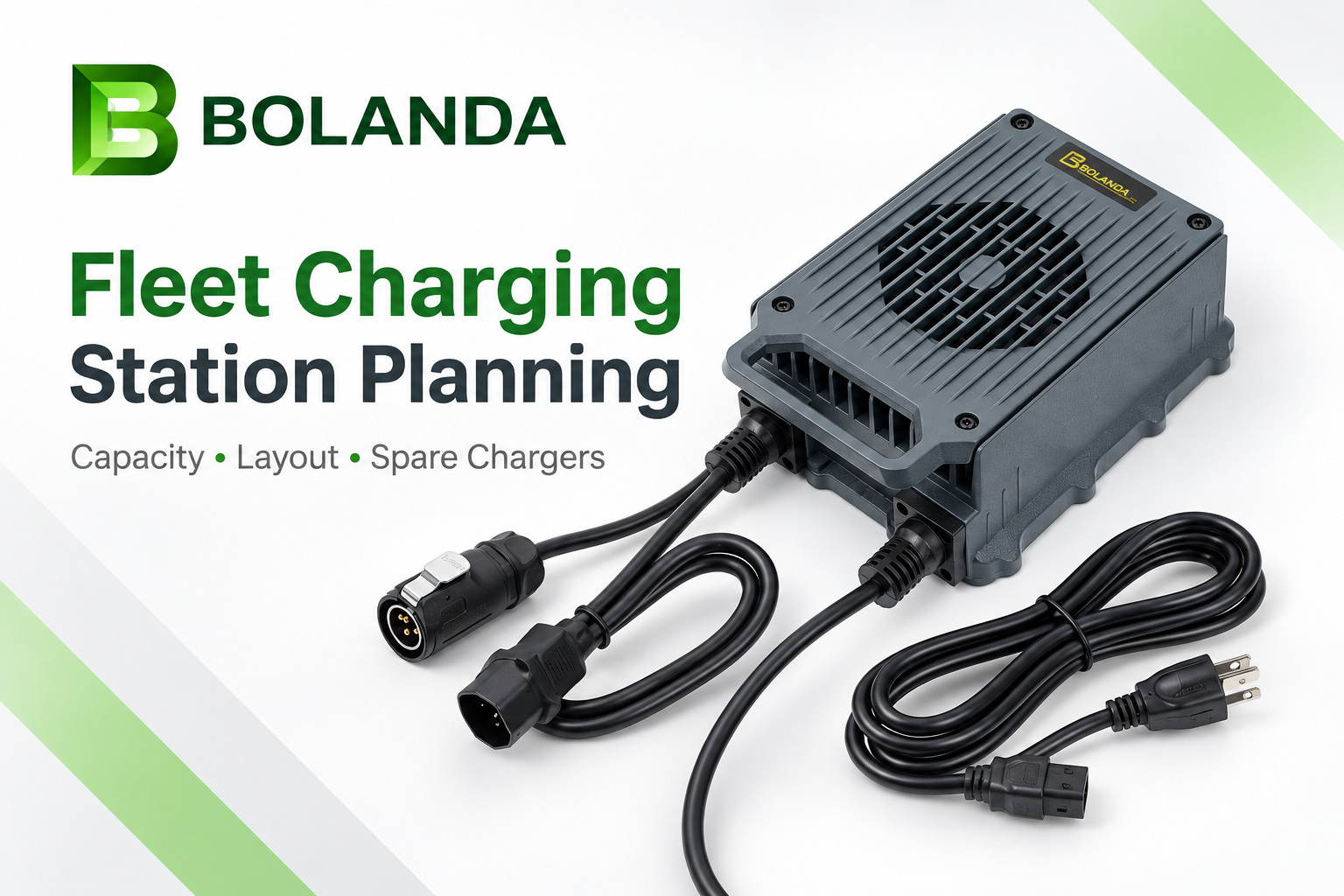
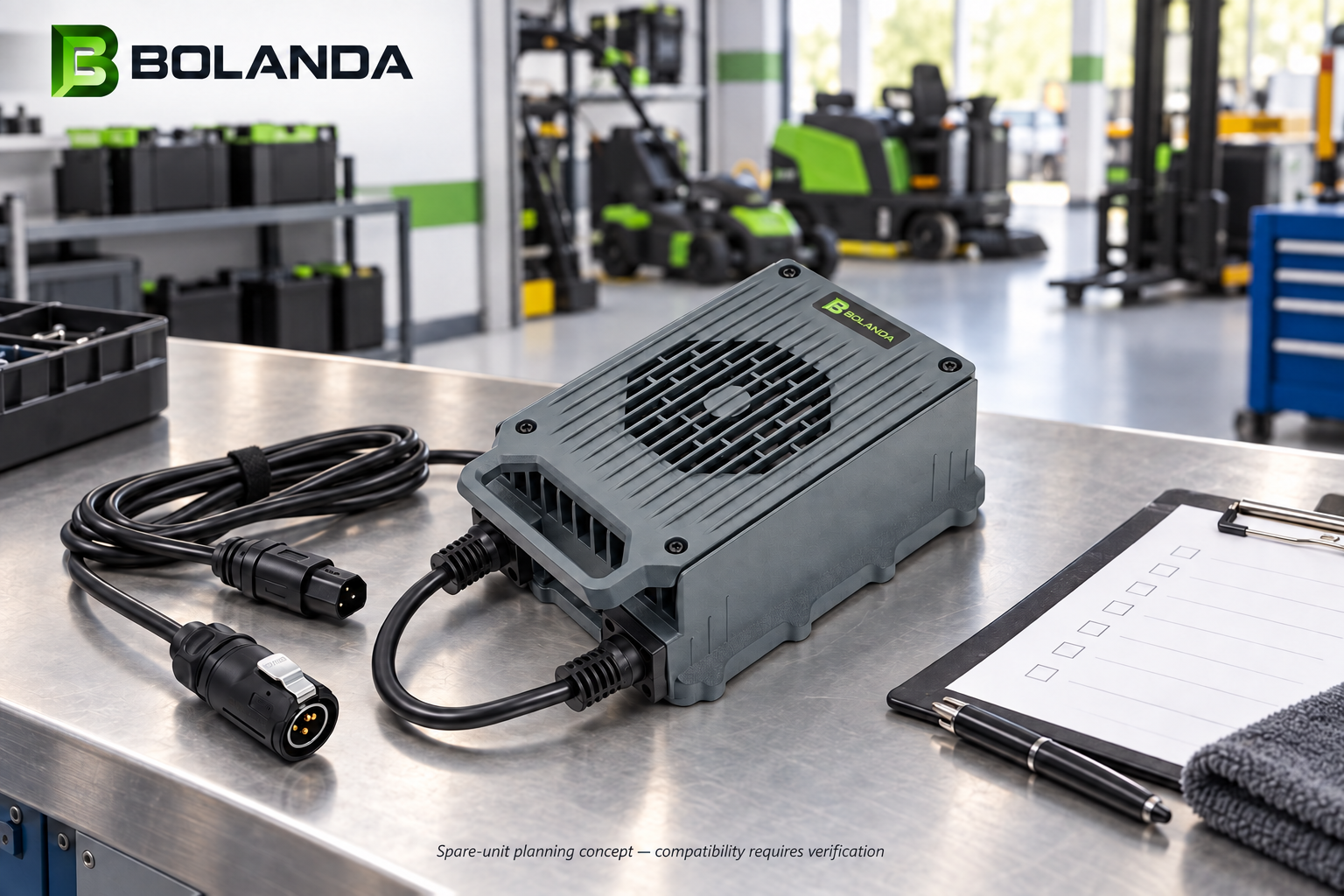
The product images are derived from Bolanda product reference materials. They show a grey charger enclosure, a handle, ventilation openings, cables and a latching connector. The photographs support discussion of the physical arrangement. Electrical ratings, battery compatibility, allowable orientation and environmental limits still need the selected model documentation.
Discuss Your Fleet Charging Project
Begin with the shift, not the charger catalogue
An equipment count is a useful starting number, but it hides the timing problem. Some vehicles return together at the end of a shift. Others circulate through short breaks. Removable packs may be exchanged while the equipment keeps working, whereas installed batteries can make the entire machine unavailable during charging. Write down which operating model applies before deciding on hardware quantities.
For each group, record when charging can begin and when the battery or machine must be available again. Include handling time: moving equipment, checking the connection, identifying the correct bay and returning the charged unit to service. If those tasks consume part of a short break, the charger does not receive the entire break as usable charging time.
Ask the operations team about difficult days as well as normal days. A late return, a second shift or a concentrated delivery window can create a charging queue that an average-day calculation misses. Describe these conditions as scenarios with dates or operating assumptions, rather than calling every unusual event a worst case.
The output should be a short demand profile. It needs battery groups, arrival windows, departure deadlines and the expected work pattern. Procurement can then ask suppliers to evaluate a defined operating requirement instead of requesting a universal charger for an undefined fleet.
| Planning input | What to record | Why it changes procurement |
|---|---|---|
| Fleet groups | Equipment model, battery identity and population | Different groups may need different charger configurations |
| Arrival pattern | Earliest and latest return times, clustered returns | Simultaneous demand can exceed daily-average demand |
| Departure deadline | When each group must return to work | A position occupied after the deadline provides no operational benefit |
| Charging duration | Measured time under agreed starting and finishing conditions | Nominal charger current alone cannot define bay occupancy |
| Handling and supervision | Connection, checks, movement and release tasks | Labor and queue time reduce usable charging windows |
| Site conditions | Space, electrical supply, temperature and access | The proposed layout must suit the installation |
| Recovery requirement | Permitted downtime and replacement route | Determines which spare configurations are useful |
Map compatibility before assigning charging bays
Create a compatibility register linking each approved charger configuration to the battery and equipment it may serve. The register should identify the battery chemistry, pack model, approved charging conditions and physical interface. Where communication, enable signals or temperature feedback are required, include the matching documents and revisions. Do not rely on a handwritten voltage label alone.
A connector that fits mechanically is not enough evidence. Pin assignments, polarity, electrical capability, interlock behavior and charging logic may differ. The visible latch in the reference photograph is a useful handling feature to discuss; it is not proof that the charger is suitable for any particular machine. Request the actual connector identification and mating specification.
Decide how users will recognize the correct combination at the station. Bay identifiers and equipment identifiers can help, but color coding should supplement an approved compatibility system rather than replace it. Any label must remain clear during routine handling and should refer to a configuration the maintenance team can trace.
For mixed fleets, separate confirmed compatibility from a proposed future common platform. Standardization may be possible, but it requires review and evidence. Buying one configuration for every bay before that review can leave a fleet with plenty of chargers and too few usable charging positions.
How many charging positions does the fleet need?
Think in occupied charging positions over time. For a first estimate, add the charger-hours needed within the planning window and divide by the usable hours per position. Round up to a whole position. This gives a capacity lower bound under the stated assumptions. It does not prove that every arrival and departure constraint can be met.
Next, place each charging session into its actual time window. Check whether two sessions require the same position at the same time. Include the time needed to clear a completed unit and connect the next one. When several machines must leave together, their shared deadline can drive the position count even if part of the day remains quiet.
Use measured or agreed session durations, not a fixed duration copied across all batteries. A heavily used pack and a lightly used pack may occupy a charger for different lengths of time. Temperature restrictions, battery condition and the required finishing state can also change the schedule. Mark uncertain durations as assumptions to verify during a pilot.
Keep active positions distinct from spare chargers. A spare stored for recovery does not increase normal charging capacity unless the site has an approved place to use it. Equally, an empty shelf position does not add capacity if there is no compatible charger, suitable supply arrangement or operating procedure for that position.
A simple scheduling example shows why averages are not enough
Consider a hypothetical fleet with twelve compatible battery packs. Assume each requires a four-hour reserved charging slot under a defined, validated procedure. In the first scenario, six packs are available at 08:00 and needed at 12:00; the other six arrive at 12:00 and are needed at 16:00. Six positions can serve those two groups sequentially if the assumed slot includes the required handover time.
Now change only the return pattern. All twelve packs arrive at 08:00 and all are needed at 12:00. The same forty-eight charger-hours are required, but twelve positions are needed within that four-hour deadline under these assumptions. Dividing the daily requirement by an eight-hour day would still produce six, which would be misleading for the second scenario.
This example is scheduling arithmetic, not a charging-time claim about the product shown. Real session duration must be established for the approved battery and charger combination. If the timetable does not fit, the answer may involve more positions, a different return schedule or an approved battery exchange arrangement. Increasing charge current is not automatically a permissible solution.
Use this exercise with the people who dispatch equipment. They can often identify a hidden constraint, such as all operators taking the same break or charged packs being released only at a scheduled collection time. Those details belong in the purchasing brief because they determine what usable capacity means.
| Illustrative scenario | Charging demand | Positions implied by the stated schedule |
|---|---|---|
| Two sequential groups | Six four-hour slots at 08:00; six at 12:00 | Six, if handover is included and all other conditions are met |
| One common deadline | Twelve four-hour slots at 08:00, all due at 12:00 | Twelve; the spare afternoon does not solve the morning deadline |
| Uncertain return times | Same daily demand, variable arrivals | Requires a timed schedule and pilot observations |
| One position unavailable | Demand unchanged during maintenance | Check the remaining schedule and the replacement procedure |
Define charging duration with an observable finishing condition
“Ready in four hours” needs a definition of ready. Specify the battery starting condition, the intended finishing state and the conditions under which the duration is measured. A status light, a completed charge cycle and enough energy for the next task may represent different operational criteria. The battery and equipment requirements should determine the accepted criterion.
Avoid assuming that current remains at its maximum throughout the entire session. Charging behavior may change through the cycle, and the system may limit current under certain conditions. Texas Instruments' technical video on long battery-charge taper time discusses several factors that can extend charging, including supply limitations, resistance and thermal behavior. It supports asking for measured system evidence rather than predicting every session from one headline rating.
For planning, request a charging record on the approved configuration. It should identify the pack, charger revision, starting condition, ambient conditions, elapsed time and finishing criterion. If the equipment remains powered while charging, make that part of the test arrangement. Otherwise, the recorded time may not represent the site workflow.
Do not hide inconvenient results by averaging them away. A small number of late sessions may be operationally significant when a dispatch deadline is fixed. Keep a record of the conditions associated with those sessions and decide whether they require a different schedule, further engineering review or a separate operating rule.
Separate the electrical supply review from the charger count
Once the proposed number of active positions is known, the site team needs the input requirements of the selected charger configurations. Output power alone is not an installation specification. Ask for the applicable input information, operating conditions and manufacturer instructions, then have the installation reviewed by qualified electrical professionals for the location and use.
Describe the intended simultaneous operating pattern. A room with twelve installed chargers may operate all twelve together or use a managed sequence. Those are different planning cases. Any diversity or sequencing assumption must reflect a controlled operating arrangement; it should not exist only in a spreadsheet while users can turn on every charger at once.
Keep the procurement boundary explicit. The charger supplier may provide product input data and installation requirements, while the site's appointed professionals determine the supply and protective arrangements. Identify who is responsible for the room installation, outlets, distribution, inspection and commissioning. A charger quotation should not be mistaken for approval of the entire electrical installation.
Plan for future expansion without treating it as already available capacity. Reserve physical space if useful, but document what further electrical and operational review will be needed before adding chargers. A spare socket or an unused shelf does not, by itself, confirm that the site can support another active position.

Lay out the station around movement and access
A charging area is also a traffic and handling area. Draw the route taken by arriving equipment, people connecting it, and equipment returning to work. Look for crossings, narrow turning areas and places where a cable would enter a walkway. A neat row of chargers in a product photograph can become awkward when real machines and operators occupy the space.
Agree how each charger will be supported and accessed. The reference product has a visible handle, but that does not establish a wall-mounting method or a permitted installation orientation. Use the selected model's instructions. Leave access for the intended connection, inspection and approved maintenance activities without requiring someone to move another active unit first.
Consider the complete cable path. It includes the supply side, the output side and any equipment interface, not just the visible connector. Specify how cables will be stored when unused and how routine movement will avoid pulling on terminations. Cable length should follow the actual layout and the approved electrical design, rather than being extended casually after delivery.
Include ordinary housekeeping in the layout review. The station should have a place for documentation, spare accessories and equipment awaiting assessment, without those items obstructing operating positions. Test the proposed arrangement with a representative unit before ordering a full set of fixtures or furniture.
Airflow must be checked at the installed position
A vented enclosure depends on the conditions around it. Walls, shelf panels, nearby equipment and stored materials can change the air available at an installed position. The reference photographs show a prominent grille, making airflow an appropriate review question. They do not reveal the required clearance, airflow direction or approved ambient limit for the chosen model.
Murata provides power product application requirements that advise following product-specific temperature derating information and considering ambient temperature and airflow at the power supply. The procurement lesson is to assess local conditions where the product operates. That general guidance is not a specification for a Bolanda charger and does not establish its performance.
Ask the supplier what installation information must accompany the selected configuration. If chargers are arranged near one another, review the complete arrangement rather than assuming an isolated bench result applies to the group. The site assessment should consider the planned simultaneous use and the conditions the equipment is expected to encounter.
Do not use a photograph to classify a product as sealed, weatherproof or suitable for a dusty process area. Enclosure protection and environmental suitability need model-specific evidence. Where the proposed location exceeds the documented conditions, raise that mismatch before purchase instead of expecting a maintenance routine to compensate for an unsuitable installation.
Make connection and release a short, repeatable workflow
The operating routine should identify the correct equipment, the correct bay and the conditions that allow charging to begin. Base it on the approved battery, charger and site instructions. Keep routine steps concise enough to be followed during a shift change, while giving users a clear route for exceptions they are not authorized to resolve.
Decide who verifies completion and releases equipment. If a charged pack remains in a bay waiting for collection, that delay consumes capacity even though charging has finished. A visible status system can help the dispatch and maintenance teams distinguish charging, ready, reserved and unavailable positions. Choose a method that suits the operation and can be maintained reliably.
Train users to report the actual indication or symptom, not just label a charger as bad. The bay identifier, equipment identifier and displayed state can help the responsible team investigate. The routine should also identify when use must stop and who may assess the equipment, following the applicable instructions and site rules.
Avoid informal workarounds such as moving an unverified charger to whichever bay is empty. The compatibility register should remain the reference even during a busy shift. An exception process is useful precisely because operational pressure is greatest when the normal arrangement is unavailable.
Plan spare chargers by configuration and recovery time
A spare is useful when it can restore a particular unavailable function within the time the operation can tolerate. Start by identifying the charger configurations that support critical equipment. Then consider how quickly each can be replaced, configured and returned to service through the approved process. There is no universal spare percentage that fits every fleet.
A site with several incompatible charger types may need a different strategy from one with a genuinely standardized platform. One spare cannot cover every type merely because the housings look alike. Record the approved configuration, connector and relevant settings for each spare, and identify the equipment groups it may support.
Also distinguish a replacement unit from a repair plan. A spare can reduce the immediate interruption, while the failed unit still needs assessment, repair or replacement. Ask about the supplier's service process, the information needed for investigation, and the commercial arrangements that apply. Do not assume a repair turnaround or warranty outcome that has not been agreed.
Store spares under the applicable instructions and include them in the site's inspection or readiness process. An untracked spare with an uncertain configuration creates a second problem at the moment it is needed. The maintenance record should make it easy to identify an approved replacement without reopening the entire original purchasing discussion.
| Recovery question | Planning record to keep |
|---|---|
| Which equipment is affected? | Compatibility register linking charger configurations and fleet groups |
| How long can the position remain unavailable? | Operational tolerance and escalation owner |
| What replacement is ready? | Spare identifier, configuration and readiness status |
| Where can the replacement operate? | Approved position and installation arrangement |
| Who can return the position to service? | Authorized procedure and completion record |
| What happens to the removed unit? | Assessment route, symptom record and agreed service terms |
Request a Fleet Charger Proposal
Use downtime scenarios to compare purchasing options
A price comparison can include the operational consequence of an unavailable charger without inventing a return-on-investment promise. Describe a small number of scenarios: one position unavailable for a shift, a delayed replacement, or a charger group unavailable during a peak return window. Work through what happens to the dispatch schedule in each case.
Some sites can move noncritical work to another time. Others must keep a particular machine available. The cost of interruption therefore depends on the operation, not simply on charger price. Ask the site team to identify the affected activity and any credible additional cost, using its own records where available.
Compare alternatives using the same service requirement. An extra compatible spare, a different shift arrangement and an additional active position solve different problems. One improves recovery, another reduces overlap, and another adds normal capacity. Treating all three as interchangeable can make a spreadsheet look balanced while leaving the original bottleneck untouched.
Keep uncertain values visible. A planning estimate may be enough to decide which options deserve a pilot, but it should not be presented as a measured saving. The purpose of the exercise is to show which assumption drives the purchasing decision and what evidence would change that decision.
Run a pilot on representative work before the full rollout
Select a pilot that resembles the intended operation closely enough to answer the important questions. That may include a representative equipment group, the planned bay arrangement and the actual shift handover. A bench demonstration can confirm certain product behavior, but it cannot show whether the station workflow creates queues or late departures.
Define the observations before starting. Record arrival time, connection time, charging completion, release time and any reason for delay. Keep the battery and charger identifiers with the record. Otherwise, the team may know that a session was late without knowing whether the cause was equipment, handling, scheduling or an installation condition.
Have the appropriate people review different parts of the result. Operations can assess availability and movement; engineering can assess product behavior; the site's appointed electrical professionals can assess the installation within their scope. Procurement should collect the agreed conclusions and open actions rather than treating one department's approval as a substitute for all the others.
End the pilot with a decision. The next stage may be approved, held for an identified correction or limited to a particular equipment group. Record what was actually demonstrated and which assumptions remain. That makes the pilot a useful purchasing control instead of a trial that everyone remembers differently.
| Pilot measure | Record | Decision it supports |
|---|---|---|
| Bay occupancy | Connection through release, including handling delay | Whether the position count meets the timetable |
| Departure readiness | Actual release against the required deadline | Whether the operation receives usable equipment on time |
| Compatibility exceptions | Equipment and charger identities, reason for exception | Whether the approved register is complete |
| Installation observations | Approved review records and unresolved site issues | Whether the arrangement may proceed to the next stage |
| Operator interruptions | What happened and who resolved it | Whether instructions or workflow need revision |
| Recovery exercise | Approved replacement process and elapsed time | Whether the spare strategy meets the operational need |
Roll out in controlled groups and keep a configuration register
After pilot approval, give each deployed charger a clear identity linked to its approved configuration and location. The register should distinguish model information, project-specific settings where applicable, connector arrangement and the equipment group served. Keep the relevant instructions and approval records accessible to the people who manage the station.
A staged rollout can help detect issues before they affect the entire fleet. Choose stages that match the operation rather than splitting an order arbitrarily. For example, one equipment group or site area may provide a manageable first deployment. The release criteria should state what must be checked before the next group is introduced.
Control changes after installation. A replacement connector, different cable, changed battery model or revised operating schedule may affect the approved arrangement. Decide which changes require supplier input, engineering review or a renewed site assessment. Avoid treating a physical fit as permission to substitute a component or move equipment to a new use.
Keep the purchasing description aligned with the register. Repeat orders should refer to the approved configuration and any accepted revision, not only a photograph or a previous price. This becomes particularly important when a distributor orders for several sites that use similar housings with different project requirements.
Capture field issues without losing the operating context
A useful issue report explains where the charger was used, what it was connected to, what the user observed and when the problem occurred. Include identifiers, the relevant indications and any recent changes. The same apparent symptom can have different causes, so the report should preserve observations before assigning responsibility.
Separate an unavailable charging position from a confirmed charger defect. A delayed battery return, an incorrect bay assignment, a damaged interface or a site-supply issue can all interrupt charging. Classifying every interruption as a product failure distorts the purchasing evidence and can lead to the wrong corrective action.
The site's procedure should identify who may inspect, remove or return equipment to service. Do not ask unqualified users to open an enclosure or improvise electrical fault tests. Preserve the unit and its records for the responsible service or engineering team, following the manufacturer and site instructions.
Review issue patterns periodically. If delays repeatedly occur at the same shift boundary, the schedule may need attention. If a specific configuration repeatedly creates an exception, revisit the compatibility or approval record. The most useful outcome is an improved operating or product decision, supported by evidence from the actual deployment.
Compare proposals for the same fleet requirement
Send prospective suppliers the same demand profile, compatibility requirements and requested deliverables. Ask each to identify the proposed model or project route, the information still needed and the assumptions behind its offer. This is more informative than comparing unit prices for chargers that may not serve the same batteries or operating conditions.
Separate product supply from site work and ongoing support. A charger quotation may cover units, accessories, documentation and agreed sample evaluation. Installation infrastructure, site approvals and operator procedures may belong to other parties. State the boundaries so that an excluded item does not become a surprise shortly before deployment.
Request commercial detail for samples, initial deployment, spare units and later repeat orders. Clarify lead-time assumptions, minimum quantities, packaging, delivery terms and any project-specific development charges. The reference product photograph cannot establish those terms, and they should not be inferred from another customer's order.
For Bolanda, start with the battery and equipment information you already have, the number of proposed active positions, the shift pattern and the destination market. Ask the team to confirm the suitable product or customization route and the supporting information available for review. A precise operational brief helps the supplier return a proposal that purchasing and engineering can evaluate together.
Match the enquiry to the right product or manufacturing route
Fleet planning sometimes reveals that the project needs a different deliverable. An operator may need a complete charger, an equipment brand may need a customized charging product, and a design owner may need an assembled power board. The routes below connect those needs to Bolanda's existing products, categories and OEM/ODM service information.
These links do not imply that one pictured charger serves every application. Each route requires its own technical and commercial confirmation. Use the relevant page to identify the intended scope, then include the battery, equipment or design information necessary for that scope in your enquiry.
| Procurement route | Information to include |
|---|---|
| industrial lithium battery charger manufacturer | Industrial fleet project: battery group, charging windows, environment and active-position count. |
| power tool battery charger manufacturer | Tool fleet: approved battery platform, contacts and operational schedule. |
| custom lithium battery charger manufacturer | Custom project: pack specification, charging behavior, enclosure and interface needs. |
| e bike charger manufacturer | E-bike fleet: battery configuration, interface and dispatch requirements. |
| PCBA manufacturer | Board-level project: released design files, BOM, assembly and test scope. |
| electric motorcycle charger manufacturer | Motorcycle charging project: approved battery requirements and installation context. |
| LED driver manufacturer | Lighting project: identify load and control requirements rather than a battery-charging schedule. |
| brushless motor controller manufacturer | Equipment control project: motor, sensing, operating modes and integration scope. |
| AC DC power adapter manufacturer | Buying an adapter for another part of the installation? Send its input range, required output and connector drawing. Confirm where charging regulation takes place before proposing an adapter for a battery. |
| power supply PCB assembly | For a power board, attach the drawing revision to the enquiry and identify who buys the components. The quotation needs a test specification as well as an assembly quantity. |
| mobility scooter battery charger supplier | The linked scooter example is for lead-acid batteries. Check your actual battery label and equipment documentation before requesting that configuration; it is not a substitute for a lithium charging specification. |
Frequently asked questions about fleet battery charging stations
Should every vehicle have its own charger? Look at the return schedule first. Twelve batteries coming back together and leaving four hours later may occupy twelve positions for that entire window. The same twelve batteries returning in two separate groups may be able to share six positions. Both cases still require an approved battery and charger combination and a measured charging time that fits the schedule.
Can I solve a charging queue by buying a faster charger? Only if the complete battery and equipment system permits the proposed charging conditions and the installation supports them. First determine whether the queue comes from charging duration, clustered returns, handling or late collection. A faster nominal rating does not address every bottleneck.
How many spare chargers should I buy? Base the decision on critical configurations, tolerable interruption and the approved replacement route. A fixed percentage can miss a rare but essential charger type. Identify which unavailable function each spare can restore and how quickly the site can make that replacement.
Can the charger shown be used outdoors? The photographs cannot establish outdoor suitability, enclosure protection or permitted environmental exposure. Ask for the selected model's documentation and review the proposed location. Do not infer an environmental rating from the enclosure color, shape or presence of a handle.
What should I provide for a fleet quotation? Send equipment and battery identities, approved charging requirements, compatibility documents, expected quantities, shift windows, proposed location and destination market. State what remains undecided. The supplier can then explain which proposal assumptions depend on those open points.
Can one model serve several equipment brands? Possible compatibility must be demonstrated for the specific combinations. Brand names and connector fit are insufficient. Maintain a written register of approved combinations and treat a new battery or equipment revision as a review event.
How do I compare delivery promises? Ask what starts the quoted lead time and which approvals or material commitments it assumes. Distinguish standard product availability, customization, sample evaluation and the rollout schedule. A shipment date for hardware does not automatically mean the site is ready to operate.
Can Bolanda help with a custom configuration? Submit the operating and technical requirements through the OEM/ODM or contact route and request feasibility review. Configuration, quantities, documentation, samples and commercial terms are confirmed for the individual project rather than assumed from the images in this guide.
Send the fleet plan you need the supplier to solve
A strong enquiry describes the job before it asks for a price. State how many equipment or battery groups you operate, when they return, when they must be ready and which charger combinations are already approved. Add the proposed number of positions, location conditions and the role of spare units. If the count is still uncertain, share the schedule so it can be reviewed.
For the first conversation, a clear summary is enough. List the battery specifications, interface drawings and site information available, and ask how to exchange supporting files through the agreed process. Do not submit confidential engineering packages through an unsuitable channel merely to make the initial message longer.
Use the contact button below to discuss the product route, sample needs and quotation scope with Bolanda. The desired outcome is a charger proposal linked to a workable deployment plan: compatible equipment, realistic charging windows, an approved installation arrangement and a documented way to recover when a position is unavailable.


