

How to Choose a Forklift Battery Charger When the Connector Is Part of the Job
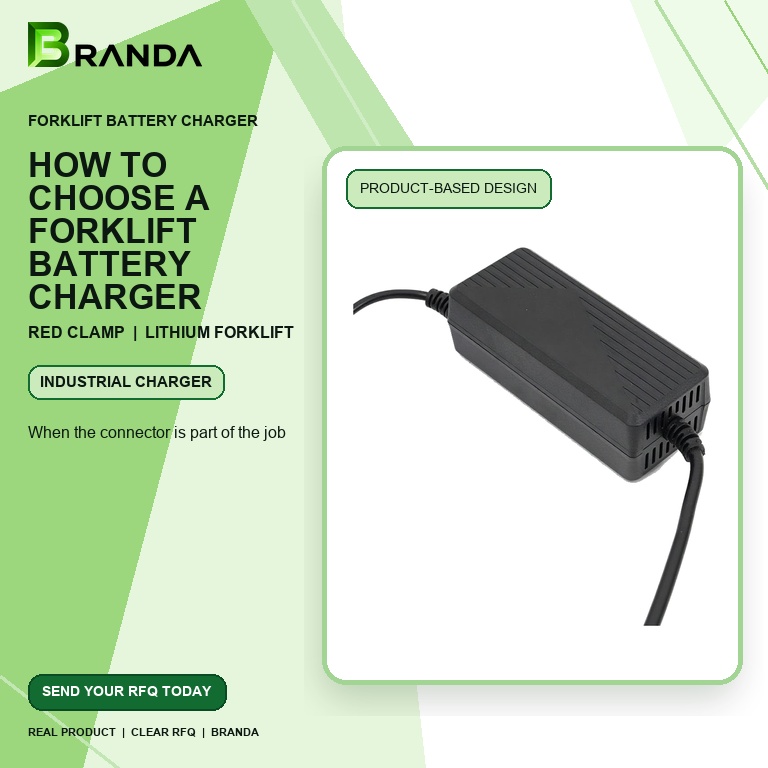
A practical sourcing guide for a black forklift charger with a red clamp-style interface. The product image is a real reference; the battery, electrical and certification limits still need confirmation for the final project.
A charger purchase starts with the battery, not the product photo
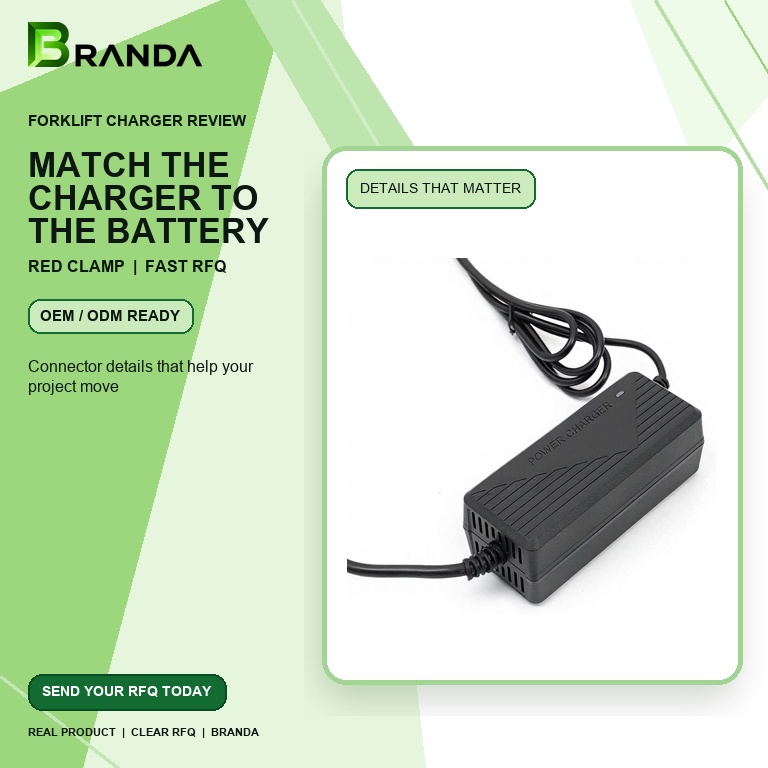
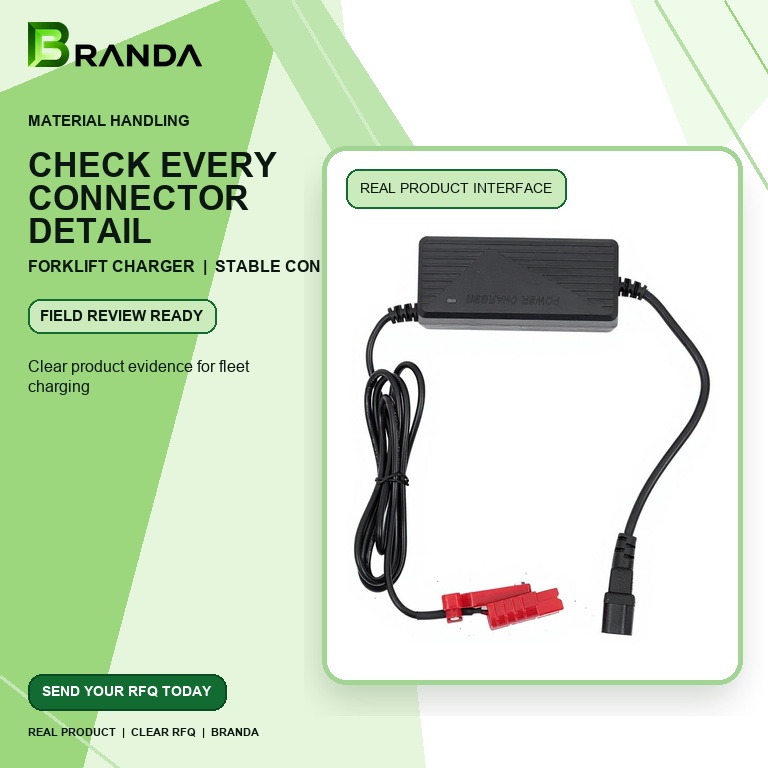
When a buyer sends us a photograph of a black charger and asks for a lower price, we do not begin with the price. we first ask what battery the charger will meet at the end of the cable. The file for Branda 321600008 shows a compact black power charger, a long black lead and a red clamp-style output connector. Those are useful visual facts. They tell us how the item is likely to be handled, but they do not replace the battery specification. A lithium forklift battery charger is part of a working system, and the battery, connector, charger profile and warehouse routine have to agree.
This is also the difference between a useful RFQ and a list of marketing words. The phrase industrial lithium battery charger manufacturer may bring up a long supplier list. A good RFQ narrows the list by asking practical questions: Which battery chemistry is in the truck? What is the approved charging voltage? How much current can the pack accept? Is the battery removable? Who connects the red clamp? Where will the charger sit when the forklift is moving in and out of the station? we would rather answer those questions on page one than discover them after a sample has been delivered.
| Visible product point | What the supplied image shows | What the project still confirms |
|---|---|---|
| Housing | Black ventilated power-charger enclosure | Dimensions, mounting space and the final environmental requirement |
| Output interface | Red clamp-style connector is visible | Mating part, polarity, contact pressure and approved harness |
| Cable | Black cable with strain-relief sections | Length, gauge, route, service loop and bend allowance |
| Input side | Separate black input lead and connector are visible | Input voltage, frequency, plug and site circuit |
| Use case | Suitable visual reference for a forklift charger project | Battery chemistry, charge profile, BMS boundary and duty cycle |
Project note: The supplied Branda 321600008 image pack does not show a complete electrical datasheet. Voltage, current, rated power, certification and BMS behavior should be treated as project-confirmation items until Branda issues the formal product or quotation document.
Why the red clamp deserves its own specification
A clamp is often described as if it were a small accessory. On a forklift floor it is a daily interface. The operator sees the clamp, picks it up, places it on the battery-side connection and removes it again. The shape affects hand position. The cable exit affects whether the lead falls toward a wheel or stays inside the intended service loop. The housing and insulation affect what happens after repeated handling. For that reason, we would put the connector on the front page of the drawing instead of hiding it in a packing list.
Color is helpful, but color is not polarity. If red is used as a visual identifier, the drawing should still show positive and negative, the mating location and the approved connection order. A maintenance technician should be able to read the work instruction without guessing which side of the battery the clamp belongs to. If a change from the red clamp to another connector is requested, the connector change should trigger a new sample review, not only a new product photograph.
we also ask the operator to perform the connection beside the real truck. A clean white product image does not show a battery cover, a nearby metal edge, a tight aisle or a cable that has already been coiled three times. Watch where the lead lands when the operator lets go. Check whether the cover presses on it. Ask the operator to disconnect by holding the connector body rather than pulling the wire. These are ordinary observations, but they often prevent a repeat failure that a bench electrical test never sees.
| Connector review | Question to ask | Evidence to retain |
|---|---|---|
| Mating point | Does the clamp reach the battery connection without stretching the cable? | Photo on the actual forklift |
| Polarity | Can positive and negative be identified without relying on color? | Marked drawing and work instruction |
| Grip | Does the clamp remain stable during the planned charge window? | Operator observation and repeat-use note |
| Cable exit | Does the lead avoid the cover, wheel and sharp edges? | Routing photo and service-loop dimension |
| Service | Can a trained technician replace or inspect the connector? | Maintenance step and spare-part reference |
Battery matching is the first technical conversation
Before selecting a charger for a lithium forklift, collect the battery maker's nominal voltage, chemistry, capacity, maximum permitted charging current, end-of-charge limit and temperature boundary. If a battery management system is installed, record whether it accepts a standalone charger or expects a charge-enable signal. A label photograph is helpful for identification, but it is not the same as a charging instruction. we have seen projects where the number on an old charger was copied into a new RFQ even though the battery pack had changed.
The clean way to handle this is to keep two columns in the inquiry. The first column says what the charger reference shows. The second says what the battery maker must confirm. That makes a discussion honest. It also helps a buyer compare an industrial lithium charger supplier with an AGV forklift charger manufacturer without assuming that every supplier is quoting the same charging method. If the battery chemistry, BMS and connector are different, a lower price on a visually similar unit may not be a saving.
| Battery-side input | Why it changes the charger decision | How to close the question |
|---|---|---|
| Nominal voltage | Sets the starting point for charger selection | Send the battery label and formal specification |
| Chemistry | Changes the approved charge behavior | Confirm with the battery maker |
| Capacity | Changes the estimated charging window | Provide Ah or Wh and the usable range |
| Permitted current | Sets the upper boundary for the output | Request written battery approval |
| BMS behavior | May require enable, communication or fault handling | State standalone or integrated charging |
| Temperature | May limit charging or require a stop condition | Include operating and charging range |
For a warehouse buyer, this table is more valuable than a generic promise of fast charging. It gives the supplier enough context to propose a safe starting point and gives the battery owner a clear list of open items. It also keeps the final approval with the people responsible for the battery, rather than letting a product page make an application decision that it cannot prove.
Turn the shift plan into a charging window
The phrase fast forklift charger sounds attractive until the shift schedule is written down. How many trucks work in the area? Do they come back one at a time or in a queue? Is the battery removed for charging? Does the operator have an overnight window or only a short meal break? A charger that is perfectly suitable for a slow overnight routine may be the wrong choice for a station that has to return energy in twenty minutes. The correct question is not simply how much power the box can deliver. It is how much approved energy the battery can accept in the time that the site actually gives it.
we usually start with a simple planning estimate and label it as an estimate. If the battery maker says a certain amount of usable energy must be returned, divide that amount by the expected charging power or current to get a first range. Then add room for the charging profile, tapering, conversion losses and the battery's own limits. The calculation is not a promise. It is a way to expose a mismatch early. If the site has only a short break but the battery needs an overnight window, the RFQ should say so before a sample is ordered.
| Fleet question | Example record | Why a supplier needs it |
|---|---|---|
| Number of vehicles | Forklifts using the station each shift | Determines charger quantity and spare-unit plan |
| Return state | Measured battery state at arrival | Sets the amount of energy to be returned |
| Charging time | Overnight, between shifts or break window | Tests whether the proposed output is practical |
| Connection events | Number of plug-in and plug-out cycles per day | Changes connector and cable durability review |
| Station layout | Wall, shelf, cabinet or mobile cart | Affects ventilation and cable routing |
| Operator | Driver, technician or automatic dock | Changes the work instruction and interface |
The red clamp makes a manual connection easy to spot, but it also makes the operator step visible. That is useful for training and for a fleet manager who wants the station to be repeatable. we would include one photograph of the normal parking position, one photograph of the battery connection and one photograph of the cable when the truck is ready to leave. Three ordinary pictures can reveal more than a paragraph that says easy to use.
Input power and the warehouse site
The input side is easy to overlook because buyers naturally focus on the battery side. The file for Branda 321600008 does show a separate input lead, but the formal input range, frequency, plug standard and protection arrangement must come from the confirmed project specification. The site supply should be measured rather than guessed from the building name. Record the nominal voltage, the normal variation, the outlet type, the fuse or breaker and the number of chargers that may share the circuit.
If the order is for export, review the input version, plug, label and documentation as one configuration. Changing a plug is not the same as changing the input design. A sample that powers on in one outlet only proves that sample condition. It does not automatically prove the market variant or the certification scope. This boundary is worth keeping in the quotation because it avoids the familiar problem of a buyer treating a broad marketing sentence as a project approval.
For the wider product line, buyers can review the logistics lithium equipment charger category and then send the measured site conditions through the Branda inquiry page. The OEM/ODM project page is a better place to discuss cable, connector, label, packaging and sample changes than a short purchase-order note.
A practical Branda 321600008 sample test
| Test stage | What to do | Pass record |
|---|---|---|
| Identity | Check model, revision, label and connector against the inquiry | Signed sample checklist and photos |
| Visual | Inspect housing, vents, cable exits, clamp body and fasteners | Marked photo set |
| Input | Use the confirmed input variant and record site conditions | Measured voltage and frequency |
| Output | Test under a named load or approved battery setup | Voltage, current, duration and instrument |
| Connection | Let the operator connect and disconnect beside the truck | Work-step observation |
| Thermal | Observe housing, cable exit and clamp after the planned window | Ambient and measurement point |
| Packaging | Open a packed sample and inspect cable protection | Packing approval record |
we would write pass, conditional pass or fail, and we would use the conditional option without embarrassment when it is honest. For example, the electrical check may pass while the cable route needs a longer service loop. The record should name the open action, the owner and the date. A note that simply says pending confirmation has no owner and therefore has no reliable next step.
The test should also include a restart or stop observation if the project requires it. What does the operator see when the connection is removed? What happens if the battery is not ready? Does the work instruction tell the operator to stop, wait or call maintenance? The exact behavior depends on the final charger design and battery system, so the article cannot invent it. The point is to make the behavior a question that gets answered before fleet rollout.
OEM and ODM options around the finished charger
A buyer may need a different cable length, a different red clamp, a different label, a country-specific plug, special packaging or a battery-side harness. Those are sensible OEM/ODM topics, but they should be listed as controlled changes. Ask which parts are standard, which parts are available at the planned quantity and which changes require a new sample. Ask for the sample charge, lead time, minimum order quantity and inspection plan as well.
Board-level terms also need a boundary. A request for charger PCB assembly or power supply PCB assembly is not automatically the same as approval of a finished forklift charger. If the project includes board work, keep the board drawing, BOM, alternative component policy and board test record in a separate package that references the final charger revision. That approach makes a change easier to trace when the battery or connector changes later.
| Possible project change | Review before sample | Release evidence |
|---|---|---|
| Red clamp or harness | Mating part, polarity, strain relief and battery fit | Connector drawing and photos |
| Cable length | Routing, bend radius and service loop | Measured sample and route note |
| Input version | Voltage, frequency, plug and label | Test condition and market document |
| Housing or label | Clearance, markings and ventilation | Approved artwork and inspection |
| Packaging | Protection of clamp and cable | Packing trial and drop-handling note |
| Board assembly | BOM, revision and test boundary | Separate board package linked to charger |
What a buyer should send with the RFQ
- Battery label, battery specification, chemistry and permitted charging current.
- Forklift model, battery compartment photograph and connection drawing.
- Site input, plug standard, circuit arrangement and charging window.
- Fleet count, daily connection events and whether charging is overnight or during breaks.
- Red clamp requirements, polarity, cable length, route and service-loop preference.
- Target market, label language, packaging requirement and expected quantity.
- Sample acceptance method, owner of approval and the date needed for the first review.
These details help a forklift charger supplier quote the same project instead of three different interpretations. They also make the next conversation shorter. If the requirement is still changing, say that openly. A supplier can review an incomplete project, but the quotation should show which fields are provisional.
Questions that come up in the warehouse
Can the red clamp be used on any lithium forklift battery?
No. The connector appearance is only one part of compatibility. Confirm battery chemistry, approved voltage, current, charge profile, BMS behavior, polarity and the mechanical mating point. The final application needs project approval.
Does a black housing mean two chargers are interchangeable?
No. Input, output, connector, cable, label, charge behavior and certification scope can differ even when the enclosure looks similar. Compare the controlled product configuration, not only the photo.
Can this product be used in an AGV charging station?
Only after the battery, docking, control signal, interlock and recovery behavior are reviewed. A manual red clamp is not automatically an AGV system. If the project needs automatic docking, state that requirement before the sample is made.
Where should we request a formal review?
Start with the Branda home page for the product context, then submit the battery information and site conditions through the inquiry page. You can also use the contact page when the project needs a direct discussion.
The most useful message is usually not the longest one. It is the one that puts the battery, the site, the connector and the sample decision on the same page. For Branda 321600008, the red clamp is a visible feature. The real value comes from proving that the feature fits the battery and the working day.
For Branda-facing forklift charger content, the key message is practical: a lithium forklift battery charger should be matched to the battery, forklift charging station, connector, cable route and duty cycle. A forklift charger manufacturer or forklift battery charger supplier should state those boundaries before quoting. This keeps Branda's discussion focused on real material-handling work.
A final field note
If we had one afternoon to prepare this charger for a buyer review, we would spend less time polishing a generic claim and more time beside the forklift. we would photograph the battery connection, measure the route, ask the operator to connect the red clamp twice, check the site outlet, and write down every open question. Then we would send the record with the RFQ. That small discipline gives an industrial lithium battery charger manufacturer a real design boundary and gives the buyer a fair basis for comparing suppliers.
The review call we would schedule before a quotation
A short technical call can save several rounds of email when the questions are prepared. we would ask the battery owner to describe the pack in plain language, then ask the maintenance technician to describe the connection in working language. The purchasing team can add the quantity and target date. Finally, the supplier can repeat the open items back to the group. This order matters because a purchasing spreadsheet often says charger, while the technician is thinking about a clamp, a cover, a cable and a battery that arrives half full.
During that call, we would not force every answer. Some answers belong to the battery maker, some belong to the site electrician and some belong to the charger manufacturer. It is enough to mark the owner. For example, the battery owner confirms the permitted current, the warehouse confirms the available charging window, and the supplier confirms whether the red clamp and cable can be changed. A clear owner is more useful than a confident sentence from the wrong person.
The call should end with a small action list rather than a vague promise to follow up. One line can ask for the battery drawing. Another can ask for the warehouse outlet photograph. Another can ask for the red clamp mating part. A fourth can ask the supplier to show the proposed sample test. When those files arrive, the quotation can be updated without starting the discussion again.
| Review participant | Question they should answer | Output from the call |
|---|---|---|
| Battery owner | What charging limits and BMS rules apply? | Battery specification and open limits |
| Warehouse lead | When and where is charging performed? | Charging window and station map |
| Maintenance technician | How will the red clamp be connected and stored? | Work-step and cable notes |
| Site electrician | What input and protection are available? | Measured input and circuit note |
| Purchasing | What quantity, timing and market are planned? | RFQ commercial boundary |
| Supplier | What can be standard, changed or sampled? | Preliminary solution scope |
Maintenance planning is part of the product introduction
A charger is often introduced with a purchase order and a carton, while the maintenance plan is left for later. we would do the opposite. Before the first fleet delivery, decide who will look at the cable, who will inspect the red clamp, where a damaged connector is placed, and how a charger is removed from service. The plan does not need to be complicated. It needs to be visible to the person who meets the fault at the start of a shift.
For the red clamp, inspect the jaw movement, the screws, the insulation, the cable exit and any discoloration after the planned number of cycles. For the charger housing, look at the vents, the seam, the indicator area and the input lead. These are not substitutes for formal electrical safety procedures. They are simple visual checks that can help a trained maintenance team identify a unit that should be isolated for further review.
Spare planning should follow the controlled configuration. If the fleet uses a particular red clamp and cable length, do not stock a visually similar connector just because it fits the shelf. The spare should have a part reference, polarity information and a replacement instruction. If an OEM change is made later, update the spare list at the same time as the product drawing.
The same logic applies to packaging. A connector can be electrically correct and still arrive with a bent latch if the cable is thrown into the carton. The packing trial should show how the charger, cable and clamp are held. The buyer should approve the packing method as part of the sample, especially when the shipment is going to another country or will be stored before the first installation.
How to compare two forklift charger suppliers fairly
Price is easy to compare because it sits in one cell. Charger projects are harder because two quotations may include different assumptions. One supplier may include a sample test, cable change and label work. Another may quote a standard charger and leave those items open. we would compare line by line: product configuration, input, output, connector, cable, label, packaging, sample, test evidence, lead time, minimum order quantity and the documents included.
| Comparison line | Ask both suppliers to state | Why the buyer benefits |
|---|---|---|
| Product configuration | Exact model, revision and visible connector | Prevents photo-based comparison |
| Electrical scope | Input, output, load condition and limits | Keeps the test boundary clear |
| Customization | Cable, connector, label, plug and housing changes | Shows what is actually included |
| Sample | Quantity, charge, lead time and approval step | Avoids an unplanned prototype cycle |
| Quality record | Inspection points and release evidence | Makes repeat orders traceable |
| Commercial terms | MOQ, packing, delivery and spare plan | Shows the total project cost |
A useful supplier response is not necessarily the one with the most words. It is the one that repeats the buyer's real boundary and identifies the questions that cannot be answered yet. If the supplier asks for the battery drawing and the site input before promising compatibility, that is a positive sign. It shows that the supplier is treating a forklift charger as an application rather than a generic black box.
Buyers who want to see how an electronic power project is organized can read the Branda blog and technical resources. For a direct project quotation, use the Branda inquiry page and attach the battery data, red clamp drawing, site conditions and planned quantity in one message.
A 30-day rollout plan for a small fleet
During the first week, confirm the battery, vehicle, site input and charging window. Do not order the sample until the connector drawing and battery-side information are at least identified. During the second week, review the sample images, confirm the cable route and prepare the operator instruction. During the third week, run the electrical, connector and thermal checks. During the fourth week, release only the approved configuration and keep the open-action list visible.
This plan is intentionally ordinary. It gives a warehouse enough time to discover that a charger shelf is in the wrong place or that a red clamp is difficult to store. It also gives the supplier time to revise a cable or label before a repeat order. A rushed fleet deployment often spends more time solving a small physical problem than the original project would have needed to prevent it.
| Rollout week | Main work | Release gate |
|---|---|---|
| Week 1 | Battery, site, fleet and connector information | RFQ boundary is complete |
| Week 2 | Sample configuration and operator work step | Sample setup is agreed |
| Week 3 | Electrical, thermal and real-route checks | Acceptance record is signed |
| Week 4 | Training, packing and repeat-order controls | Approved revision is released |
After rollout, compare the planned and actual connection events. Ask whether the cable route remained clear, whether the charger was returned to its storage point and whether the battery routine matched the original approval. Those observations can inform the next purchase without turning the first fleet into an unplanned experiment.
Forklift Charger Search Terms for This Project
For Branda 321600008, the related forklift charging terms are used in a practical way: forklift battery charger, lithium forklift battery charger, industrial forklift charger, forklift charger manufacturer, forklift battery charger supplier, warehouse forklift charger, material handling battery charger, AGV forklift charger, forklift charging station, and forklift charger OEM ODM. These phrases describe the battery, connector, station and sourcing questions that should be confirmed before a fleet order.


