

What a Good Forklift Charger Sample Test Should Prove
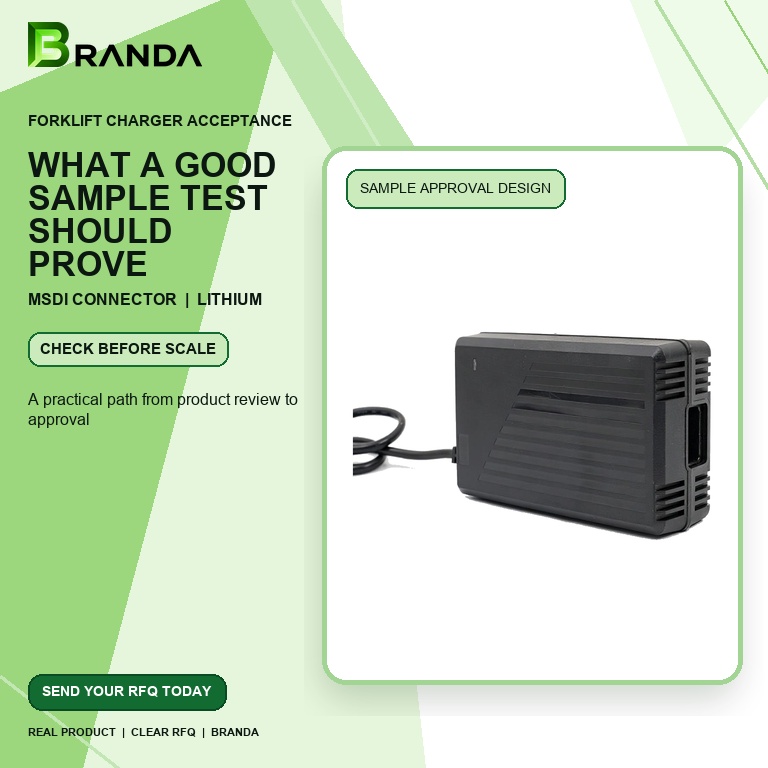
A detailed acceptance guide for a black forklift charger with a gray inline connector, covering configuration control, battery matching, electrical testing, cable routing and production release.
A good acceptance test starts before anyone plugs in
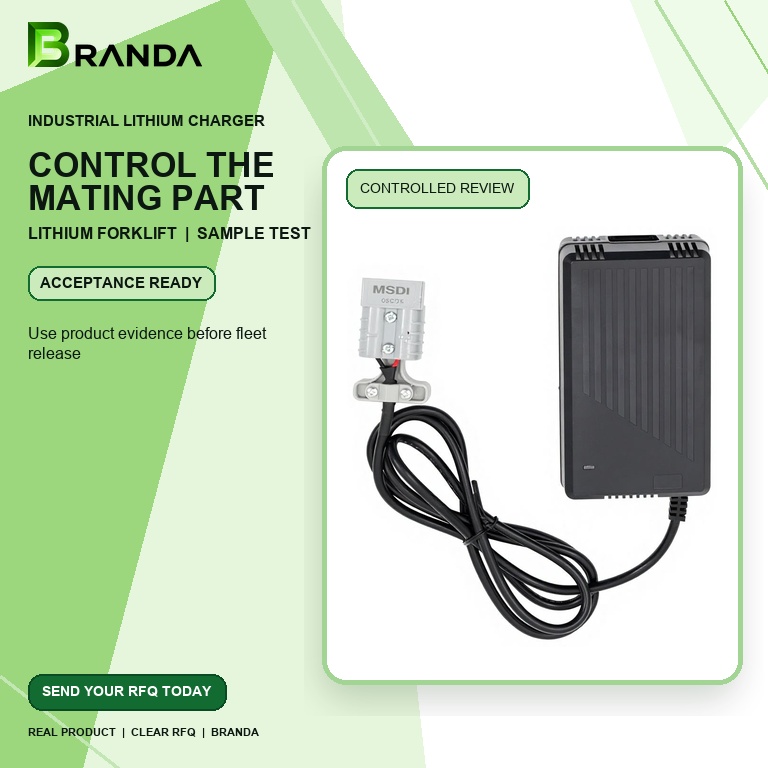
The first thing we do with a charger sample is photograph the label and write the model and revision on the test sheet. That habit sounds simple, but it prevents a common failure in multi-model projects: two black housings sit on the same bench, one cable is moved, and the record no longer proves which unit was tested. The Branda 322400005 image pack shows a black charger enclosure, a long cable and a gray inline connector with an MSDI marking visible on the connector body. The image is a useful product reference. The acceptance test still has to prove the configuration.
Acceptance is not only a meter reading. The buyer needs to know that the input version is right, the battery connection is controlled, the cable reaches the real forklift, the connector can be used without pulling on the wire, and the product behaves acceptably after the planned duty window. A lithium forklift battery charger may be electrically sound on a bench and still create a service problem beside a battery cover. That is why we test in the order the operator works.
| Sample item | Visible reference in the supplied images | Acceptance boundary |
|---|---|---|
| Housing | Black vented charger body | Dimensions, clearance, airflow and mounting position |
| Connector | Gray inline connector with MSDI marking visible | Exact part, mating half, polarity and retention |
| Cable | Black cable with a long service loop | Measured length, route, bend and strain relief |
| Indicator | Small indicator area on the charger body | Meaning of each status and the label |
| System use | Forklift or logistics charger reference | Battery approval, charge method and duty cycle |
Project note: The supplied Branda 322400005 image pack does not include a complete electrical datasheet. Exact voltage, current, rated power, charge profile, communication, certification and environmental claims must be confirmed in the formal project documents.
Freeze the configuration before the test
Write the model, revision, input version, cable length, connector description, label artwork and packaging version on the first page. Photograph both sides of the charger and the connector. If there is a battery-side drawing, attach it to the same record. If there is no drawing, mark that as an open item rather than relying on the connector photograph. A photograph can show shape and color; it rarely proves pin assignment or electrical suitability.
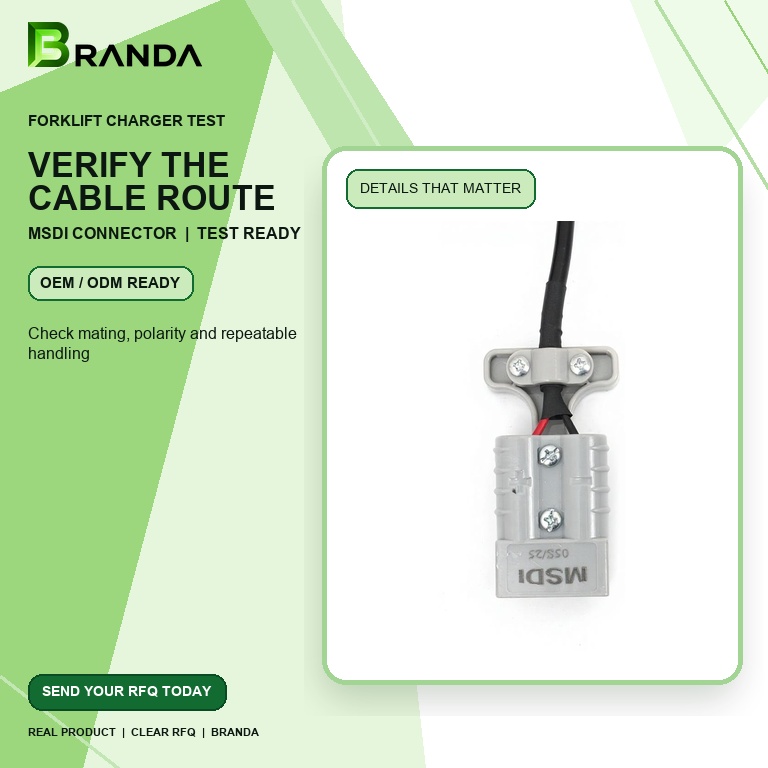
The gray inline connector deserves a close inspection because an inline connection has a different service pattern from a clamp. The operator may connect it by aligning the mating halves, pressing until the latch engages and then routing the cable. The drawing should show the mating direction and the release method. If the product is used in a tight battery compartment, the release tab and cable exit may matter more than the housing itself.
Ask the person who will maintain the forklift to perform the connection. Do not let the product designer do every step. A designer knows the connector; a technician knows the place where a glove catches, a cover presses, a cable gets bent or a connector is stored under a tool. The acceptance record should capture those comments without turning them into an accusation. The purpose is to make the finished configuration easier to use.
| Pre-test check | Action | Evidence |
|---|---|---|
| Identity | Match model and revision to the approved quotation | Label photo and signed sheet |
| Connector | Photograph the face, latch, cable exit and markings | Connector photo set |
| Mating part | Confirm the battery-side half and keying | Drawing or open-action note |
| Cable | Measure the actual lead and inspect strain relief | Measurement photo |
| Housing | Check vents, screws, seams and indicator area | Visual inspection |
| Documents | Confirm work instruction and warning label | Document revision |
Test the input before judging the output
The input condition should be written down before the charger is connected to the battery. The product image does not establish the final input range. The project document should state the intended voltage, frequency, plug and protection arrangement, and the site should be measured. If the warehouse supply does not match the sample, stop the acceptance test and resolve the variant. A new plug does not automatically create a new input design.
we also record the test instrument and the time. If the sample is checked on a convenient bench supply, that is fine for an engineering investigation, but the record should say so. If the customer wants approval for a real 100-120Vac or 200-240Vac site, the test should use the confirmed configuration. This distinction matters when a charger later travels to another market or when several stations share the same electrical circuit.
The Branda logistics lithium equipment charger page describes the relevant product category, while the OEM/ODM service page is the better place to state a different plug, input version, cable, label or packaging requirement. Keep the final input statement tied to the sample revision.
Define the load before you record a number
A line such as tested under load is too vague for a supplier acceptance record. Name the load, the battery, the state of charge, the input condition and the duration. Record voltage, current and any tapering that occurs. If the battery management system limits the current, write that down. The goal is not to force one number into every situation. The goal is to make the result repeatable for the next person.
If a buyer asks for a continuous power rating, the project should define how it is measured and for how long. A product image cannot answer that question. Nor can a nominal output label answer whether the battery accepts the full current at every state of charge. A good acceptance test separates charger capability, battery acceptance and system behavior instead of blending them into one optimistic sentence.
| Electrical record | Write this down | Why it matters |
|---|---|---|
| Input | Voltage, frequency, plug and test point | Shows the condition used |
| Load | Battery or named electronic load | Makes the result repeatable |
| Output | Voltage, current and duration | Shows actual observation |
| Battery state | State of charge or battery condition | Explains current changes |
| Indicator | Status before, during and after charge | Supports operator instruction |
| Stop event | What caused the test to end | Clarifies recovery and limits |
The connector and cable can fail the sample even when the meter passes
The gray inline connector is easy to focus on because it is the part the operator touches. Inspect the body, latch, screws, insulation, cable exit and the mating surface. Check whether the connector can be inserted in the intended direction and whether the release action is clear. If the connector has a keyed shape, record the keying. If it has a polarity marking, record where the marking is visible when the operator reaches the battery.
Then route the cable on the real forklift. Put the battery cover through its normal motion. Move the truck or simulate the normal parking position. Look for a tight bend at the charger outlet, a cable that falls into a wheel path, or a connector that is pulled sideways because the station is one step too far away. These are not cosmetic issues. A material handling battery charger depends on a cable that survives the movement around it.
we also ask the technician how the connector is stored after disconnecting. Some teams hang it on a hook; others put it on the charger shelf. If the connector is left on the floor, contamination and impact become part of the risk. A small bracket, a cable tie or a revised service loop may be a better change than a more impressive marketing line. Acceptance should make the next shift easier.
| Inline connector check | Observation | Release action |
|---|---|---|
| Mating | The connector reaches the battery without stretching | Approve route or revise cable |
| Latch | It engages and releases with the intended hand motion | Confirm instruction and force |
| Polarity | The drawing and marking agree | Lock the connector revision |
| Retention | It remains engaged during normal handling | Repeat cycle or redesign |
| Cable exit | No pinch, sharp edge or wheel path | Add service loop or holder |
| Storage | The connector has a clean place between uses | Add station accessory if needed |
Thermal review belongs beside the battery
A charger can look cool on an open table and behave differently in a cabinet, under a shelf or beside a warm battery. For Branda 322400005, write the ambient condition, the charger position, the battery condition and the duration of the run. Check the housing, vents, cable exit and connector after the planned duty window. If the customer expects repeated charges, repeat the cycle instead of stopping after the first few minutes.
The record does not need to pretend that one sample proves every environment. It should state what was tested. If the warehouse is dusty or humid, write that into the project review. If the unit will be installed inside a vehicle compartment, test the actual clearance. The phrase industrial lithium battery charger manufacturer describes a supplier category; it is not a substitute for an environmental requirement.
Branda 322400005 is reviewed around the real forklift charging station, not only on a bench. The battery information, input condition, gray connector, cable route and repeat-use evidence give a forklift charger manufacturer the boundaries needed for a controlled release.
A controlled acceptance decision
we keep the decision line simple: pass, conditional pass or fail. A pass means the controlled configuration met the agreed checks. A conditional pass names the remaining action. A fail says which requirement was not met and what must happen before another test. This wording reduces the temptation to call a sample approved because the housing looks good or because the output voltage appeared on a meter.
| Acceptance line | Pass example | Open action example |
|---|---|---|
| Model and revision | Matches the approved sample | Supplier to send corrected label |
| Input | Confirmed site variant used | Request alternate input version |
| Electrical | Named load and duration completed | Repeat with approved battery |
| Connector | Gray inline part mates and releases correctly | Confirm mating half drawing |
| Cable | Route avoids cover, wheel and sharp edge | Revise service loop |
| Thermal | Observed condition is within the project limit | Repeat in final cabinet |
| Packaging | Connector and cable arrive protected | Add packing insert |
Do not leave the last column empty. If a reviewer writes pending confirmation, assign the confirmation to a person and a date. If a buyer changes the connector after the test, reopen the connector and cable rows. If the battery changes, reopen the charge profile and output rows. Change control is not bureaucracy in this case. It is the memory of the sample.
How this supports OEM and ODM production
The project can start with a standard charger and still need a controlled custom configuration. The change may be the gray inline connector, the cable length, the label, the plug, the carton or the battery-side harness. Put each request into the quotation and the sample drawing. Ask which change is included, which is optional, which affects minimum order quantity and which requires an extra test.
If the buyer also wants charger PCB assembly or power supply PCB assembly, keep the board-level evidence in a linked but separate package. The board revision, BOM, component alternatives and functional test should be traceable to the finished charger revision. That separation is useful when a board component changes but the operator-facing connector and cable remain the same. It is also useful when the battery application changes and only the final system test needs to be reopened.
The Branda OEM/ODM page outlines a project path from requirement review and solution proposal to sample evaluation, approval, production and inspection. For a product such as Branda 322400005, that sequence gives the inline connector and cable route a clear place in the project instead of leaving them to the last packing review.
A complete test sheet for the forklift bay
- Model, revision, label and connector photograph are attached.
- The intended input voltage, frequency, plug and circuit are recorded.
- The load or battery setup is named and the output record includes time.
- The gray inline connector and mating half match the drawing.
- The cable route works with the battery cover and the normal parking position.
- The connector has a repeatable connection, release and storage step.
- Thermal observations were made after the planned duty window.
- Open actions have an owner, a due date and a new revision if needed.
- The accepted sample is referenced by the purchase order and repeat order.
Questions buyers ask before release
Does the image prove the electrical specification?
No. It proves the visible housing, cable and connector reference. Use the formal specification and the agreed sample test for voltage, current, rated power, charge profile and certification.
Can the gray connector be replaced?
It can be reviewed as an OEM or ODM change. The mating part, polarity, cable, strain relief, label and sample test should be reviewed together.
Is a manual inline connector suitable for an AGV?
Not automatically. An AGV forklift charger manufacturer must review the battery, docking position, control signal, interlocks and recovery behavior as an integration project.
What is the next step after acceptance?
Send the accepted sample record, battery data, connector drawing, site input and quantity through the Branda inquiry page. The contact page can be used when a technical review is needed before the purchase order.
Branda's forklift charger acceptance package should connect the product, battery and warehouse routine in one record. A lithium forklift battery charger is not approved by appearance alone; the forklift charging station, connector, cable route, input condition and repeat-use test all belong in the review. That is the level of detail a forklift charger manufacturer and a forklift battery charger supplier need before a repeat order.
The practical conclusion
Branda 322400005 is easiest to evaluate when it is treated as a complete working connection rather than a black box with a cable. The gray inline connector is a visible starting point. The important work is to prove the mating part, polarity, cable route, input condition, charge behavior and repeat-use routine. A careful sample record gives the buyer something solid to approve and gives the supplier a clear configuration to reproduce.
If we had to reduce the whole acceptance process to one sentence, it would be this: test the charger where the forklift works, with the battery information in front of you, and write down the part that still needs a decision. That sentence is less exciting than a universal performance claim, but it is much more useful when the first production shipment is already on its way.
Read the acceptance sheet as a story
A useful acceptance sheet tells the story of the sample from the first photograph to the final release. It says what arrived, what was connected, under which input it was tested, what the battery was doing, how the operator handled the gray inline connector and what remained open. If the sheet only contains a single output number, the reader cannot tell whether the sample was used in the intended way. The sequence matters because the charger is not used as an isolated component.
we like to mark the sheet with a simple timeline: received, inspected, powered, connected, run, stopped, cleaned and released. This makes it easier to compare samples from different suppliers. It also helps when a later question comes from the warehouse. Instead of searching through emails, the team can see the condition in which the charger was accepted and the exact connector and cable revision that were used.
The timeline should not hide uncertainty. If the battery state was unknown, say unknown. If the intended mating half was not available, say not tested. If the sample was checked on a lab load rather than a forklift battery, say lab load. Honest notes do not weaken a project. They show where a second test is needed and keep a reviewer from assuming more than the evidence supports.
| Timeline point | Question | Record format |
|---|---|---|
| Received | Did the sample arrive with the correct label and packaging? | Photos and packing note |
| Inspected | Are the housing, cable and connector undamaged? | Visual checklist |
| Powered | Was the intended input used? | Input reading and instrument |
| Connected | Did the gray inline connector mate correctly? | Mating and polarity note |
| Run | What load, battery and duration were used? | Electrical and thermal log |
| Released | Which open actions remain? | Pass or conditional-pass record |
When a sample needs a second round
A second sample is not automatically a failure. Sometimes the first sample proves the electrical platform and exposes a cable-route issue. Sometimes the customer changes the battery-side connector after the first operator review. Sometimes the input version was chosen from an early site assumption. The important thing is to say what changed and retest the affected rows instead of starting over without a record.
For example, if the gray inline connector changes but the housing and input stay the same, the second round should focus on mating, polarity, retention, service loop, operator release and any label or packing change. If the battery changes, reopen the charge profile and output tests. If the charger moves into a cabinet, reopen thermal and clearance checks. A targeted retest is faster and clearer than a generic statement that the new sample is similar.
The supplier should also receive the reason for the second sample. A request such as please improve it is difficult to act on. A request such as the connector latch is hard to release with gloves and the cable is pulled sideways at the battery cover gives the supplier a usable design boundary. The best feedback names the location, the action and the condition under which the problem appears.
Handover to maintenance and purchasing
Acceptance is complete only when the next team can identify the approved charger. Give maintenance the connector drawing, cable dimension, label photograph, cleaning note and isolation procedure. Give purchasing the model, revision, input, output, connector, cable, packaging, quantity and approved supplier scope. Give the warehouse a short operator instruction. The same product can be described differently for each team, but all three descriptions should point to the same controlled revision.
Keep a spare connector reference beside the charger record. If the gray inline connector is labeled with a specific family or part marking, copy that marking accurately from the approved drawing. Do not let the spare list be based on a photograph alone. If the project uses a custom cable, keep the length and strain-relief detail with the spare information. These small records prevent a replacement from becoming an unapproved configuration.
The purchasing team should also know which changes require a new acceptance. A new label may be a document review. A new input version is an electrical review. A new cable or connector is a mechanical and operator review. A battery change is a system review. A clear change matrix makes repeat orders faster because the team can reopen only the relevant checks.
| Change after approval | Minimum review to reopen | Owner |
|---|---|---|
| Label or warning text | Artwork, visibility and document check | Product and quality |
| Input or plug | Electrical condition and market document | Engineering and site |
| Connector | Mating, polarity, retention and operator step | Engineering and maintenance |
| Cable | Length, route, bend and packing | Engineering and warehouse |
| Battery | Charge profile, current and BMS boundary | Battery owner and engineering |
| Board assembly | BOM, revision and board test evidence | Electronics and quality |
What the buyer should ask for in a formal package
The formal package does not need to be large, but it should be complete enough to reproduce the approval. we would ask for the product drawing or controlled photograph, the electrical specification, the connector and cable definition, the input and plug information, the label artwork, the sample test record, the packing method and the list of open project assumptions. If certification is required, ask which document applies to which market and product revision.
The Branda contact page and inquiry page can be used to start that package. The OEM/ODM page is useful when the requirement includes a custom connector, cable, label, plug, packaging or board-level scope. The logistics charger category keeps the product tied to the material-handling application rather than a generic power-supply description.
A buyer should not be embarrassed to ask for a clarification before signing a purchase order. Ask what the sample proves, what it does not prove and what the next approval step is. Those three questions are especially useful when a project uses phrases such as industrial lithium battery charger manufacturer, forklift charger supplier or AGV forklift charger manufacturer. The words identify a market; the sample record identifies the actual product.
A post-approval review after the first shipment
After the first shipment reaches the warehouse, ask for one short review. Did the packaging protect the connector? Did the cable arrive without a sharp bend? Could the operator find the approved mating point? Did the charger sit where the drawing expected it to sit? Were any labels difficult to read? The answers can be added to the supplier scorecard and the next order without reopening every part of the project.
If a problem appears, capture it with the same language used at acceptance. Say which model and revision were involved, where the problem appeared, under what input and battery condition it happened, and whether the issue is electrical, mechanical, operator or packaging related. A careful first report helps the supplier respond. A general message that the charger is not good usually creates another round of questions before anyone can act.
The real goal of acceptance is not to make a document look complete. It is to create a repeatable handover from supplier to warehouse. When the model, connector, cable, input, battery and test conditions are connected in one record, a buyer can scale with more confidence and a supplier can reproduce the same configuration with fewer surprises.


