

Forklift charger acceptance test: the notes I keep
The sample is on the workbench. Before anybody plugs it in, I take a photo of the label and write Branda 321440002 on the test sheet. The file says 29.6V, 6A and 144W. It also shows a 100-120Vac input, a 200mm lead and a black inline connector. Good. Now I want to see what happens next to the forklift.
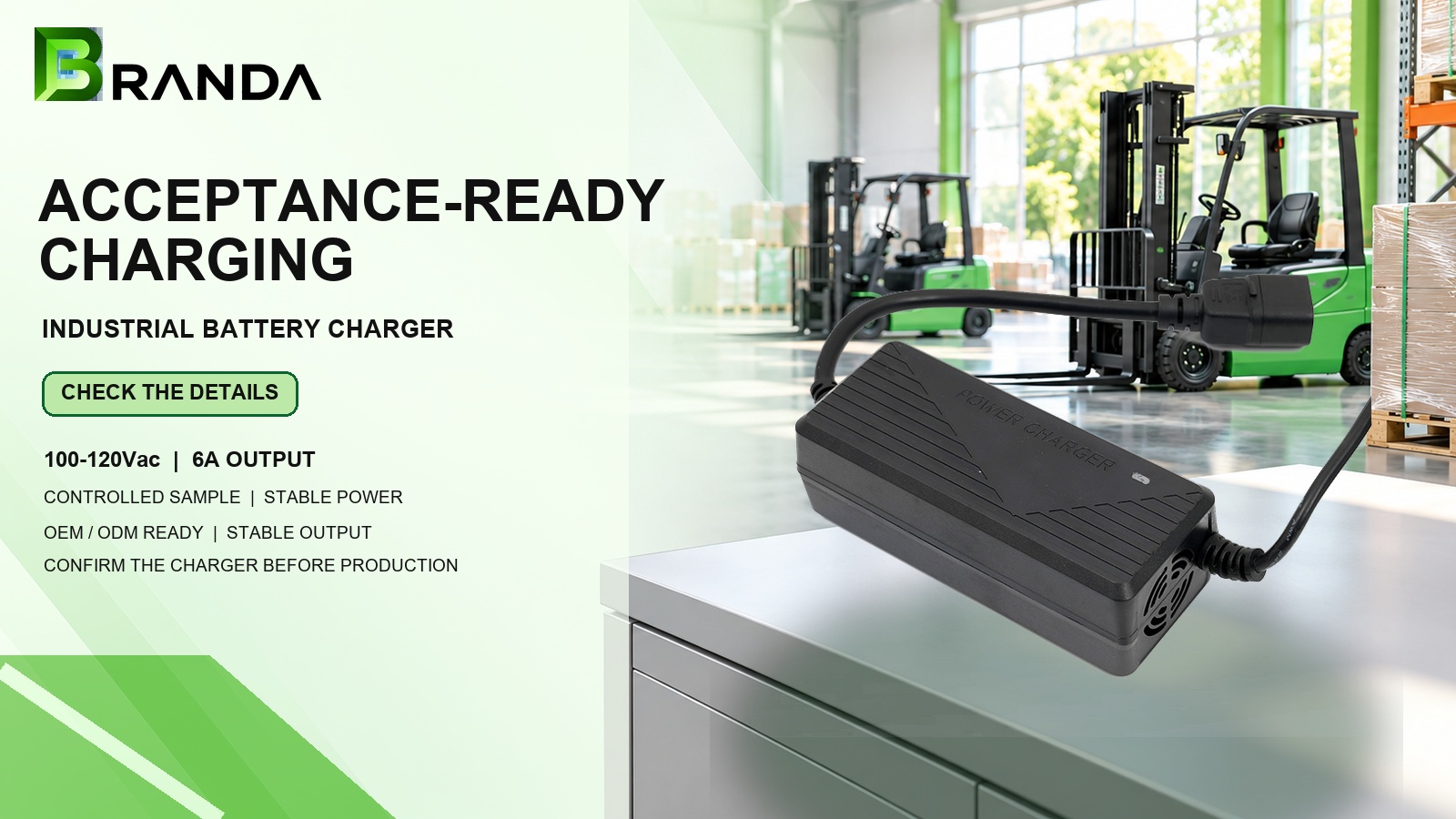
| Product detail | 321440002 reference | What I still check |
|---|---|---|
| Output | 29.6V / 6A / 144W | Named load and test condition |
| Input | 100-120Vac, 50-60Hz | Site outlet |
| Connector | Black inline | Mating part and polarity |
| Cable | 200mm | Real route beside the forklift |
I ask the technician to use the charger as he normally would. No coaching at first. He checks the housing, finds the connector, opens the battery cover and tries the cable. That short walk from the bench to the truck tells me more than a neat product picture. If the technician says, “I have to hold the cover with one hand,” I write it down. That is a real use issue, not a wording issue. Is the connector easy to reach? Does the lead fall where a wheel can catch it? Does the cover press on the cable? We write down the awkward part instead of pretending it is not there.
The input check is not complicated. The intended outlet must match the 100-120Vac version shown in the file. If the site is 220-240Vac, I stop and ask for the right charger variant. A new plug is not a new input design. I record the outlet, frequency and label before continuing.
For the electrical run, I write the load and the time on the sheet. 29.6V times 6A gives 177.6W on paper, while the file calls the unit 144W. That is not a reason to guess. It is a reason to write the test condition clearly. “Tested under load” is not enough. The next person should know which load, which battery and which input produced the reading.
Then I use the black connector again. I look at the mating part, polarity, retention and the cable exit. I ask the operator to disconnect it. Does he hold the body or pull the wire? A small service-loop change can be worth more than another page of general quality language. This is a material handling battery charger; the cable is part of uptime.
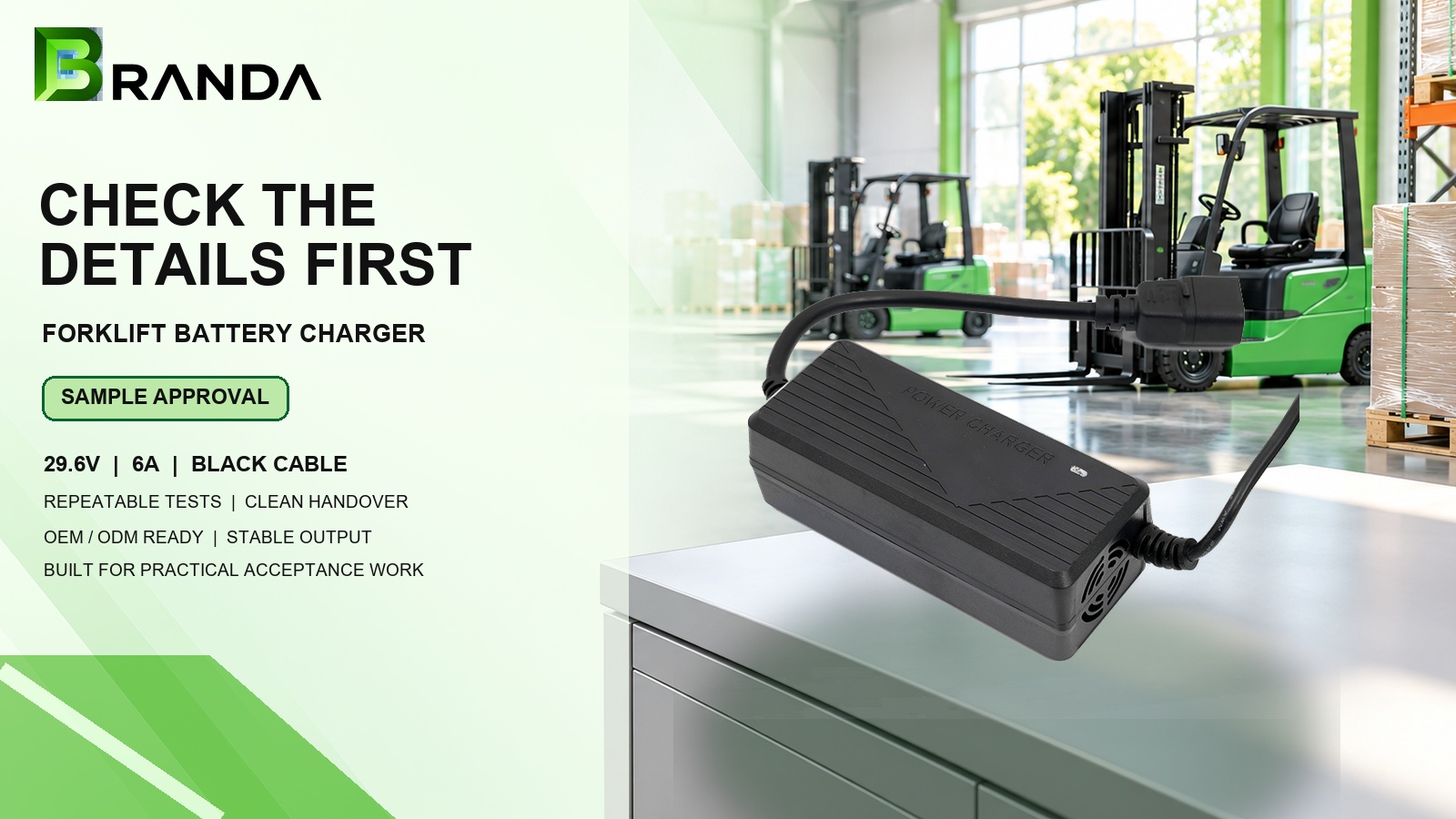
My final note has three choices: pass, conditional pass or fail. If the cable route is still open, I write the owner's name and a date. “Pending confirmation” goes nowhere. The purchase order should carry the approved model, input, output, connector, cable, label and packing details. I also ask the next shift to read the label. Two similar boxes should not depend on memory.
If charger PCB assembly or power supply PCB assembly is part of the project, I keep its BOM and test evidence in a separate package and link it to the finished charger. The Bolanda OEM/ODM process is useful for separating board work from the finished forklift charger.
An AGV request is another discussion: battery, docking, control and recovery have to be reviewed. A manual inline connector is not automatically an AGV system. That is why I would keep the phrase AGV forklift charger manufacturer tied to a real integration requirement rather than using it as a blanket product claim. Send the test plan and battery information through the Bolanda inquiry page before production.


