

Forklift battery charger RFQ: what I would ask before buying
I would not place an order for a forklift battery charger from the model number alone. The file for 321200007 is useful, though. It gives us 29.6V, 5A, 120W, a 200-240Vac input and a blue clamp connection. That is enough to start a conversation with an industrial lithium battery charger manufacturer. It is not enough to skip the battery check.
The first thing I ask a customer is simple: which battery will this charger connect to? Please send the battery label, but send the battery specification as well. The label may say 29.6V. It may also say 24V, 25.6V or something else. Those numbers do not tell the whole charging story. We still need the chemistry, capacity, permitted charging current and the battery maker's instructions. If there is a BMS, I want to know whether the pack accepts a standalone charger or waits for a signal.
Here is the short version of the branda 321200007 file.
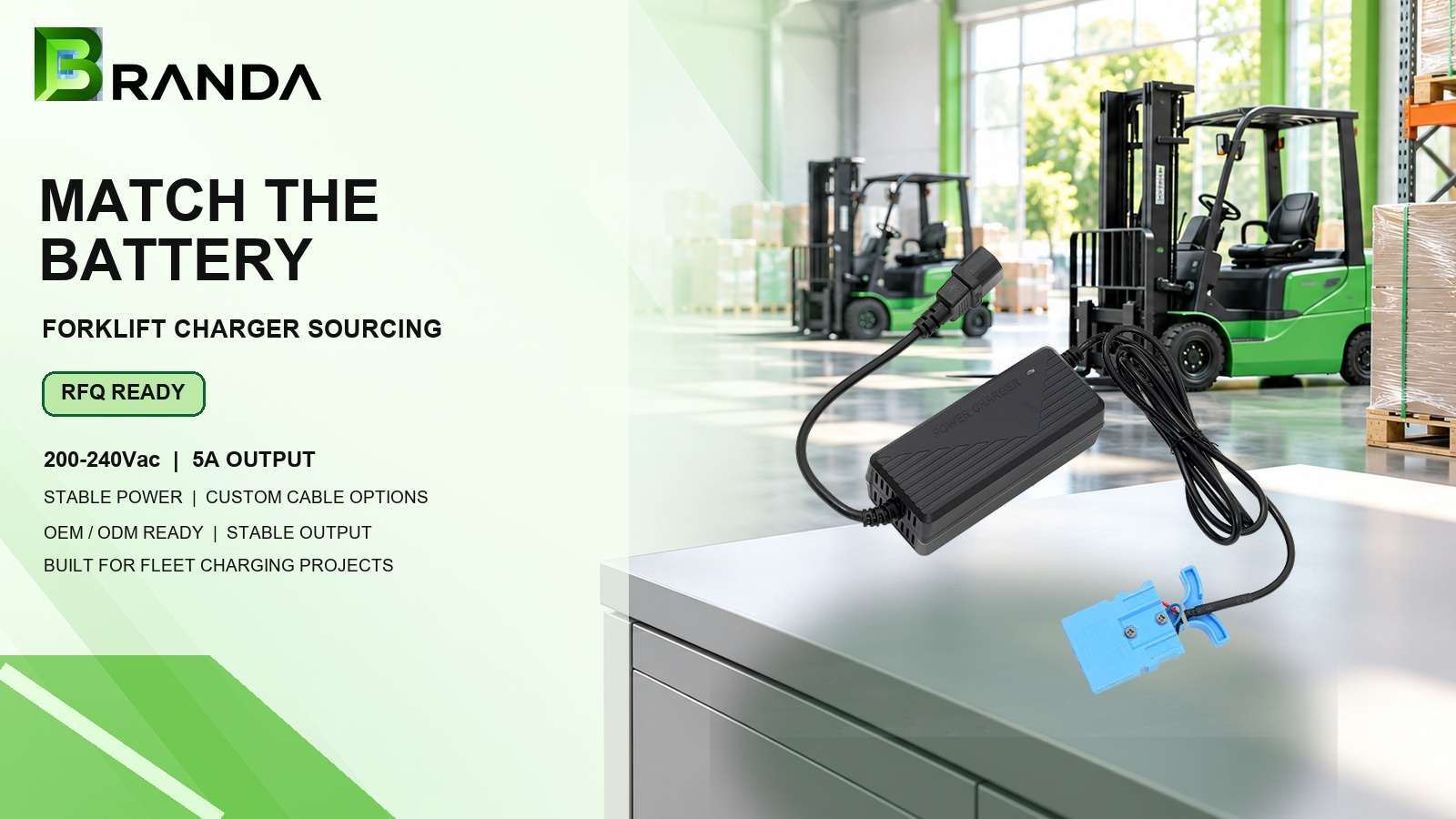
| Product detail | 321200007 reference | Still to be checked |
|---|---|---|
| Output | 29.6V / 5A / 120W | Battery maker approval |
| Input | 200-240Vac, 50-60Hz | Site supply and plug |
| Connection | Blue clamp-style | Polarity and mating point |
| Cable | 200mm shown | Route beside the battery |
Product detail | 321200007 reference | Still to be checked
Output | 29.6V / 5A / 120W | Battery maker approval
Input | 200-240Vac, 50-60Hz | Site supply and plug
Connection | Blue clamp-style | Polarity and mating point
Cable | 200mm shown | Route beside battery
Product: 321200007
Output: 29.6V / 5A / 120W
Input shown: 200-240Vac, 50-60Hz
Connection shown: blue clamp-style connector
Cable shown: 200mm
I would put those five lines beside the battery reference in the RFQ. That prevents a very ordinary mistake: someone changes the battery later and keeps the old charger because the housing looks the same.
The charging window matters too. A warehouse manager may say “we need fast charging,” but what does that mean here? Is the truck parked overnight? Does it come back during a 30-minute break? Are three vehicles sharing one outlet? If 30Ah has to be returned and 5A is the current-only estimate, the simple arithmetic says six hours. Real charging can take longer because current may taper and the battery may limit acceptance. I would use six hours as a planning number, not as a promise.
A small note in the RFQ saves time later:
- number of forklifts using the station;
- battery state when the truck returns;
- hours available for charging;
- whether the charger is inside, dusty, damp or hot;
- who connects the blue clamp;
- where the cable is expected to run.
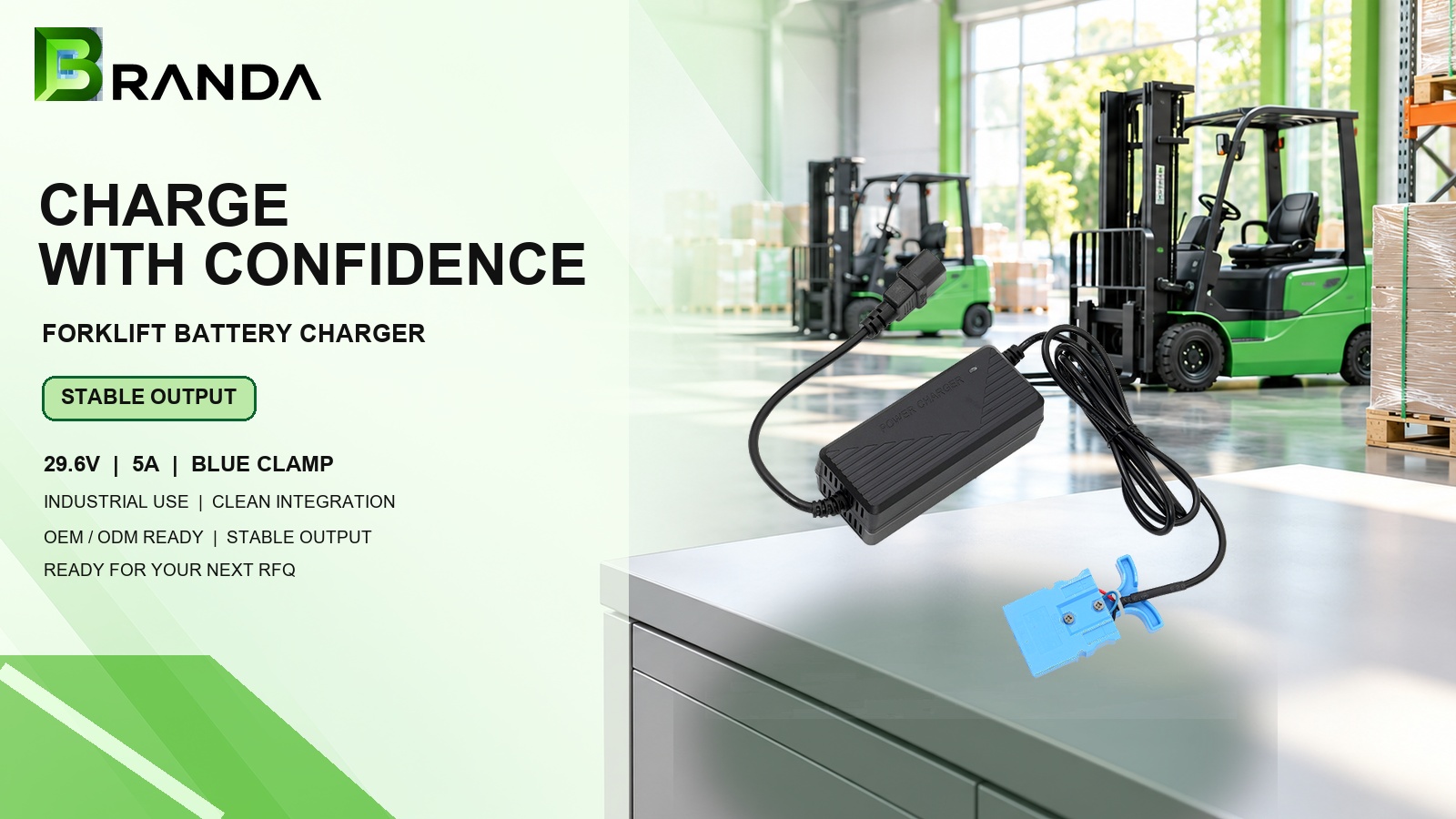
The last two points are easy to ignore. They should not be ignored. A 200mm cable may fit one battery compartment and be awkward in another. A blue clamp is easy to see, but colour is not polarity. The drawing still needs positive and negative identification, the mating point and a clear work instruction. Let a technician connect it on the actual forklift, not only on a clean sample bench. Check the cable around the battery cover and wheels. A charger can have the right output and still be a poor fit for the working area.
I also check the site input before asking for a quote. The file shows 200-240Vac, which fits many 230Vac warehouses. I would still record the measured voltage, frequency, plug and circuit arrangement. If several chargers are on one circuit, that belongs in the conversation. If the customer is in another market, the input variant, plug, label and documents should be reviewed together. A broad input number is not the same as a blanket certification claim.
For a first sample I would record the model, revision, label, input, output, connector and cable. Then I would check the output under a named load, look at the connector after the planned charging window and write down anything awkward about the cable. “Looks good” is not an approval note. “Electrical check passed; service loop needs 80mm more” is useful.
Connector, label, cable, packaging and input variants are reasonable OEM/ODM discussion points. Board-level work, such as charger PCB assembly or power supply PCB assembly, should be listed separately from approval of the finished forklift charger. For a review, send the battery specification, vehicle information, site input, charging hours, connector drawing, quantity and target market through theBranda inquiry page. The final battery fit and certification scope still need project confirmation. The contact page and logistics lithium equipment charger category are useful starting points.


