

Power tool charger compatibility is decided by four things, not by whether the battery slides onto the charger: the mechanical interface, the voltage window, the charge-control scheme and the temperature-sensing circuit. A charger from another brand will usually refuse to charge a pack it was not designed for, and a slide-on adapter does not change that. Matching all four layers — or buying a charger built for your exact pack — is the only reliable route.
The four layers below explain what battery charger compatibility actually requires, and the seven checks at the end are the version to run before you plug in a pack from another brand.
What power tool charger compatibility really means
A charger is a power supply with a termination strategy. Compatibility means the pack can accept what the charger delivers, and the charger can stop when the pack says stop. Four layers have to line up at the same time:
| Layer | What it covers | What happens if it does not match |
|---|---|---|
| Mechanical interface | Slide rails, latch, contact block position, keying ribs, signal contacts | The pack will not seat, sits loosely, or contacts only part of the terminal block |
| Electrical rating | Nominal voltage, maximum charge voltage, charge current | Undercharge, overcharge, BMS lockout, or a pack that never reaches full |
| Charge control | Whether the constant-current/constant-voltage curve runs in the charger or in the pack's BMS | No termination, repeated restarts, or a charger that never recognises the pack |
| Thermal and protection | Temperature sensor (NTC) contact, cut-off logic, overcurrent and short-circuit protection | Charging continues on a hot or faulty pack with no safety backstop |
Most "it fits but will not charge" complaints fail at the third or fourth layer, not the first. That is why a visual comparison of two battery slots proves very little.
Layer 1: The interface is keyed, not universal
Every power tool battery platform is a closed system by design. The plastic rails, the latch position, the height of the contact block and the spacing of the terminals are all part of the brand's tool ecosystem, and they are usually patented or at least deliberately different. Even where two brands use a similar five-cell pack, the ribs that guide the pack into the charger are frequently offset by a few millimetres.
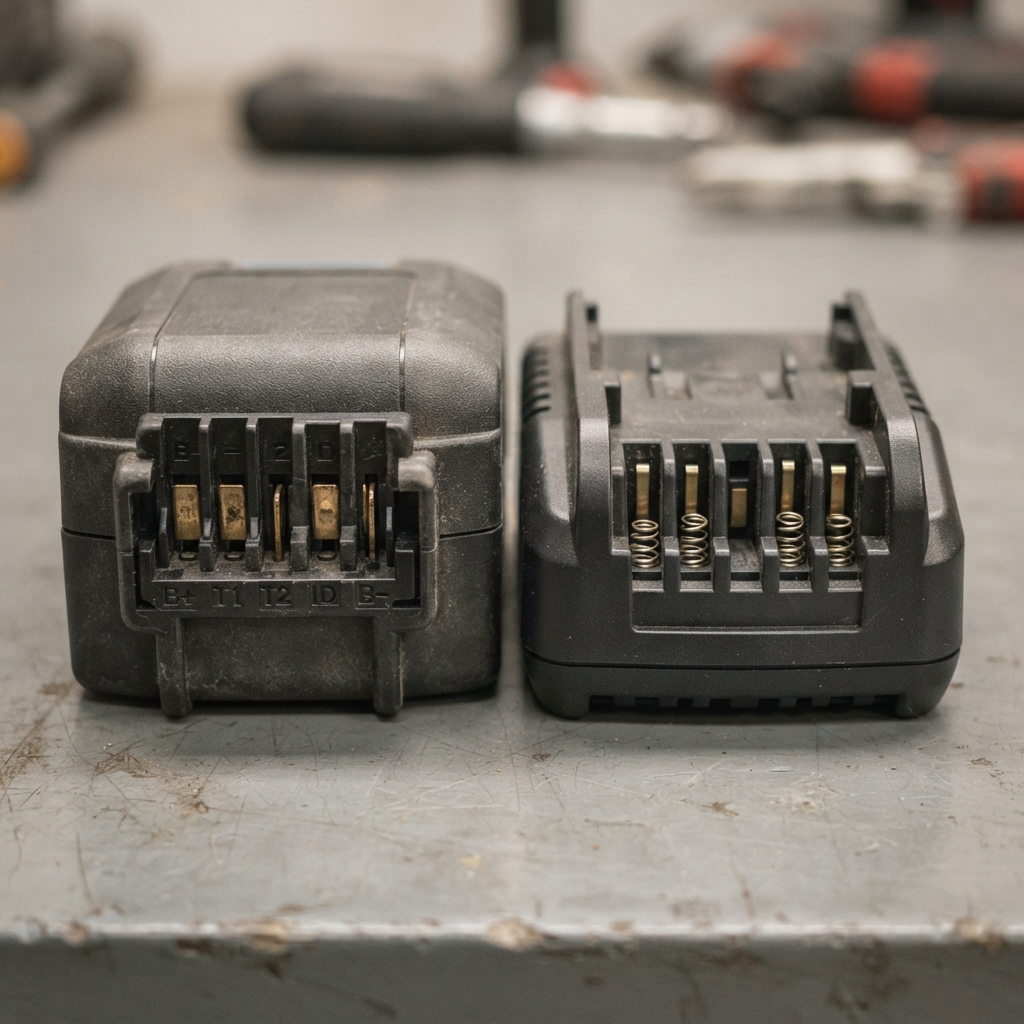
Two practical consequences follow. First, a pack that seats with force is not seated correctly; forcing it bends the contacts and creates resistance at the terminal, which is a heat source. Second, the number of contacts matters. A two-contact block carries only positive and negative, while a four- or five-contact block usually adds a temperature sensor and, on some platforms, an identification or communication pin. A charger that expects those signals will not start without them.
Layer 2: Charger voltage matching — 12V, 18V and 20V MAX
Voltage is the layer buyers misread most often, and where most power tool charger compatibility decisions are actually lost, because marketing names and electrical reality diverge. A lithium-ion cell charges to about 4.2 V, so the pack's full-charge voltage is the cell count multiplied by 4.2 V, while the nominal voltage is the cell count multiplied by 3.6 V.
| Platform label | Cells in series | Nominal voltage | Full-charge voltage | Typical charger output label |
|---|---|---|---|---|
| 12V | 3 | 10.8V / 12V | About 12.6V | 12.6V |
| 18V / 20V MAX | 5 | 18V | About 21V | 20.8–21.2V |
| 36V / 40V MAX | 10 | 36V | About 42V | 42V |
This is why "20V MAX" and "18V" describe the same five-cell platform, and why a charger labelled 21 V belongs to that platform while a 42 V unit belongs to the 36V/40V class. A charger whose output window does not reach the pack's full-charge voltage can never fill it; one whose window sits above it will drive the pack into protection.
Charger voltage matching therefore starts with the cell count, not the marketing name. If you are shopping for an 18V battery charger, the label to compare is the output window: a 20V MAX battery charger rated 20.8–21.2 V is the five-cell unit, and it will not fill a three-cell pack correctly.
A real product shows how specific this gets. Our HR18C battery charger is rated 18 W with a 12.65–13.1 V output at 1.25–1.55 A, fed by 90–264 V AC input at 47–63 Hz. That output window is built for a three-cell 12 V pack — it is not an 18 V charger, despite the model name. The lesson for buyers is to read the output voltage on the label, never the model number or the marketing category.
Layer 3: Who controls the charging curve?
Lithium packs are charged in two stages: constant current until the pack approaches full charge, then constant voltage while the current tapers. Someone has to measure the pack and decide when to switch and when to stop, and manufacturers split that job in two different ways.
In a charger-managed design, the charger holds the algorithm and reads the pack's voltage and temperature directly. In a pack-managed design, the battery's own BMS controls the FETs and the fuel gauge, and the charger is closer to a constant-voltage source with a current limit. Neither is better, but they are not interchangeable. A pack expecting a managed charger may accept a dumb supply and never balance; a pack with an integrated BMS may simply refuse to open its FETs for a charger that cannot complete the handshake.
The distinction matters when you compare a lithium battery charger from one brand with a pack from another: the charger may be a complete charging system, or only half of one.
This is the layer where cross-brand experiments most often fail silently: the indicator light comes on, nothing charges, and the pack is no better or worse afterwards.
Layer 4: Temperature sensing and protection
The NTC temperature sensor is the safety layer that adapters most often drop. A pack under fast charge heats up, and a cell that is already hot — after a long cut, or left in the sun — should not accept full current. The thermistor inside the pack reports that condition through an extra contact, and the charger is supposed to reduce current or pause.
Household charger safety is addressed by IEC 60335-2-29, which covers battery chargers for household and similar use with an output not exceeding 120 V ripple-free DC (IEC 60335-2-29:2016+A1:2019). The tool side sits under the EN 62841-1 family for motor-operated hand-held tools (EN 62841-1:2015). Neither standard makes a charger compatible with an arbitrary pack; both assume the charger was assessed with the battery it is sold with.
What a cross-brand battery adapter usually bypasses
Adapters are mechanical converters. They move the contacts, and in most cases that is all they move.
| Function | Carried by a matched charger | Typical adapter | Practical consequence |
|---|---|---|---|
| Positive and negative power | Yes | Yes | The pack may charge, which is what makes the setup feel safe |
| Temperature sensor (NTC) | Yes | Often not connected, or connected to the wrong pin | No thermal cut-off; a hot pack keeps charging |
| Pack identification / communication | Yes | Usually absent | Charger may refuse to start, or default to a conservative profile |
| Latch and retention | Matched | Approximate | Vibration loosens the pack; arcing pits the contacts |
| Voltage window | Matched to the pack | Whatever both ends happen to be | A 12 V pack on a 21 V charger, or the reverse |
That is the practical reason a cross-brand battery adapter is a gamble: it makes the pack fit without making the pair compatible. An adapter is only defensible when the maker documents that it carries the temperature signal and is rated for both the pack and the charger. A moulded plastic block sold without that documentation is an unknown circuit, and the first charge is the experiment.
Seven checks before you charge another brand's battery
- Read both labels. Write down the pack's nominal voltage, full-charge voltage and capacity, and the charger's output voltage and current. If either label is unreadable, stop.
- Count the cells. Divide the pack's full-charge voltage by 4.2 V. Three cells means a 12 V platform, five means 18V/20V, ten means 36V/40V. The cell count must match the charger's window.
- Compare maximum charge voltage, not marketing volts. A charger that tops out below the pack's full-charge voltage will never finish the charge properly.
- Inspect the contact block. Count the contacts on both sides. If the pack has more contacts than the charger's block can reach, a signal is being abandoned.
- Establish who terminates the charge. Ask the pack supplier whether the BMS controls charging or expects a managed charger. Without an answer, treat the pair as incompatible.
- Check the current against the pack's limit. Charging at 0.5C to 1C is the usual comfortable band for tool packs; a charger rated above the pack's stated maximum charge current is the wrong charger, not a faster one.
- Confirm documentation for the combination. Ask for the test reports covering the charger and the specific pack, not the charger alone. If the supplier cannot name the pack it was assessed with, the combination is untested.
If any one of the seven answers is unknown, the safe decision is not to charge. Power tool charger compatibility is a property of the pair — charger plus pack — and not of either part on its own.
When mixing platforms is reasonable
There are two legitimate cases. The first is a single manufacturer supplying both the pack and the charger under different brand names — common in private-label programmes, where the interface and the charging profile are the same product with different labels. The second is a charger explicitly sold by the tool maker for that pack, including adapters with electronics inside that the maker supports.
Everything else is a compromise. If your workshop runs two platforms, the practical answer is two chargers and a clear labelling rule, not one charger and a box of adapters. Our guide to matching charger power to battery capacity walks through the current and charge-time arithmetic, and the smart charger selection guide covers what a managed charger should monitor when several packs share a bench.
Charger compatibility for OEM and private-label programmes
For buyers sourcing chargers rather than choosing one off a shelf, power tool charger compatibility is a specification exercise, not a visual one. Brandapcba Electronics is a Ningbo-based electronics manufacturer that has supported B2B projects since 2003, with engineering coordination, assembly, production testing, inspection, certification support and delivery coordination for export programmes.
The starting document is the battery specification, not a photograph of a connector. A workable enquiry states the chemistry, nominal voltage, maximum charge voltage, capacity and maximum charge current; the connector model or a dimensioned drawing with pinout and polarity; whether the pack's BMS expects a managed charger or a fixed supply; the NTC curve if a temperature contact is used; the destination market and its mains voltage; and the documents the market requires. The battery charger OEM/ODM buyer guide sets out the rest of the project paperwork.
Models such as the HR18C show the level of detail involved: an 18 W output, a 12.65–13.1 V window, 1.25–1.55 A, 90–264 V AC input and listed output overcurrent and short-circuit protection, with market documentation requested for the exact model and configuration. Whether that unit suits a given pack still depends on the pack's own limits — the datasheet pair is the evidence, not the product photo.
Common mistakes that damage packs
- Treating "20V" as a universal voltage. It identifies a five-cell platform, not a connector or a charging profile.
- Buying the adapter first. The adapter is the cheapest part of the system and the one that removes the safety signals.
- Ignoring the temperature contact. A charger that cannot see the NTC is charging blind.
- Assuming a bigger charger charges faster. Current is limited by the pack, and a charger above that limit simply runs into the BMS.
- Assuming compatibility is a charger feature. Power tool charger compatibility depends on the pack as much as the charger; the same unit can be right for one pack and wrong for another.
- Charging a hot pack. Let a pack that has just finished a heavy cut cool to near room temperature first.
- Leaving packs on the charger for days. Remove them once the charge completes; storage at partial charge is kinder to the cells.
Frequently asked questions
Can I use a different brand's battery in my power tool charger?
Generally no. Power tool charger compatibility is designed per platform: the interface, voltage window, charge-control scheme and temperature sensing are one system. Even when a pack can be made to seat, the charger has no way to verify the pack's limits, so the safe assumption is incompatibility unless the charger maker documents support for that exact pack.
Are 18V and 20V MAX batteries the same platform?
Yes in most cases. Both describe a five-cell lithium pack: 18 V nominal and about 21 V at full charge. The difference is marketing. What matters is the full-charge voltage and the interface, not the number on the label.
Will a 20V charger charge an 18V battery?
If both are five-cell packs on the same interface, the voltage window matches and the charge can proceed. It will not work across cell counts: a 21 V charger cannot properly charge a 12 V three-cell pack or a 42 V ten-cell pack.
Is it safe to use a cross-brand battery adapter?
Only when the adapter carries the temperature sensor and is rated for both the pack and the charger, and the maker documents it. Most low-cost adapters pass only positive and negative, which removes the thermal cut-off and any pack identification.
Why does my charger flash red with a new battery?
The usual causes are poor contact at the terminals, a pack voltage outside the charger's window, an open or missing temperature sensor, or a BMS that has latched after a fault. Clean the contacts, reseat the pack, and test the pack on a charger known to work with it before assuming the charger has failed.
Can I charge a lithium pack on a NiCd charger?
No. Nickel-cadmium chargers use a different termination method and have no cell-balancing or per-cell protection for lithium packs. The reverse is equally unsafe: a lithium charger must never be used on a nickel-cadmium pack.
What output voltage should a charger have for an 18V pack?
About 20.8–21.2 V for a five-cell pack, which is the full-charge voltage of 5 × 4.2 V. Confirm against the pack's own datasheet, because some packs specify a slightly different maximum charge voltage.
How do I verify compatibility for a bulk order?
Send the pack datasheet, connector drawing and BMS behaviour to the charger supplier, request the charger specification against those figures, then test samples on the actual packs before approving production. The test report should name both the charger model and the pack it was assessed with.
Conclusion
Power tool charger compatibility comes down to four matching layers and one habit: read the pack label before you read the charger's marketing name. Interface, voltage window, charge control and temperature sensing all have to agree, and an adapter that only moves two contacts leaves the last two layers unprotected. For a single user, that means one platform, one charger and no experiments on a hot pack. For a buyer, it means sending the battery specification first and asking the supplier to answer it in writing.
If you are matching a charger to a pack for a private-label or OEM programme, send the battery label, connector photo or drawing and destination market through our contact page, and we will review the configuration against the specification you provide.


