

Two electric vehicle chargers can look almost identical and still belong to different purchasing records. Branda 321440002 is a 29.6V, 6A and 144W reference for 100-120Vac, 50-60Hz input, with a 200mm US cord and a blue battery-side connector. That combination is easy to describe once the details are written together. It is easy to confuse when procurement remembers only “29.6V charger.”
This article uses the supplied reference for Branda 321440002. Confirm the battery and destination-market requirements before purchase.
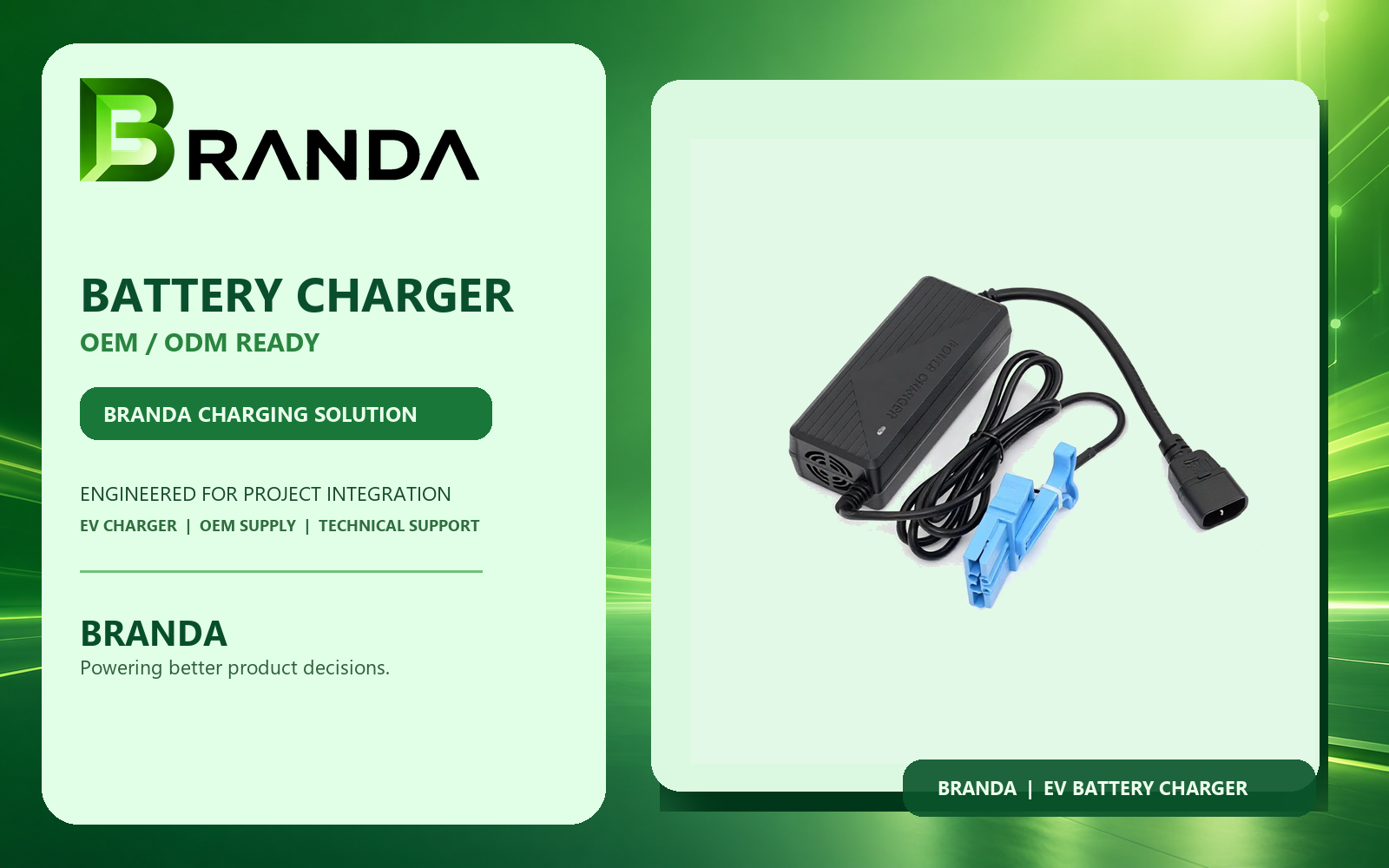
Quick specification record
| Field | Supplied reference | What the buyer should confirm |
|---|---|---|
| Model reference | Branda 321440002 | Keep the Branda prefix and label revision together. |
| Product family | Electric vehicle battery charger / power adapter | Match the battery and vehicle application. |
| Output | 29.6Vdc, 6A | Confirm the battery charge voltage and current limit. |
| Rated power | 144W | Use the approved test condition. |
| AC input | 100-120Vac, 50-60Hz | Confirm the site supply and market cord. |
| Cord | 200mm US cord | Measure the installed route. |
| Battery connector | Blue battery-side connector shown in the supplied product set | Approve the mating pair and polarity. |
Write the full configuration, not the family name
I would put the complete electrical and interface line on the quotation: Branda 321440002, 29.6Vdc, 6A, 144W, 100-120Vac, 50-60Hz, 200mm US cord and blue battery-side connector.
This is not needless paperwork. A red connector version can share the same black housing. A 200-240Vac version can share the same output. The details are what stop a similar-looking replacement from being sent to the wrong charging bay.
What the supplied photos tell us
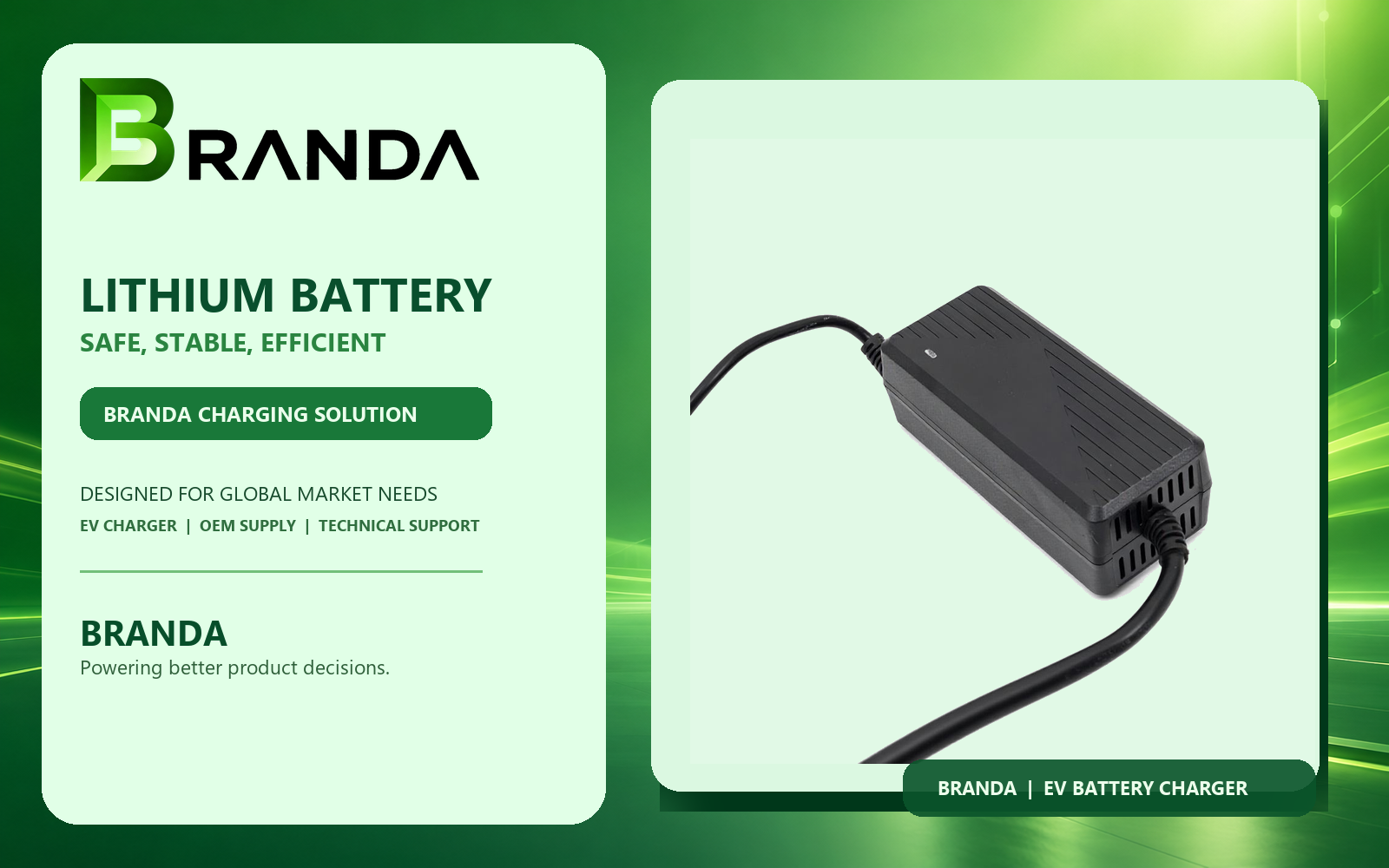
The product set shows the familiar black power-charger housing, ventilation openings, status indicator and blue battery-side interface. The specification page identifies the 6A29.6V reference as 144W with 100-120Vac input.
The images help with identity and layout. They do not replace the battery sheet. Before a buyer calls this an approved EV battery charger for a vehicle, the battery chemistry, full-charge voltage, BMS current limit and connector mating need to be recorded.
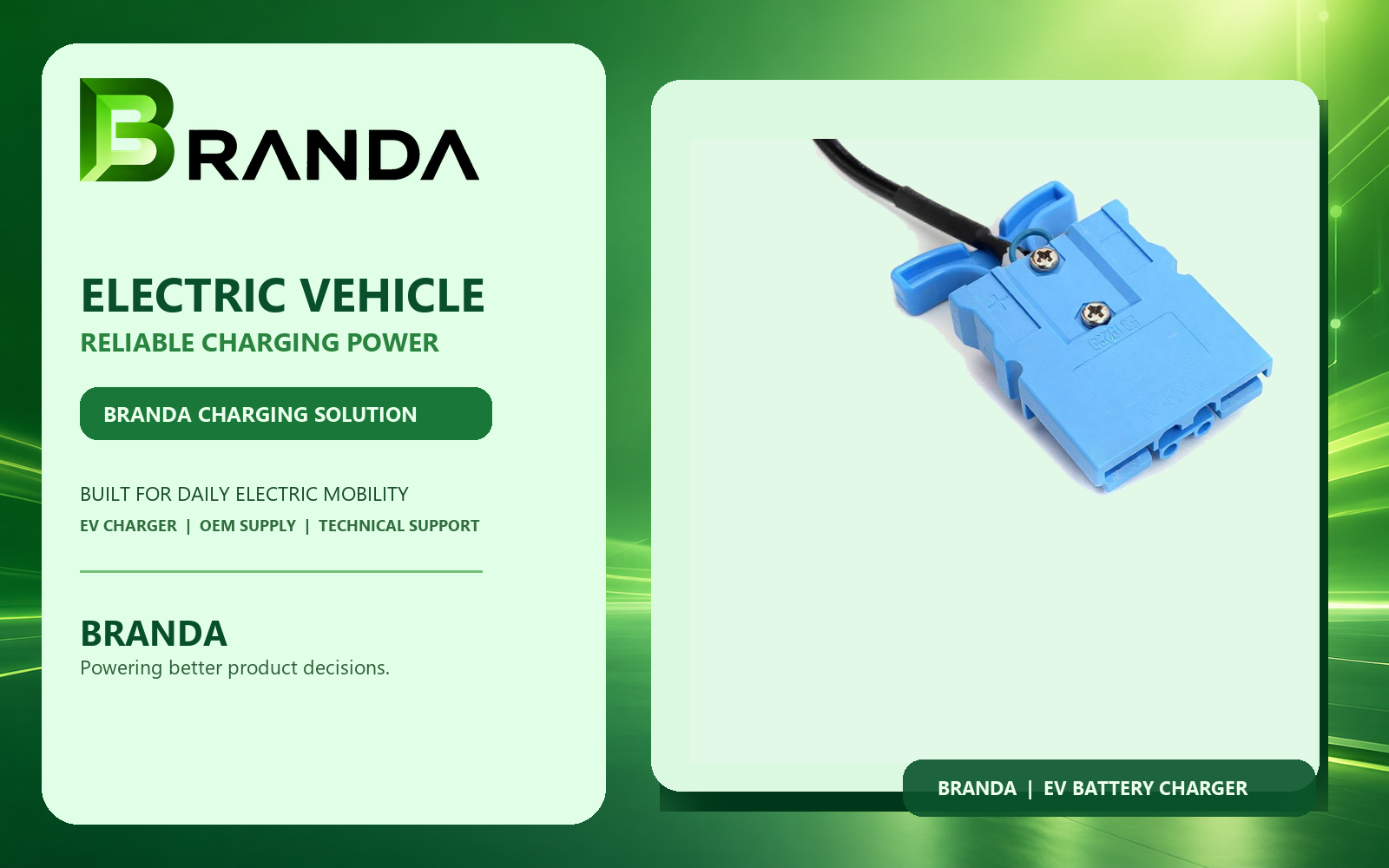
Blue is a helpful handling cue
Color coding can reduce selection mistakes. An operator who has been told to use the blue-interface charger can find it quickly, even when the labels are small or the workshop is busy.
The cue should be backed by a part reference. Check contact position, polarity, keying, retention and cable exit. Then ask the operator to connect and release it several times. A good connector feels predictable, not forced.
The sample record should include open questions
I would not hide an unknown battery profile behind a generic word such as compatible. In the sample record, write battery profile pending if the battery document has not arrived. Write connector drawing pending if the buyer has sent only a photograph.
That approach makes the next action obvious. Engineering can request the missing data, quality can hold the correct inspection point and purchasing can see why the model is still in technical review.
A better OEM conversation with Branda
The fixed starting point for Branda 321440002 is 29.6Vdc, 6A, 144W and 100-120Vac input. The review may then cover the blue connector, cable length, cord set, label, packaging and instructions around the target electric mobility platform.
Use the Branda OEM and ODM page when preparing the enquiry. Include expected daily use and target market. Those details help a charger supplier quote the actual project rather than a generic catalogue item.
Buyer worksheet before the purchase order
| Review item | Buyer provides | Supplier returns |
|---|---|---|
| Battery | Part number, chemistry, nominal voltage and full-charge voltage | Compatibility assumption and approved charging profile |
| BMS | Maximum current, temperature limits and communication requirement | Charging behavior and fault handling |
| Connector | Mating part, polarity, keying and photos or drawing | Connector code, cable exit and sample result |
| Input | Site voltage, frequency, plug and target market | Controlled input variant and label artwork |
| Cable | Route, storage point and traffic constraints | Released cord length and strain-relief note |
| Testing | Battery condition, duty cycle and acceptance criteria | Test record and open-item list |
How buyers compare the best electric vehicle charger options
For a buyer searching for the best electric vehicle charger, the shortest route to a sound decision is a written comparison rather than a product photo. Put the battery chemistry, full-charge voltage, maximum charging current, BMS limits, connector, input supply and target market on one sheet. Then compare each electric vehicle battery charger against the same fields. This method makes an EV charger quotation easier to audit and reduces the chance of mixing a 100-120Vac model with a 200-240Vac model.
Cost matters, but EV charger cost is not only the unit price. A practical comparison also includes the approved cord, connector, sample testing, label artwork, packaging, compliance review, minimum order quantity and expected lead time. When an OEM electric vehicle charger project is quoted, these details should be separated into confirmed requirements and open choices. That gives purchasing a clean comparison and gives engineering a clear list of questions.
Application checklist before requesting a quotation
- Battery: chemistry, nominal voltage, full-charge voltage and capacity.
- Charging profile: maximum current, BMS limits, temperature range and fault response.
- Mechanical fit: connector family, polarity, keying, cable exit and operator clearance.
- Site: input voltage, frequency, plug, charging-bay conditions and storage location.
- Commercial scope: sample quantity, target market, private-label needs, MOQ and delivery window.
For Branda 321440002, the supplied reference is 29.6Vdc, 6A, 144W rated power and 100-120Vac, 50-60Hz, with a blue battery-side connector. These are useful starting points for a technical review, not a universal compatibility statement. The final choice should be released only after the battery and connector have been checked together.
Related Branda resources for the next project step
Buyers can continue the review through the Branda website, the Branda product center, the related battery charger product page, the Branda OEM and ODM support page, the battery charger manufacturer service and the Branda technical enquiry page. These are all Branda website resources for moving from a general electric vehicle charger search to a product comparison, battery-specific quotation, sample review or private-label discussion.
Branda project review and product-reference path
A responsible electric vehicle charger review should keep the battery, connector, input supply, charging routine and target market in one controlled record. The Branda product reference gives buyers a concrete page to compare fitment and enquiry information, while the Branda charger manufacturer resource explains how a battery charger project can move into technical review. For Branda 321440002, the supplied starting point is 29.6Vdc, 6A, 144W rated power and 100-120Vac, 50-60Hz; final compatibility still requires a project-specific check.
For OEM electric vehicle charger sourcing, use the Branda OEM/ODM service page to prepare input and output requirements, battery details, connector drawings, target market, sample needs and estimated order quantity. Then use the Branda contact page for a project-specific response. These internal references keep product information, technical questions and commercial follow-up connected on the same domain.
Frequently asked questions
What makes Branda 321440002 different in the supplied set?
It is shown as a 6A29.6V reference with 144W output, 100-120Vac input and a blue battery-side connector.
Does blue mean a different charging voltage?
No. Color is an identification aid. Voltage, current, polarity and battery compatibility must be confirmed from the technical record.
What should be checked before a purchase order?
Check the battery, BMS limits, connector mating, input supply, US cord, label, test record and target market.
Talk to Branda about the application
If you are comparing an electric vehicle charger supplier, send Branda the battery part number, chemistry, charge voltage, maximum current, BMS limits, connector drawing or photos, site input, plug, cable route, target market and expected quantity. These details let the engineering team review Branda 321440002 against the real vehicle application rather than a generic catalogue description.
Review Branda OEM/ODM support | Send a technical enquiry
The electrical references in this article come from the supplied product information. Final compatibility, certification, pricing, MOQ, lead time and delivery terms require project-specific confirmation.


