

A 54.6V electric vehicle charger should be chosen from the battery's full-charge requirement, not from a familiar nominal-voltage label. Branda 321600008 is shown in the supplied information as a 3A54.6V reference with 163W rated power, 200-240Vac, 50-60Hz input and a 200mm EU cord. The red battery-side clip is easy to identify. The part that needs the most care is the match between 54.6V output, the battery BMS and the daily charging routine.
This article uses the supplied reference for Branda 321600008. Confirm the battery and destination-market requirements before purchase.
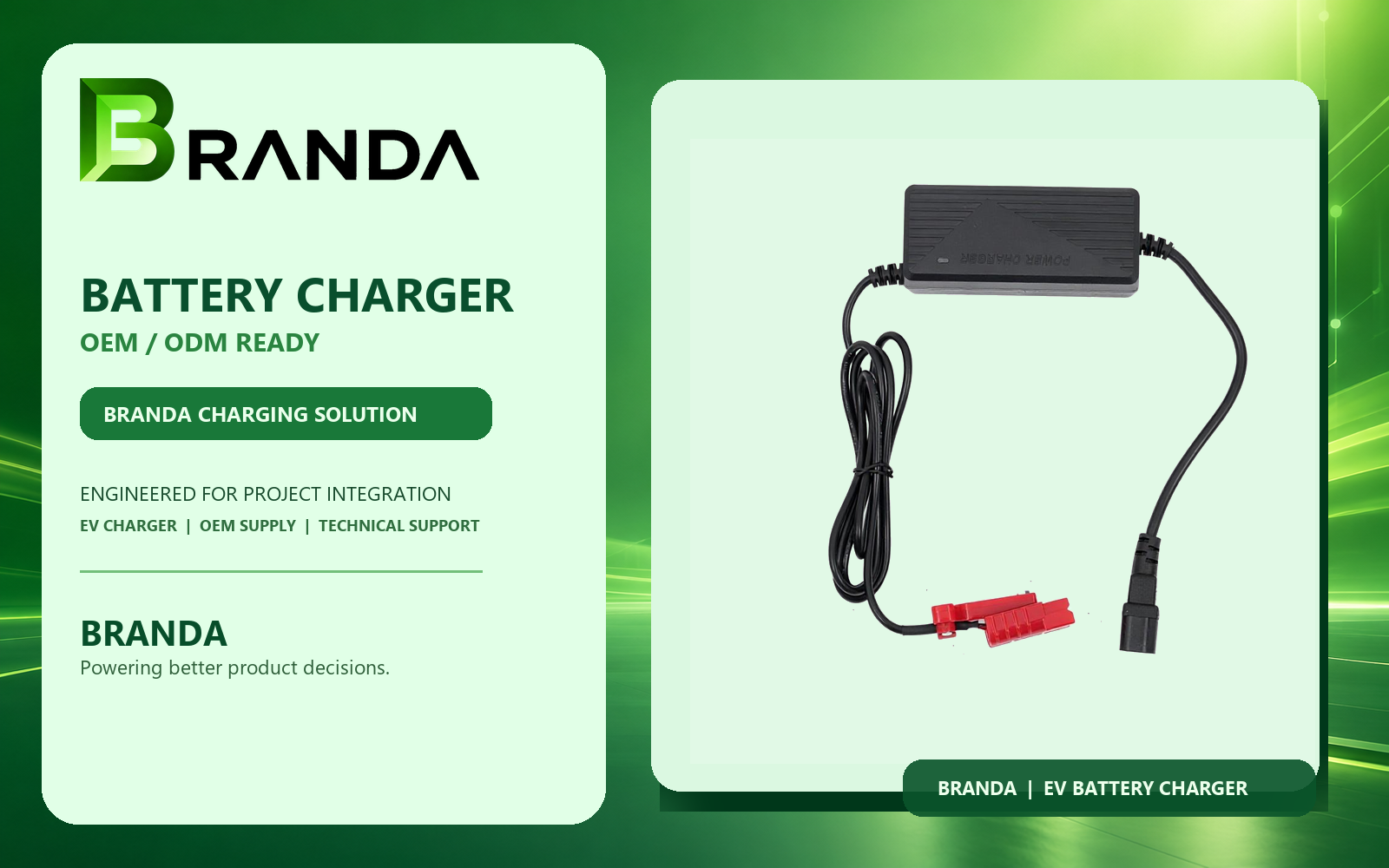
Quick specification record
| Field | Supplied reference | What the buyer should confirm |
|---|---|---|
| Model reference | Branda 321600008 | Keep the Branda prefix and label revision together. |
| Product family | Electric vehicle battery charger / power adapter | Match the battery and vehicle application. |
| Output | 54.6Vdc, 3A | Confirm the battery charge voltage and current limit. |
| Rated power | 163W | Use the approved test condition. |
| AC input | 200-240Vac, 50-60Hz | Confirm the site supply and market cord. |
| Cord | 200mm EU cord | Measure the installed route. |
| Battery connector | Red battery-side clip shown in the supplied product set | Approve the mating pair and polarity. |
54.6V narrows the choice, but does not finish it
A 54.6V output often points to a 48V-class lithium battery arrangement, but that phrase alone is not an approval. Cell count, chemistry, BMS settings and the manufacturer's full-charge instruction still matter.
For Branda 321600008, the supplied reference is 54.6Vdc at 3A and 163W. I would ask for the battery label and charge limits before using the model in a vehicle. That one request prevents a lot of guesswork later.
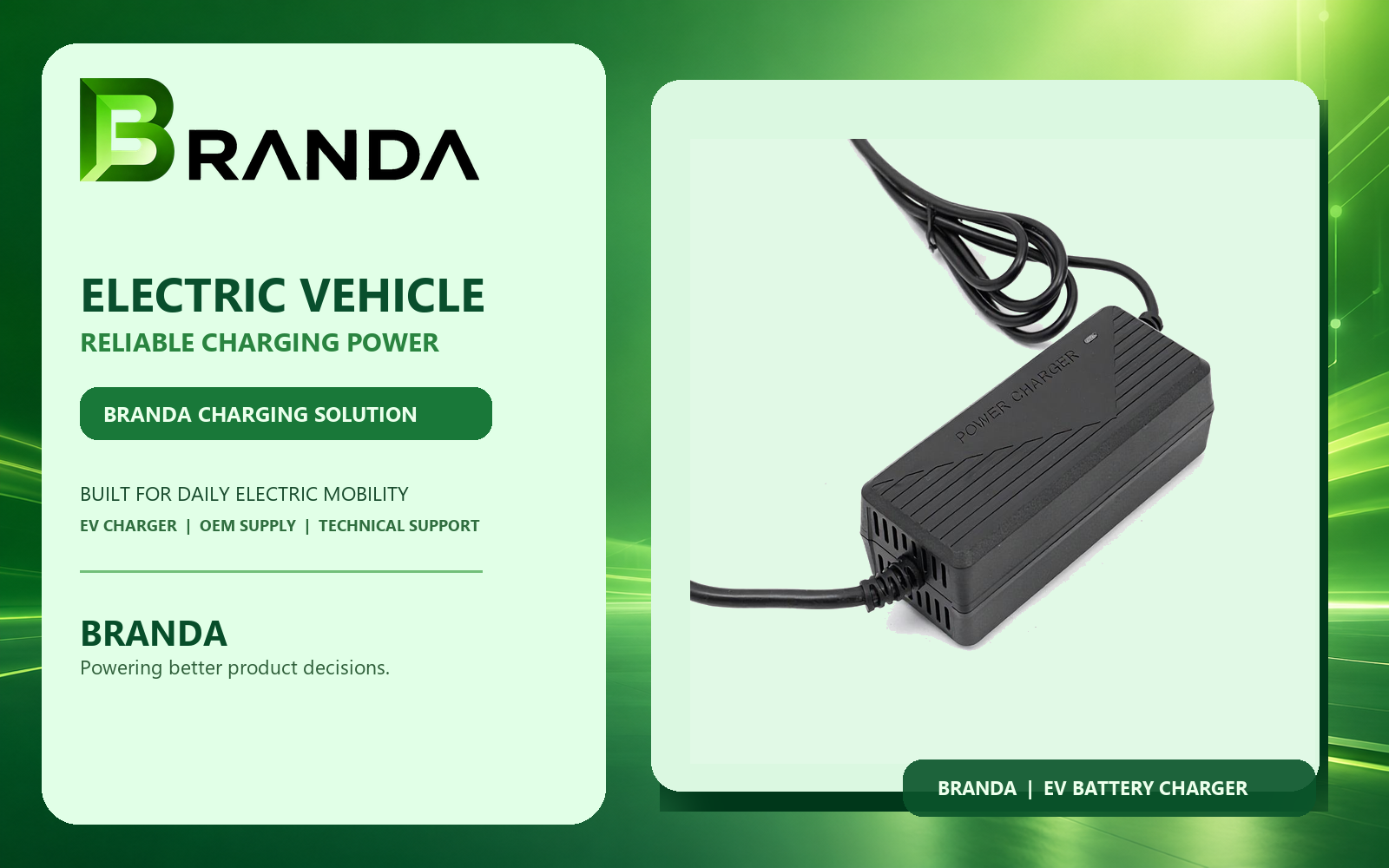
A measured 3A charging routine
Three amps can be a sensible choice when the vehicle is charged during a planned service period or overnight. The lower current may fit the battery's limit and the available dwell time without chasing an unnecessary headline speed.
The answer changes if the vehicle needs frequent top-ups between jobs. Test the actual battery, note the starting state of charge and measure the full routine. Do not turn 163W into a universal charging-time promise.
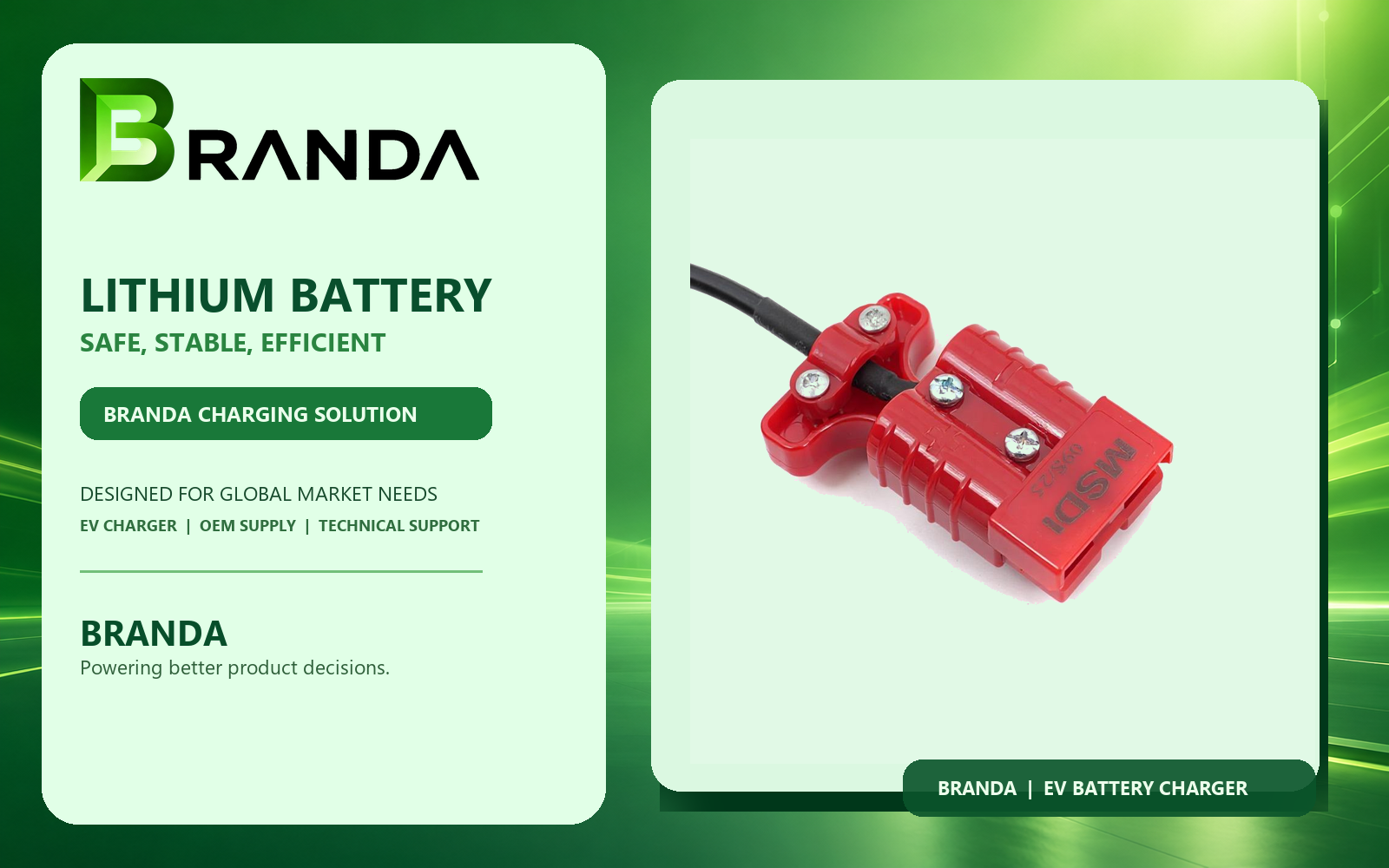
Check the red clip and the route to it
The red connector is a useful visual mark in a workshop. It should still be checked as a mating pair: contact layout, polarity, keying, retention and cable direction all need to agree with the battery.
The 200mm EU cord reference also deserves a practical look. Measure from the outlet to the place where the charger and battery connector will rest. If the route runs beside a wheel or a wet area, the bay needs a better storage point before the charger enters routine use.
Protection claims should become test questions
The supplied product material presents over-voltage, over-current, over-temperature, over-charge and short-circuit protection as safety points. I would turn each one into a question for the test plan: what condition is applied, what should the charger do and how does it recover?
That makes the product description more credible. It also helps Branda and the buyer agree on what is included in the sample record instead of leaving “multi-protection” as an undefined phrase.
Prepare a project-specific request
For an OEM discussion, send the battery part number, chemistry, charge voltage, maximum current, BMS limits, connector drawing, 200-240Vac site requirement, EU cord, target market and expected quantity. Identify the starting reference as Branda 321600008.
Branda's contact page is the natural next step for a technical review. The clearer the battery and vehicle information, the easier it is to decide what stays fixed and what can be customized.
Buyer worksheet before the purchase order
| Review item | Buyer provides | Supplier returns |
|---|---|---|
| Battery | Part number, chemistry, nominal voltage and full-charge voltage | Compatibility assumption and approved charging profile |
| BMS | Maximum current, temperature limits and communication requirement | Charging behavior and fault handling |
| Connector | Mating part, polarity, keying and photos or drawing | Connector code, cable exit and sample result |
| Input | Site voltage, frequency, plug and target market | Controlled input variant and label artwork |
| Cable | Route, storage point and traffic constraints | Released cord length and strain-relief note |
| Testing | Battery condition, duty cycle and acceptance criteria | Test record and open-item list |
How buyers compare the best electric vehicle charger options
For a buyer searching for the best electric vehicle charger, the shortest route to a sound decision is a written comparison rather than a product photo. Put the battery chemistry, full-charge voltage, maximum charging current, BMS limits, connector, input supply and target market on one sheet. Then compare each electric vehicle battery charger against the same fields. This method makes an EV charger quotation easier to audit and reduces the chance of mixing a 100-120Vac model with a 200-240Vac model.
Cost matters, but EV charger cost is not only the unit price. A practical comparison also includes the approved cord, connector, sample testing, label artwork, packaging, compliance review, minimum order quantity and expected lead time. When an OEM electric vehicle charger project is quoted, these details should be separated into confirmed requirements and open choices. That gives purchasing a clean comparison and gives engineering a clear list of questions.
Application checklist before requesting a quotation
- Battery: chemistry, nominal voltage, full-charge voltage and capacity.
- Charging profile: maximum current, BMS limits, temperature range and fault response.
- Mechanical fit: connector family, polarity, keying, cable exit and operator clearance.
- Site: input voltage, frequency, plug, charging-bay conditions and storage location.
- Commercial scope: sample quantity, target market, private-label needs, MOQ and delivery window.
For Branda 321600008, the supplied reference is 54.6Vdc, 3A, 163W rated power and 200-240Vac, 50-60Hz, with a red battery-side connector. These are useful starting points for a technical review, not a universal compatibility statement. The final choice should be released only after the battery and connector have been checked together.
Related Branda resources for the next project step
Buyers can continue the review through the Branda website, the Branda product center, the related battery charger product page, the Branda OEM and ODM support page, the battery charger manufacturer service and the Branda technical enquiry page. These are all Branda website resources for moving from a general electric vehicle charger search to a product comparison, battery-specific quotation, sample review or private-label discussion.
Branda project review and product-reference path
A responsible electric vehicle charger review should keep the battery, connector, input supply, charging routine and target market in one controlled record. The Branda product reference gives buyers a concrete page to compare fitment and enquiry information, while the Branda charger manufacturer resource explains how a battery charger project can move into technical review. For Branda 321600008, the supplied starting point is 54.6Vdc, 3A, 163W rated power and 200-240Vac, 50-60Hz; final compatibility still requires a project-specific check.
For OEM electric vehicle charger sourcing, use the Branda OEM/ODM service page to prepare input and output requirements, battery details, connector drawings, target market, sample needs and estimated order quantity. Then use the Branda contact page for a project-specific response. These internal references keep product information, technical questions and commercial follow-up connected on the same domain.
Frequently asked questions
What is the output of Branda 321600008?
The supplied specification lists 54.6Vdc, 3A and 163W rated output.
What input is listed?
The supplied material lists 200-240Vac and 50-60Hz, with a 200mm EU cord reference.
Does 54.6V mean it fits every 48V-class battery?
No. Battery chemistry, BMS limits, connector and the approved charge profile must be confirmed.
Talk to Branda about the application
If you are comparing an electric vehicle charger supplier, send Branda the battery part number, chemistry, charge voltage, maximum current, BMS limits, connector drawing or photos, site input, plug, cable route, target market and expected quantity. These details let the engineering team review Branda 321600008 against the real vehicle application rather than a generic catalogue description.
Review Branda OEM/ODM support | Send a technical enquiry
The electrical references in this article come from the supplied product information. Final compatibility, certification, pricing, MOQ, lead time and delivery terms require project-specific confirmation.


