

If you are sourcing a blue-interface Branda tool battery charger reference, the safest starting point is not a generic voltage claim. It is a complete review of the battery platform, charge profile, connector, input plug, cable route and target market. This guide explains how to evaluate the supplied Branda product reference and how to prepare a practical OEM or ODM enquiry.
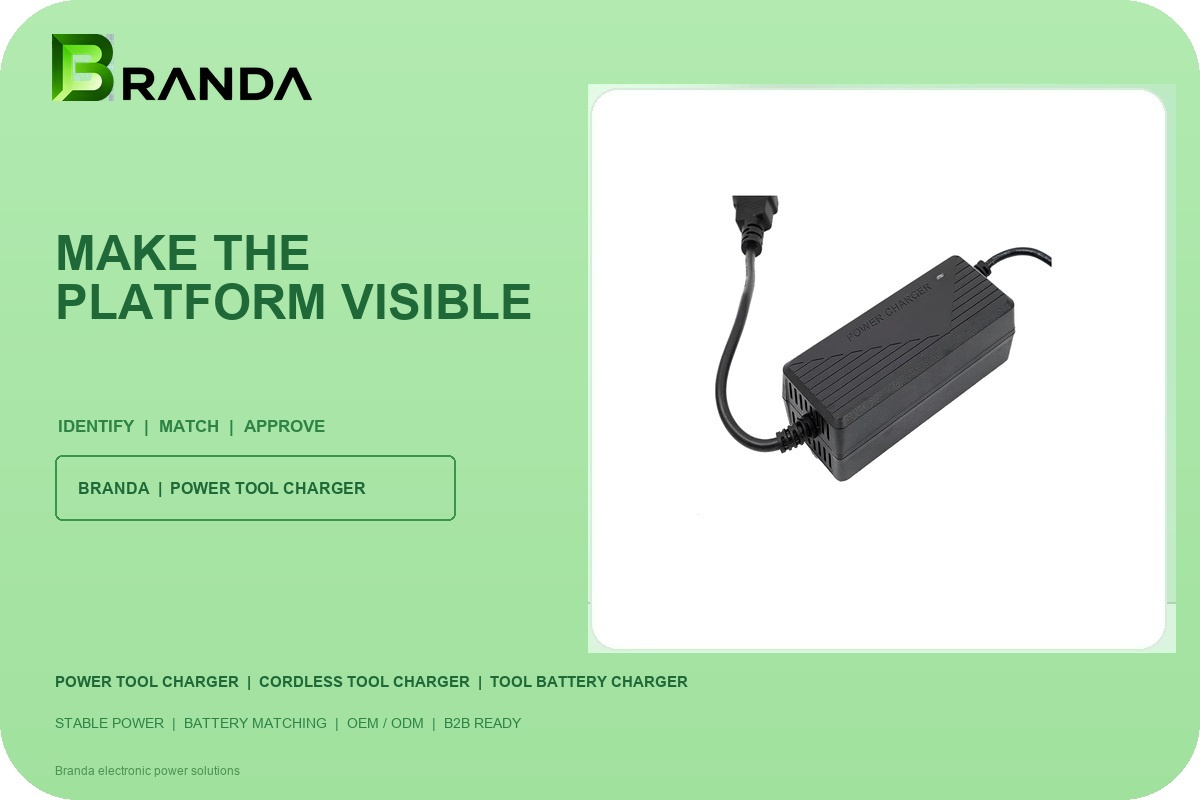
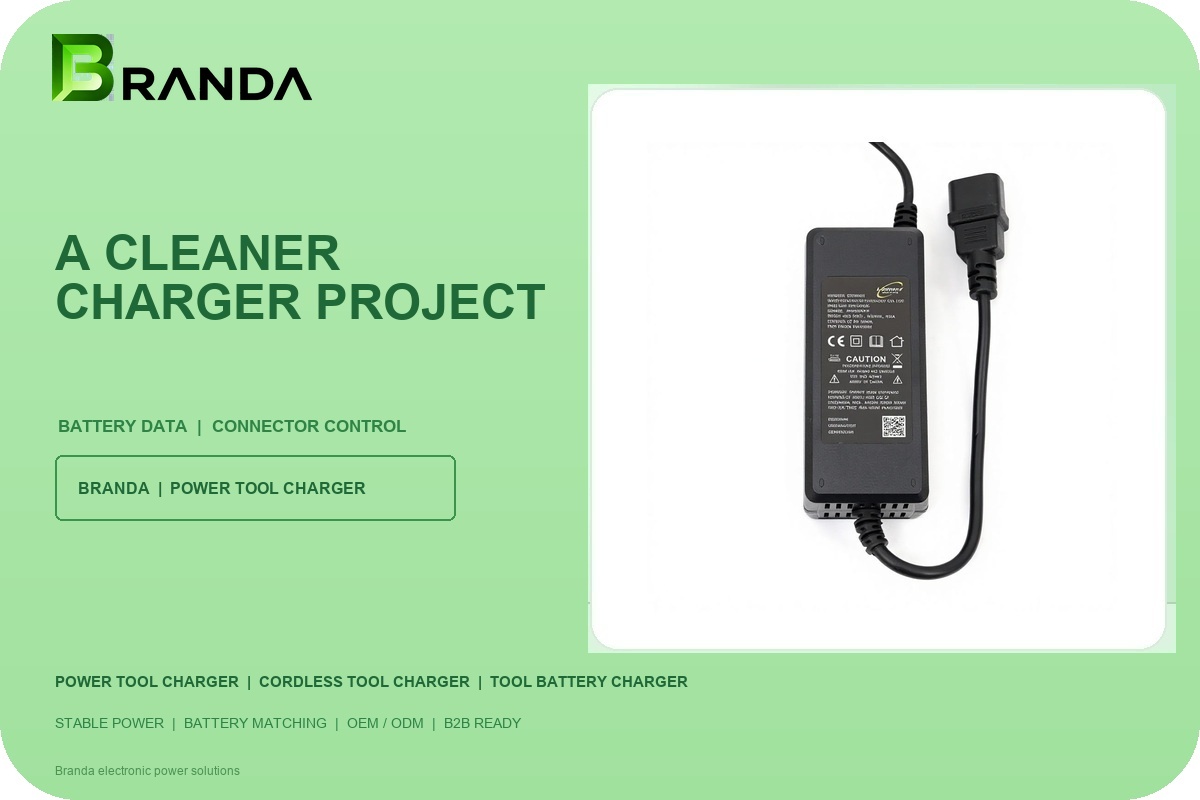
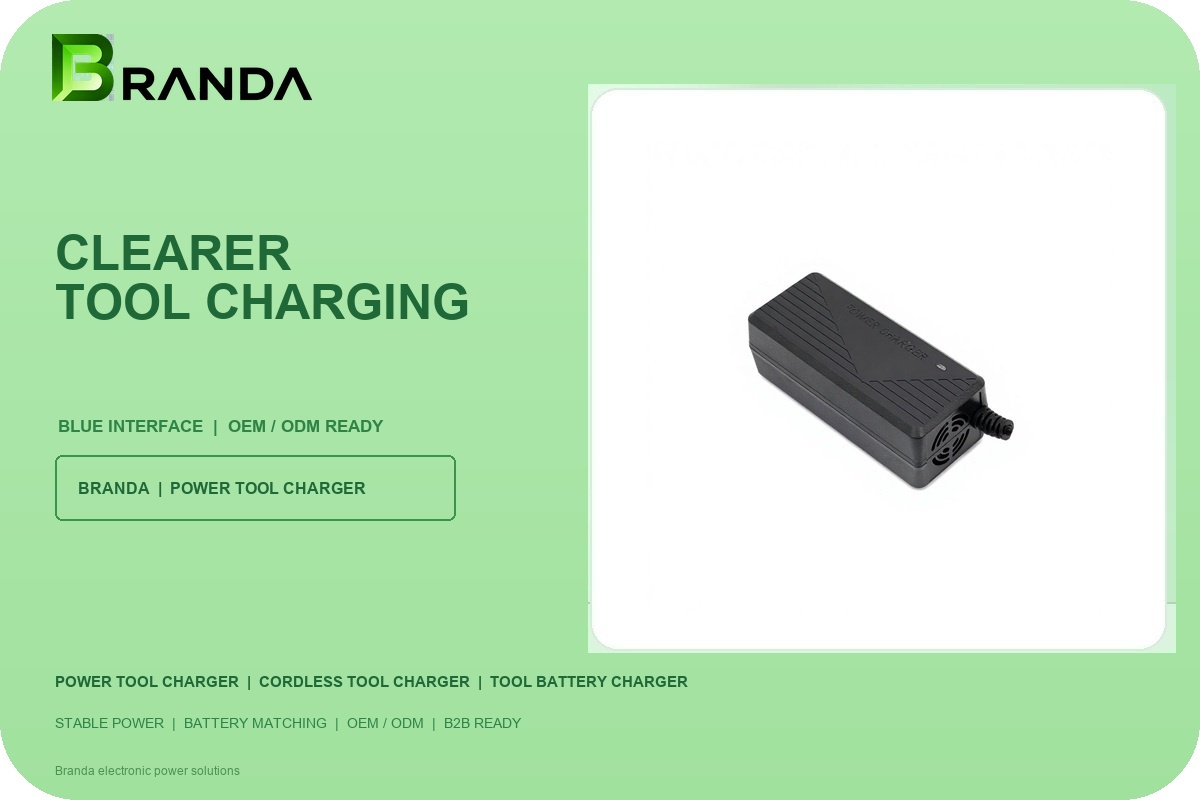
The supplied product images show a compact black charger housing, molded top ribs, cable strain relief and a blue battery-side connector shown in the supplied set. That makes the reference easy to recognize, while the final electrical compatibility still needs confirmation against the intended battery. The goal is a charger project that a buyer, engineer, operator and quality team can all describe in the same words.
Start with the battery, not the charger shell
When buyers search for a blue-interface Branda tool battery charger reference, they often begin with the enclosure. That is a sensible first filter, but it is not the approval point. The charger has to be matched with the battery chemistry, nominal voltage, full-charge voltage, allowed current, BMS behavior and connector. A clean housing can make a strong first impression while still being the wrong electrical fit.
For a power tool charger project, keep the battery data beside the charger data. This simple habit prevents the common mistake of treating a cordless tool charger as a generic power adapter. The correct question is not only whether the charger turns on. It is whether the complete battery platform has an approved charging routine.
Branda can review the charger around the application, but the review needs inputs. Send the battery label, a data sheet or a representative sample, then identify what is fixed and what may change. That turns a product enquiry into an engineering conversation instead of a guess based on a photograph.
What the supplied product set shows
The supplied product set presents a compact black charger housing, molded top ribs, cable strain relief and a blue battery-side connector shown in the supplied set. These visible details are useful for a catalogue page because they show the construction language, the cable exits and the intended product family. They also help a warehouse team separate charger families during picking and service.
The images do not prove an output voltage, charge current, battery chemistry or certification scope. Those items should be taken from the controlled specification and confirmed for the target market. A responsible tool battery charger supplier keeps the product photo and the technical release record connected.
Use the product images as the start of the discussion: Where will the charger sit? Which battery will it charge? How often will the operator connect it? What connector, plug, label and package are needed? Those questions create a usable brief for Branda OEM/ODM review.
What is confirmed and what still needs review?
| Project field | Visible or supplied reference | Buyer approval action |
|---|---|---|
| Product family | Power tool charger / cordless tool charger | Confirm the intended tool or battery platform. |
| Housing | a compact black charger housing, molded top ribs, cable strain relief and a blue battery-side connector shown in the supplied set | Review placement, clearance and service access. |
| Connector | The blue interface helps separate one charger family from another, but the battery-side mating specification must still be confirmed before an order. | Approve the mating pair, polarity and keying. |
| Electrical profile | Use the controlled specification for the selected configuration. | Match voltage, current, chemistry and BMS limits. |
| Input side | Confirm plug, cord set, market and frequency. | Freeze the destination-market configuration. |
| Customization | OEM/ODM scope may include charging parameters, connectors, cables, housing, plug and packaging. | List each change with a revision and sample check. |
The buyer checklist for a power tool charger
Before comparing quotations, write the project in a short configuration line. Include the input supply, output profile, battery chemistry, maximum charge current, connector, cable length, plug, target market and expected quantity. If a field is unknown, mark it as open rather than filling it with the word universal.
This record is especially important when the same workshop uses several cordless tool battery charger families. Similar housings can hide different charge curves or different battery-side contacts. A model label, connector reference and approved battery ID should travel together from sample to production.
The checklist also makes marketing claims safer. Branda can describe a charger as an OEM-ready reference, a custom power tool charger platform or a battery charger for power tools under review. The final compatibility statement remains tied to the approved battery and configuration.
Why connectors deserve their own approval step
The blue interface helps separate one charger family from another, but the battery-side mating specification must still be confirmed before an order. A connector is not approved because it looks familiar. The mating half, polarity, keying, pin assignment, latch, contact condition and cable exit all matter.
Ask an operator to connect and release the charger with the gloves and access conditions used in the real workshop. Note where the connector rests between charging cycles. If the cable pulls sideways, lands on a sharp edge or lies in a walking path, the sample review should record the issue.
When a connector changes, review the drawing, cable, strain relief, label, packaging and test method together. Branda's OEM/ODM workflow describes connectors and cables as part of the project scope, not as an afterthought added after the charger has already been approved.
Thermal behavior is an application question
The visual design of this product family points to interface identification, platform documentation, clean product differentiation and OEM/ODM readiness. That does not mean a buyer can promise a fixed runtime or a universal duty cycle. Thermal performance depends on the approved load, ambient conditions, enclosure clearance, charging profile and where the charger is placed.
A practical sample test should use the real installation position whenever possible. Do not approve a charger only on an open bench if the final tool room will place it under a shelf or inside a cabinet. Photograph the clearance, the cable route and the location of the battery connector.
For a fan-cooled or vented charger, keep the airflow path clear and include cleaning or inspection in the service note. For every tool battery charger, document unusual heat, noise, odor, connector temperature and restart behavior as observations rather than assumptions.
Input, plug and target market
The input side is easy to overlook because buyers naturally focus on the battery. Yet the input voltage, frequency, plug family, cord set, label language and target-market documentation all belong in the same release record.
A quotation should state which input variant is included and which plug is supplied. If the customer needs a different cord set, say whether it is a standard option or a project change. This prevents a low first price from becoming a late-stage correction.
Branda's public buyer guide recommends sharing the target market, quantity and required documentation during the enquiry. That is useful for a cordless tool charger because the charger is often sold as part of a branded tool or battery program, not as an anonymous spare.
Charging profile and BMS boundaries
A lithium tool charger must follow the battery maker's charging boundary. Nominal voltage alone is not enough. The approved profile may depend on cell arrangement, full-charge voltage, current limit, temperature feedback and communication between the battery and charger.
Ask whether the battery includes a BMS and what the BMS expects from the charger. If the system uses temperature sensing or communication, include that requirement in the RFQ. If the battery does not use those functions, document the assumption instead of leaving it silent.
This is also where a custom power tool charger earns its value. A supplier can discuss the electronic solution, but the product cannot be responsibly called compatible until the battery platform and the charger behavior have been tested together.
Cable length and workshop handling
Cable length should be measured from the actual wall socket or power strip to the connector resting point. Add the service loop, the bend at the charger and the route around the tool or battery. A cable that looks long on a product card may be awkward in a crowded workshop.
During a sample review, repeat the connection after a normal shift. Check whether the operator can find the cable, connect the battery without twisting the lead and return the connector to a clean location. These details affect perceived quality as much as the first charging cycle.
If a private-label project needs a different cable length, record the new length as a controlled change. The housing, strain relief, packaging and user instructions may need a matching revision.
How to compare charger quotations fairly
Price, delivery and output are important, but they do not make two power tool charger quotations equivalent. Add the input variant, plug, cable, connector, label, package, sample status, documentation and testing scope to the comparison sheet.
One supplier may quote the charger body while another includes the battery-side connector and a market-specific cord. One may include artwork changes while another treats them as a separate engineering charge. Put each item in a separate row so the comparison is visible.
A clear quote helps Branda sell on project value rather than a vague promise. It also helps a buyer see whether a custom lithium tool charger, an OEM charger or a catalogue reference is the right route for the order.
Quick quotation comparison
| Quotation line | Why it matters | Do not leave blank |
|---|---|---|
| Battery platform | Determines the approved charging profile. | Chemistry, nominal voltage and battery ID. |
| Connector and cable | Controls fit, handling and service risk. | Mating part, polarity, keying and cable route. |
| Input and plug | Controls the destination-market installation. | Supply, frequency, cord set and plug. |
| Label and package | Keeps private-label batches traceable. | Artwork revision, language and manual. |
| Testing | Shows whether the sample fits the real workflow. | Battery condition, test method and result. |
| Commercial scope | Makes supplier comparisons fair. | MOQ, sample status, lead time and delivery terms. |
A sample approval record that technicians can use
Keep the sample record short enough for a technician to use without rewriting it. Start with the product reference, battery ID, output setting, input variant, connector code, cable length and sample revision.
Add three checks: identity and fit, normal charging behavior, and operator handling. Attach a label photo, connector photo, battery reference, cable-route photo and open-item list. The record should say what was tested, under which conditions and who owns the next action.
A sample described only as good is difficult to reproduce. A sample described with a controlled battery, connector and test condition becomes a useful bridge to production. That is the difference between a product image and a repeatable tool charger project.
OEM, ODM and private-label planning
A private-label power tool charger project may change the logo, label language, plug, connector, cable, housing, package or manual. Each change should have an owner, a drawing or artwork file, a revision and an approval date.
Branda's public OEM/ODM information describes a path from requirement review to solution proposal, sample evaluation, project approval, production and inspection. That sequence is useful because it separates a catalogue reference from the configuration that is actually released.
If the product is intended for a distributor program, decide early which fields must stay fixed across batches. Battery compatibility and connector control may be locked, while packaging or label language changes by market. A clear boundary prevents unnecessary re-testing and prevents uncontrolled substitutions.
Quality records and certification questions
A mark visible on a product image is not the same as a current certificate pack. Ask what documents apply to the exact configuration, destination market, cord set, connector and label revision. Keep the answer in the project record.
The quality file can include the approved specification, sample report, label artwork, user instructions, production inspection plan and any applicable declarations or test reports. If the connector or input cord changes, ask whether the document review must be reopened.
Branda's public guidance states that certification availability and scope are confirmed by product model and target market. That is the right standard for a tool battery charger buyer: specific, traceable and free of blanket claims.
Daily use, storage and service
Operators notice whether the charger has a stable place to rest, whether the connector is easy to identify and whether the cable can be stored without a sharp bend. These small details shape the real experience of a cordless tool charger.
Set a simple stop rule for damaged insulation, unusual heat, exposed conductors, loose contacts, cracked connector bodies, missing labels or a battery change. The operator should know when to stop and call maintenance rather than continue until the fault becomes severe.
For a fleet buyer, keep the spare charger record beside the battery platform record. A similar-looking charger is not a spare until its input, output, connector, cable, label and approved battery match.
When this Branda reference belongs on a shortlist
This blue-interface Branda tool battery charger reference belongs on a shortlist when its visible construction, input option, output profile, connector and cable match the intended battery platform after technical review. The product should then be tested in the real tool-room or service workflow.
It is a strong starting point for a B2B buyer that needs an OEM or ODM conversation rather than a one-off marketplace adapter. The shortlist should still include the battery data, connector drawing, target market and quantity.
It should not be presented as a universal charger without that review. Accurate boundaries build more trust than a broad compatibility slogan, especially when a brand owner is responsible for a complete cordless tool system.
A practical RFQ for Branda
Send the product type and intended application first. Then attach the battery label or data sheet, nominal and full-charge voltage, charge current, BMS information, connector photos or drawing, input plug, cable request, target market and expected quantity.
If the project needs a custom label, private packaging, a different cable or a connector change, list those as separate requirements. A short, complete RFQ is faster to review than a long message that leaves the battery platform unclear.
For this article's blue-interface Branda tool battery charger reference, include the requested application and the reason for choosing the visible design. That gives Branda a basis for an OEM/ODM response and makes the next sample discussion more concrete.
Useful Branda resources for the next step
Use the Branda home page to review the company's electronic power product scope. The OEM/ODM page explains the project path and customization topics. The battery charger buyer guide lists the information needed for a relevant quotation, including battery specifications, connectors, plugs, quantity and target market.
When the battery platform is ready for review, use the Branda contact page to send the product brief. The Branda blog can also be used to compare related application guides. These are direct Branda pages, not placeholder links.
Frequently asked questions
Does a blue interface mean the charger fits every blue battery?
No. Color is an identification aid only. The buyer still needs the battery chemistry, voltage, current, BMS behavior, contact arrangement, polarity and approved mating connector.
Why use a tool battery charger with a visible interface color?
A clear interface color can reduce picking mistakes when a workshop handles several charger families. It works best when the color is tied to a controlled model, label, connector drawing and storage rule.
What makes a project ready for Branda OEM/ODM review?
A project is easier to review when the buyer provides the battery information, connector details, target market, expected quantity, input plug, cable needs and required label or packaging changes.
Final buyer decision
The right blue-interface Branda tool battery charger reference is the one that matches the battery, connector, input environment and daily routine with evidence. Use the supplied product images to identify the construction and interface, then use the controlled specification and sample record to approve the electrical and mechanical details.
Branda's value for a B2B project is the ability to discuss the charger as part of a complete electronic power solution. A buyer can ask for a catalogue reference, a private-label version, an OEM configuration or a custom battery charger review. The final scope should always be confirmed for the selected model, battery and market.
Project enquiry checklist: product type; intended tool or battery; chemistry; nominal and full-charge voltage; charge current; BMS behavior; connector drawing or photos; input supply; plug; cable length; target market; expected quantity; label; packaging; and required documents.
Review the charger buyer guide Send a Branda enquiry
The article uses the supplied product images and public Branda project guidance. Final specifications, compatibility, certification, pricing, MOQ, lead time and delivery terms require confirmation for the exact configuration and target market.


