

Direct answer: an e-bike charger becomes reliable in the field when the battery, charger, cable, connector, housing, software behavior and user environment are treated as one system. A field-return box rarely arrives with a neat root cause. It may contain a charger with a warm connector, a cable that has been bent beside a workbench for six months, or a battery that the user tried to charge immediately after a cold ride. A short room-temperature bench test will not reveal every one of those conditions. The practical target is not simply a charger that turns on; it is a repeatable charging product that behaves predictably across the situations customers actually create.
This guide is aimed at the people who normally have to make the charger decision: an e-bike brand manager with a launch date, a fleet operator trying to reduce downtime, a battery-pack engineer checking compatibility, a distributor planning a replacement line, or an OEM buyer comparing suppliers. It is for the project that needs more than a catalog photograph and a unit price. The same questions are useful when evaluating an e bike charger manufacturer, a private-label charger program, or a supplier coordinating the charger, cable, plug, label and carton as one package.
Bolanda supports electronic power product development, manufacturing coordination, sample review and OEM/ODM discussions. A quotation still needs a project-specific review: the final charging profile, certification scope, minimum order quantity, lead time and customization feasibility all depend on the selected model and destination market. The notes below are meant to improve the engineering brief before that conversation. They are not a substitute for the battery owner's approved limits or the requirements that apply in the market where the product will be sold.
Request an E-Bike Charger Reliability Review
Why reliability starts before the first quotation
Many charger projects begin with three things: a nominal voltage, a photograph and an expected unit price. Those details are useful, but none of them tells the supplier what a Tuesday afternoon looks like for the product. A 48 V battery may belong to a commuter e-bike, a delivery fleet, a cargo bike or a vehicle stored in a hot service room. The charge frequency, cable movement, storage condition and customer expectation can be completely different. A reliability comparison is weak when that operating context remains hidden.
Start with a short use-case description, even if the project is still at quotation stage. Write down who charges the battery, where charging occurs, how often a typical battery is charged, how long the charger remains connected after the indicator changes, and whether the charger travels with the user. Add the target market, mains conditions, plug type, expected annual quantity and any service requirement. Ten honest lines about the operating routine can prevent several weeks of testing the wrong configuration. They also give the supplier something concrete to challenge, which is usually more useful than a vague promise of “normal use.”
Reliability is also a commercial issue. One charger failure can become a replacement shipment, a support case, an idle fleet vehicle, a battery return that is not actually defective, or a product review that damages the brand. The cheapest initial charger is not always the lowest-cost choice if its connector, cable or thermal margin is unsuitable for the application. When suppliers are compared, put evidence, scope and change control beside the first unit price. The extra question often costs less than the second shipment, especially when a product is sold through distributors who cannot diagnose the battery at the counter.
1. Define the real e-bike charging duty cycle
Here is a simple example. A commuter charger may be plugged in once each evening and left on a wooden shelf. A delivery fleet charger may be moved between batteries all afternoon, with warm packs arriving one after another. Both products may carry the same nominal output label, but the second use case gives the connector, cable and enclosure much less time to cool. If the quotation does not distinguish those two routines, the supplier is being asked to solve an unstated problem.
The duty cycle describes how the product is used over time. It should include the number of charging sessions per day, the expected battery state at the beginning of a session, the usual charge duration, the time the charger may remain connected after completion, and the interval between sessions. A household commuter may charge once every day or two. A rental fleet may charge many batteries in a row with short cooling periods. A service center may connect batteries that arrive at very different states of charge.
Do not describe the duty cycle only as annual quantity. Annual demand tells the supplier about production volume, but it says little about thermal stress. Two buyers can order the same number of chargers while creating completely different electrical workloads. A fleet buyer should state the number of charging cycles per charger per day and whether the charger is used in a rack, on a bench or inside a restricted cabinet.
| Duty-cycle input | Why it changes reliability | What the buyer should state |
|---|---|---|
| Sessions per day | Controls repeated thermal loading and cooling time. | Typical, peak and seasonal usage. |
| Battery state at connection | A low battery can create a longer high-current period. | Expected state range and any deep-discharge cases. |
| Post-charge connection | Standby losses and enclosure temperature may continue. | Whether overnight connection is allowed. |
| Installation position | Airflow and cable strain differ between bench and rack use. | Clearance, orientation and surrounding surfaces. |
| User handling | Frequent plugging creates wear at the connector and cable exit. | Expected mating cycles and handling by staff or consumers. |
| Service environment | Dust, moisture and heat affect thermal and insulation margin. | Indoor, covered outdoor, workshop or fleet depot. |
A useful specification separates normal use from foreseeable misuse. For example, the charger may be intended for a dry indoor room, but the user may carry it in a damp pannier or place it on a dusty garage floor. The buyer does not need to promise that the product supports every misuse. The buyer does need to decide which foreseeable conditions should be tested, warned against or excluded in the instructions.
2. Freeze the battery and BMS behavior
Battery chemistry, series count, maximum charge voltage and approved current are the first electrical boundaries. A nominal label is not enough. The battery owner should identify the exact pack revision, cell arrangement, capacity range, BMS behavior and temperature sensing method. If several batteries share a connector, list each approved model rather than describing the charger as universal.
The BMS may interrupt the charge path, limit current, report a temperature condition or require a defined restart sequence. A charger that continues to behave as though the battery is accepting current can create confusing field symptoms. The system requirement should state what happens when the battery is too cold, too hot, disconnected, deeply discharged, fully charged or temporarily inhibited.
The buyer should also define what information is available at the connector. Some projects use only positive and negative contacts. Others use a thermistor, identification contact or communication line. The supplier should not infer the pinout from wire color or a photograph. Provide a controlled drawing with the viewing direction, contact numbering, keying and expected electrical state.
3. Review the complete energy path
Reliability is distributed across the entire energy path. The path may include the wall plug, input cable, adapter stage, charger PCB, output cable, connector, battery contact, BMS and cells. A failure at any one point can look like a charger fault. A loose battery terminal can be mistaken for a weak power supply. A high-resistance cable can be mistaken for an incorrect charging profile. The test plan should isolate the path instead of changing several parts at once.
Ask the supplier to show where current is measured, where protection acts and which components carry the highest thermal load. The review does not require the buyer to dictate every component. It does require enough visibility to understand the design margin and the effect of a change. Critical components should have approved alternatives and a change-review rule.
When a charger is built around an external AC/DC stage, the output cable and connector still need their own review. A reliable adapter cannot compensate for undersized wire, poor crimping or a contact that is not suited to repeated mating. When the charger and power stage are integrated, the enclosure, isolation distance, airflow and service method become part of the same approval.
4. Thermal design is more than a room-temperature test
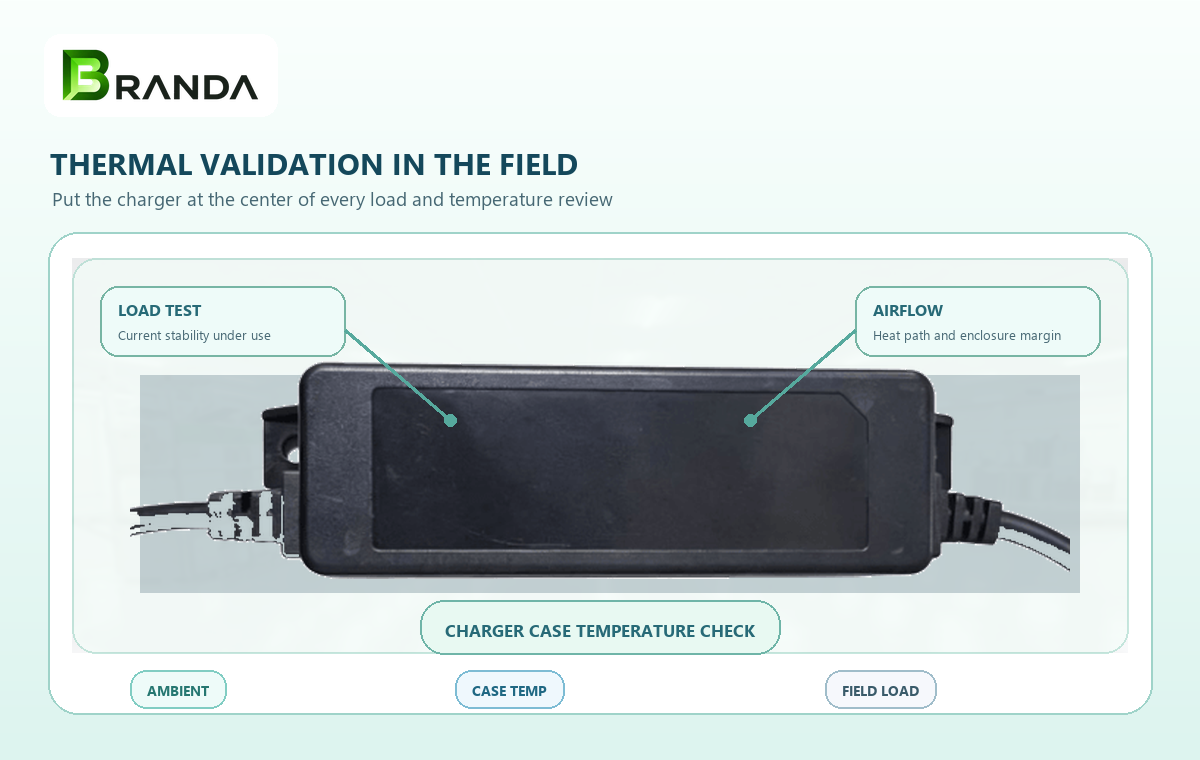
Heat is one of the most common reasons a charger that looks correct in a sample review becomes unreliable in the field. The critical temperature is not always the hottest point on the outer case. It may be a switching device, transformer, rectifier, connector, cable crimp, current-sense element or battery contact. The measurement method should identify the location, instrument, ambient condition and charger state.
Test the charger at the highest intended input condition and at the lower and upper limits of the specified mains range. Repeat the test with the battery at a realistic low state of charge. If the charger is used in a rack or cabinet, reproduce the spacing and airflow. A free-air bench test can hide a thermal problem that appears when several chargers operate side by side.
| Thermal checkpoint | Typical observation | Buyer decision |
|---|---|---|
| Charger enclosure | Surface temperature during the longest normal session. | Acceptable touch temperature and mounting clearance. |
| Power components | Peak case or board temperature under high load. | Thermal margin, derating and component review. |
| Output connector | Heating caused by contact resistance or small terminals. | Connector family, crimp method and mating-cycle requirement. |
| Cable exit | Temperature and flexing at strain relief. | Bend radius, cable jacket and relief geometry. |
| Battery-side contact | Heating at the mating interface during charge. | Contact plating, pressure and contamination control. |
| Rack or cabinet | Accumulated heat with neighboring chargers. | Spacing, airflow and simultaneous-use limit. |
Thermal protection should be documented as behavior, not as a marketing phrase. State whether the charger reduces current, pauses, latches a fault, waits for recovery or requires disconnection. The restart behavior matters because a fleet operator may not be present when a charger reaches a limit. A recovery path that is safe but too difficult to understand can still create service calls.
5. Cable and connector reliability
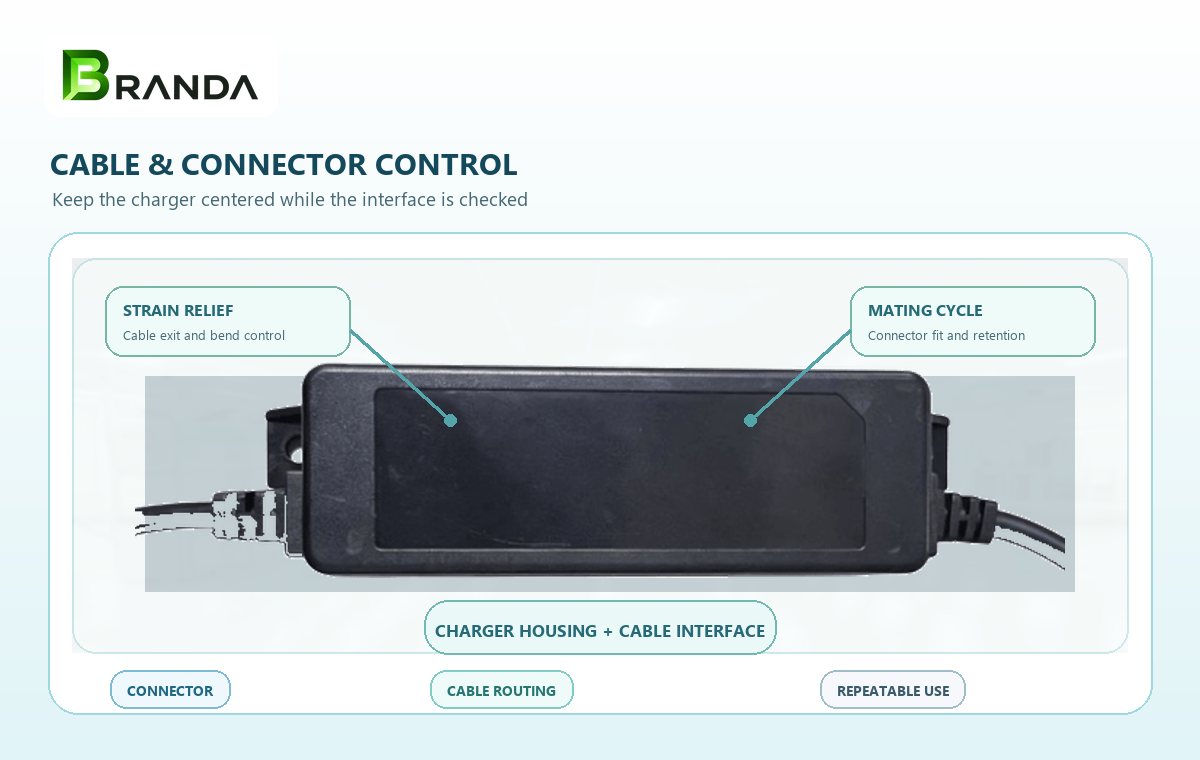
The output cable is often the part that receives the most physical abuse. It is pulled across a bench, bent near the housing, wrapped around a charger, compressed in a bag and inserted at different angles. The buyer should define cable length, conductor size, jacket material, bend radius, strain relief, connector keying and the expected number of mating cycles.
Inspect the cable exit after repeated flexing. The failure may begin inside the jacket before a visible crack appears. A good sample review records the bend direction, radius, force, cycle count and electrical continuity before and after the test. If the connector is keyed, verify that the key prevents an incorrect insertion without creating a sharp stress point for the user.
Contact resistance deserves a place in the production plan. A connector can pass an initial continuity check and still create heat after contamination, wear or repeated mating. Ask how terminals are crimped, whether the crimp tool is controlled, how pull force is checked and how rejected cable assemblies are segregated. These questions are especially important for a project sold through multiple distributors because a field failure can be difficult to trace back to one assembly lot.
When the battery connector is proprietary, the buyer should own the interface definition. A supplier may be able to source or assemble the connector, but the battery owner should confirm the pinout, contact sequence, mechanical envelope and approved mating parts. Keep the drawing revision with the charger specification and make any connector change a controlled engineering change.
6. Input quality, protection and regional use
An e-bike charger may be used in homes, shops, service rooms, depots and temporary charging stations. Input quality can vary. The specification should state the intended voltage and frequency range, the plug standard, the expected surge environment and whether an external adapter is included. If the charger is part of a larger system, decide which device owns input protection and how the user is expected to replace a fuse or cable.
Do not copy a generic list of protections into a product page without verifying the design. The buyer should ask how over-voltage, over-current, short-circuit, over-temperature and abnormal load conditions are detected and what the user sees. The test report should connect each protection claim to a defined condition, expected response and recovery method.
For a multi-region product, keep the electrical core and regional package separate in the RFQ. A charger may require different plugs, labels, power cords and documentation while retaining the same core. The production file should identify which changes are cosmetic, which affect the input stage and which trigger a new compliance review.
7. Noise, EMI and user experience
Noise is a reliability issue when the charger is used near a bedroom, office or customer service desk. A fan that starts at the wrong threshold can create complaints even when the electrical performance is acceptable. Conversely, a silent enclosure with insufficient airflow can create thermal stress. The buyer should describe the noise expectation and the operating environment.
Electrical noise can also affect the larger e-bike system. A charger may sit near a display, communication cable, battery management electronics or other sensitive equipment. The supplier should review grounding, cable routing, filtering and enclosure relationships for the actual system. A short bench test with no neighboring electronics does not show every field interaction.
Record the indicator behavior in plain language. Users should understand whether the charger is charging, complete, waiting, inhibited or in a fault state. If the indicator cannot distinguish those conditions, the service team may receive unnecessary battery returns. The manual, label and product page should use the same state names as the approved test record.
8. Build a reliability test matrix
A reliability matrix should combine electrical conditions, mechanical handling, temperature, time and user behavior. It does not need to test every theoretical combination; that would create a beautiful spreadsheet and a very slow project. It does need to cover the combinations that are plausible for the intended market. Before the test starts, write down the sample identification, battery condition, input condition, duration, measured values, pass criteria and recovery method.
| Test family | Example condition | Evidence to keep |
|---|---|---|
| Repeated charge | Multiple sessions with controlled cooling intervals. | Voltage, current, temperature and session log. |
| High ambient | Charge at the upper intended ambient temperature. | Sensor position, airflow, peak temperature and response. |
| Low ambient | Start or inhibit behavior at the lower boundary. | Battery sensor value and charger state. |
| Cable flexing | Repeated bending at the housing exit and connector. | Cycle count, continuity, insulation and photographs. |
| Mating cycles | Repeated insertion and removal with the approved battery. | Force, contact resistance and latch condition. |
| Input variation | Specified low, nominal and high input conditions. | Input reading, output behavior and protection response. |
| Recovery | Disconnect, reconnect, temporary inhibit and restart. | Expected state versus observed state. |
| Storage and transport | Packaging, vibration or temperature exposure defined by the project. | Pre-test and post-test electrical and mechanical checks. |
Use clear statuses such as pass, fail, conditional and not tested. A conditional result is useful when an electrical sample is stable but the final label, regional plug or packaging is still open. It should not be used to hide an unresolved charging or thermal problem. The report should identify the owner, next action and retest requirement for every open item.
9. Production testing and traceability
A reliability plan is incomplete if it exists only in engineering. The production line needs a practical test that detects the failures most likely to escape. Depending on the charger architecture, the line may check input current, output voltage, indicator state, connector polarity, functional charging behavior, insulation or a programmed load response. The test limits should be revision-controlled and linked to the approved sample.
Traceability should cover the charger model, PCB revision, critical component lot, cable assembly, plug package and test result. The exact amount of traceability depends on the project risk and commercial requirement. A fleet or private-label buyer may need a serial number or date code. A lower-volume project may use lot records and a test report. The important point is that a field failure can be narrowed to a defined configuration rather than treated as an anonymous product.
Ask how failed units are controlled. A failed charger should be identified, segregated and reviewed. Rework should be recorded, and a reworked unit should not be mixed into a passed lot without a defined retest. If a test limit changes, the buyer and supplier should agree whether existing stock needs review. This is the type of basic discipline that prevents a small process issue from becoming a large recall or replacement program.
10. Packaging, storage and service instructions
Packaging is part of reliability because it controls what happens before the charger reaches the user. A cable can be bent too tightly in a carton. A connector can be damaged by a loose accessory. A charger can be stored in a hot warehouse for months. The RFQ should identify packaging constraints, storage temperature, humidity assumptions and any required protection for the cable or plug.
Instructions should explain where to place the charger, what to do if an indicator shows a fault, whether the charger should be disconnected after completion, and which battery models are approved. Keep the language consistent with the technical test record. Avoid saying that the charger is compatible with every similar battery if the approved list is narrower.
Service teams benefit from a short diagnostic sequence. Ask the user to confirm input power, indicator state, connector seating, battery temperature and the battery model before replacing the charger. A clear sequence reduces unnecessary replacement shipments and helps distinguish a charger issue from a battery or cable issue.
11. How to compare an e-bike charger manufacturer
When comparing an e bike charger manufacturer, buyers should separate what is standard from what is project-specific. A supplier may offer a standard charger body but still need a new connector, cable, label, plug, charging profile or test fixture. Ask the supplier to list included and excluded scope line by line.
| Comparison area | Question for the supplier | Buyer evidence |
|---|---|---|
| Battery fit | Which battery models and revisions are included? | Approved battery list and sample IDs. |
| Connector | Who owns the pinout and how is the mating part controlled? | Drawing, photographs and mating-cycle requirement. |
| Thermal margin | What conditions were used for temperature validation? | Test setup, limits and measured values. |
| Production test | Which parameters are checked on every unit or lot? | Test flow, limit table and sample report. |
| Change control | Which changes require buyer approval? | Change notification process and revision history. |
| Commercial scope | What are the assumptions behind MOQ, sample fee and lead time? | Quotation with one-time and recurring items separated. |
12. When the project needs more than a charger
An e-bike platform may include an external adapter, a display, a motor controller, an LED accessory or a replacement mobility product. The buyer should not force every work package into one vague charger quotation. Instead, describe the system relationship and ask which items can be reviewed together.
A private-label brand may need a power tool battery charger manufacturer for a separate tool platform, a electric motorcycle charger manufacturer for a higher-energy vehicle, or an industrial lithium battery charger manufacturer for a fleet or logistics application. The product family may also include a LED driver manufacturer or a brushless motor controller manufacturer. Each request needs its own output, current, environment and validation boundary.
When an external adapter is part of the system, include the requirement for an AC DC power adapter manufacturer review. If the buyer owns the electronics design and needs assembly, a power supply PCB assembly discussion may be more appropriate than a finished charger quotation. A mobility product may also require a mobility scooter battery charger supplier review.
How to turn reliability findings into a purchasing decision
Test results are useful only when they lead to a decision. Before the first sample is ordered, agree on which findings are release blockers, which findings require a corrective action, and which findings can remain open until the pilot build. This prevents a commercial team from treating an engineering warning as a minor detail and prevents an engineering team from delaying a low-risk packaging decision that does not affect the charging function.
| Finding | Suggested decision | Commercial consequence |
|---|---|---|
| Wrong output voltage, polarity or charge limit | Stop release and correct the electrical configuration. | New sample, retest and possible battery review. |
| Connector temperature exceeds the agreed limit | Hold the configuration until cable, contact or current path is corrected. | May change cable source, tooling, BOM or unit cost. |
| Minor label or carton artwork issue | Allow conditional approval with a controlled artwork action. | Production hold only if the artwork affects safety or identification. |
| Indicator wording is unclear | Update instructions and confirm the user support flow. | Could reduce avoidable returns without changing hardware. |
| Intermittent cable fault during flex test | Reject the cable construction or strain relief and repeat the test. | May affect tooling, cable length, packaging and supplier lead time. |
This release logic also helps a buyer compare suppliers fairly. One supplier may report every open point in detail while another supplier may simply mark a sample as passed. The longer report is not automatically better, but a buyer should ask both suppliers to use the same status definitions. A common pass, fail, conditional and not-tested vocabulary makes supplier comparisons more honest.
Use a failure review loop after the first shipment
Field reliability work should continue after launch. Set a short review loop for the first production lots, for example at the first 30, 90 and 180 days or after a defined number of customer uses. Review warranty claims, replacement reasons, customer photographs, battery model, charger lot, cable condition and environmental information. A small sample of returned products can reveal a pattern before the pattern becomes a large service cost.
Returned products should be separated into confirmed charger faults, confirmed battery or vehicle faults, installation or handling issues, no-fault-found cases and cases that need more information. This classification is more valuable than simply counting all returns as charger failures. If many units are no-fault-found, the next action may be a diagnostic guide or indicator change rather than a hardware redesign.
| Return data | Useful question | Possible action |
|---|---|---|
| Charger lot and date code | Is the issue concentrated in one production period? | Contain the lot and review production records. |
| Battery and bike model | Does the issue occur with one revision or combination? | Check compatibility list and BMS behavior. |
| Connector and cable photographs | Is there heat, abrasion, bent contact or strain damage? | Improve cable construction, service instructions or packaging. |
| User environment | Was the charger used in a hot, damp, dusty or restricted space? | Update warnings, validation conditions or enclosure design. |
| No-fault-found rate | Can support staff reproduce the reported symptom? | Create a diagnosis flow before authorizing replacement. |
Give the supplier a concise monthly or quarterly summary rather than sending unstructured comments. Include the symptom, configuration, evidence, containment, root-cause status and requested response date. This creates a shared engineering record and helps protect both sides when a battery, cable or vehicle component is found to be the actual cause.
What a high-quality quotation should make clear
A useful charger quotation is more than a unit price and a photograph. It should identify the model, electrical output, input range, connector, cable, plug, label, packaging, sample quantity, MOQ, lead time, test scope and assumptions. If a price depends on a customer-supplied battery or a specific annual volume, that condition should be visible.
Ask the supplier to separate standard configuration from custom work. For example, a standard enclosure may be available at one MOQ, while a custom cable, private label, new connector or new housing may require tooling and a higher MOQ. Separating these items lets a buyer choose a practical first phase instead of rejecting a capable supplier because several optional requirements were combined into one unexplained price.
| Quotation line | Buyer should verify | Why it matters |
|---|---|---|
| Sample price | Configuration, battery used and test report included. | Prevents a sample from being compared with a different scope. |
| NRE or tooling | Cable, mold, fixture, label or packaging tooling ownership. | Clarifies one-time cost and future flexibility. |
| MOQ | Which component or customization creates the MOQ. | Helps plan a pilot and avoid excess inventory. |
| Lead time | Sample, pilot and repeat-order timing, including material lead time. | Supports a realistic launch plan. |
| Quality scope | Every-unit test, lot test, report and traceability included. | Links price to the reliability evidence received. |
When the technical and commercial assumptions are visible, the buyer can issue a more accurate purchase order and the supplier can plan the correct material and test resources. That is the practical difference between requesting a charger price and requesting a controlled charger program.
13. A buyer-ready RFQ structure
A good RFQ is easy to answer because it separates confirmed information from open questions. Start with the battery model and revision, chemistry, series count, capacity, maximum charge voltage, approved current, BMS behavior and temperature window. Add connector drawings, cable length, plug standard, target market and expected quantity. State whether you need a standard product, private label, custom cable, custom housing, custom charging profile or a complete OEM/ODM build.
Include the acceptance plan in the same package. List the required functional checks, thermal conditions, mating cycles, cable flexing, indicator behavior, protection responses, packaging checks and documentation. If a requirement is not yet decided, label it as open. A visible open item is safer than an assumption hidden inside a quotation.
Ask the supplier to return a marked-up scope. The response should identify standard items, customized items, one-time charges, recurring costs, MOQ assumptions, sample timing, information needed from the buyer, test evidence and change-control rules. This makes the first comparison more useful and reduces the chance that an important item disappears between engineering and purchasing.
14. Common field-return patterns
Return pattern 1: charger does not start. Check input power, plug, indicator state, connector seating, battery temperature and BMS inhibit before replacing the unit. The charger may be functioning correctly while the battery is outside its allowed charging window.
Return pattern 2: charger becomes hot. Record ambient temperature, charge current, battery condition, ventilation, cable temperature and connector temperature. A warm enclosure can be normal within a defined limit. A hot connector or cable exit needs a separate review.
Return pattern 3: charge stops before completion. Compare the battery revision, temperature feedback and end-of-charge behavior. Do not change the battery and charger together without recording the change. A BMS event may be interpreted as a charger failure if the indicator logic is unclear.
Return pattern 4: intermittent charging. Inspect the cable exit, plug, connector latch, contact resistance and battery terminals. Flex the cable while monitoring the electrical state. Many intermittent issues require a mechanical fix rather than a new charging algorithm.
Return pattern 5: customer reports noise. Identify whether the noise comes from a fan, magnetics, vibration or an external surface. Record when the sound starts and whether it correlates with current level or temperature. A change to the enclosure or fan control should be reviewed for thermal impact.
15. Documentation that protects the buyer and supplier
Keep one controlled project folder for the battery specification, connector drawing, charger specification, test plan, sample photos, reports, deviations, approved label, packaging artwork, production test limits and change notices. The file names should include model and revision. Avoid storing the only approved drawing in an email thread that cannot be found when a supplier change is proposed.
The approval record should state the permitted use of the sample. An engineering sample may be suitable for battery compatibility testing but not for a finished-market claim. A pilot sample may be suitable for restricted customer trials but not for broad release. The status should be visible to sales, purchasing and service teams.
When a supplier proposes an alternative component, cable, connector, plug or enclosure, ask which approved characteristic could change. The right question is not only whether the part is available. It is whether the change affects temperature, isolation, output behavior, fit, noise, service, certification scope or production test. That review prevents a supply decision from creating an unplanned product change.
16. Questions buyers ask
How do we choose an e-bike charger manufacturer?
Choose based on evidence that matches the project: battery compatibility, interface control, thermal testing, production test capability, documentation, change management and commercial scope. A supplier can be technically strong and still be a poor fit if it cannot support the required quantity, plug package or service model.
Should a charger be tested with the complete e-bike?
Test the complete bike or a representative system when the charger interacts with the bike housing, battery latch, cable routing, communication interface or thermal environment. A battery-only fixture may be enough for an early electrical review, but it should not replace the system conditions that affect field reliability.
What battery data should be sent first?
Send chemistry, series count, capacity, maximum charge voltage, approved current, BMS behavior, temperature sensing, model revision and connector pinout. If any value is not confirmed, mark it as open. Do not ask a supplier to guess a critical charging limit from a label.
How many samples are needed?
The number depends on the battery variants, test families and intended production risk. One sample may support an early fit check. Several samples from a defined build are more useful for pilot validation, especially when the project includes cable assemblies, connectors, labels or multiple revisions.
What should be included in a reliability report?
Include sample IDs, configuration, battery condition, input condition, test equipment, measurement points, limits, observed values, photographs, status, deviations, corrective actions and approval owner. A report that only says pass does not show what was actually tested.
Can a charger be used for several battery capacities?
Possibly, but the approved battery list must be explicit. Shared nominal voltage does not prove shared charge voltage, current, temperature window or BMS behavior. Test and document each intended combination.
Can the supplier customize the logo and packaging?
Private-label customization may be possible, but logo, label, enclosure and packaging changes should be included in the project scope. Confirm artwork format, approval steps, one-time charges, MOQ, sample timing and production change control before placing the order.
Can the same partner support other electronics?
That depends on the verified scope. A broader project may include a LED driver manufacturer, a brushless motor controller manufacturer, an AC DC power adapter manufacturer or a power supply PCB assembly partner. Keep each technical boundary separate even when one supplier coordinates the work.
17. Send the right enquiry
When you contact a supplier, explain the commercial use case as well as the electrical requirement. State whether the charger is for a new e-bike platform, a replacement program, a rental fleet, a private-label launch or a service part. Mention the target market, estimated annual demand, sample quantity, required launch date and whether the supplier should provide a report.
Attach the battery data, connector drawing, photographs, cable constraints, label artwork if available, plug requirement, packaging expectation and test plan. If the project may later include a motor controller, LED accessory, external adapter or PCBA, say so early. The supplier can then decide which engineering inputs should be reviewed together and which should remain separate work packages.
Bolanda's contact page provides a direct route for a project-specific enquiry. Use the button below and include the information that is already confirmed. The final product fit, charging behavior, certification scope, MOQ, lead time and pricing should be confirmed after technical review.
Contact Bolanda for an E-Bike Charger Reliability Review
Final checklist: define the real duty cycle, confirm the battery and BMS limits, review the full energy path, measure thermal behavior, control cable and connector construction, test input and recovery behavior, create a production test, keep traceability, document packaging and service use, compare suppliers on evidence, and send a complete enquiry. That sequence helps a buyer reduce avoidable returns and gives the manufacturer the information needed to build a charger that remains predictable after the first shipment.


