

Model 321440002 Charger Procurement Guide: How to Validate a Blue Clamp Interface Before Scale-Up
Procurement view: model 321440002 should enter a sourcing process as a defined charger platform with a battery interface, not as a standalone enclosure. The reference images show a black ribbed charger body, a long cable assembly and a blue clamp-style connector. Those features provide a useful starting point for an RFQ. They do not, on their own, establish electrical ratings, battery chemistry, charging logic, certifications or compatibility with an unapproved pack.
This version of the buyer guide focuses on procurement and scale-up. It is designed for product managers, sourcing managers, engineering teams, distributors, service organizations and brands that want to qualify a repeatable supplier rather than purchase an isolated sample. The central question is simple: what evidence must be in place before the buyer moves from a promising reference image to a controlled production order?
The answer is not one datasheet. It is a chain of evidence: a battery boundary, a mating-interface definition, a sample record, a comparable quotation, a line-level functional test and an agreed change process. When those pieces are connected, the charger becomes easier to price, approve, forecast and support in the field.
Start a Model 321440002 Procurement Review
1. Define the Scale-Up Decision Before Sampling
Many charger projects lose time because the first sample is ordered before the buyer decides what the sample is supposed to prove. Is it a visual benchmark, a mechanical-fit sample, an electrical feasibility unit, a private-label first article or a production-equivalent sample? Each purpose needs different evidence. A product can pass a visual check and still be unsuitable for the battery. It can charge a laboratory load and still fail the user interface or packaging review.
For model 321440002, write the sampling purpose in the purchase request. Name the target equipment, battery owner, market, sample quantity, required branding and decision date. State which features are fixed and which are provisional. If the blue clamp is an existing field interface, identify the approved mating part. If it is a proposed interface, say so and ask the supplier to show the validation assumptions.
A scale-up decision should have an owner. Engineering may own electrical approval, quality may own process evidence, purchasing may own commercial scope and product management may own launch timing. One person should coordinate the final disposition so that a sample is not considered approved by one department while another still has a blocking question.
| Sampling purpose | What it can prove | What it cannot prove alone |
|---|---|---|
| Visual benchmark | Housing shape, cable layout and visible interface concept. | Electrical compatibility or production consistency. |
| Mechanical-fit sample | Mating, clearance, retention and cable reach. | Charging curve, thermal margin or market compliance. |
| Electrical feasibility unit | Behavior with the defined battery or test setup. | Branding, packaging or line repeatability. |
| First article | Approved appearance, marking and configured scope. | Long-term field performance without a plan. |
| Production-equivalent sample | A bridge to process approval and pilot release. | Unreviewed future changes or alternate components. |
2. Make the Blue Clamp a Controlled Design Input
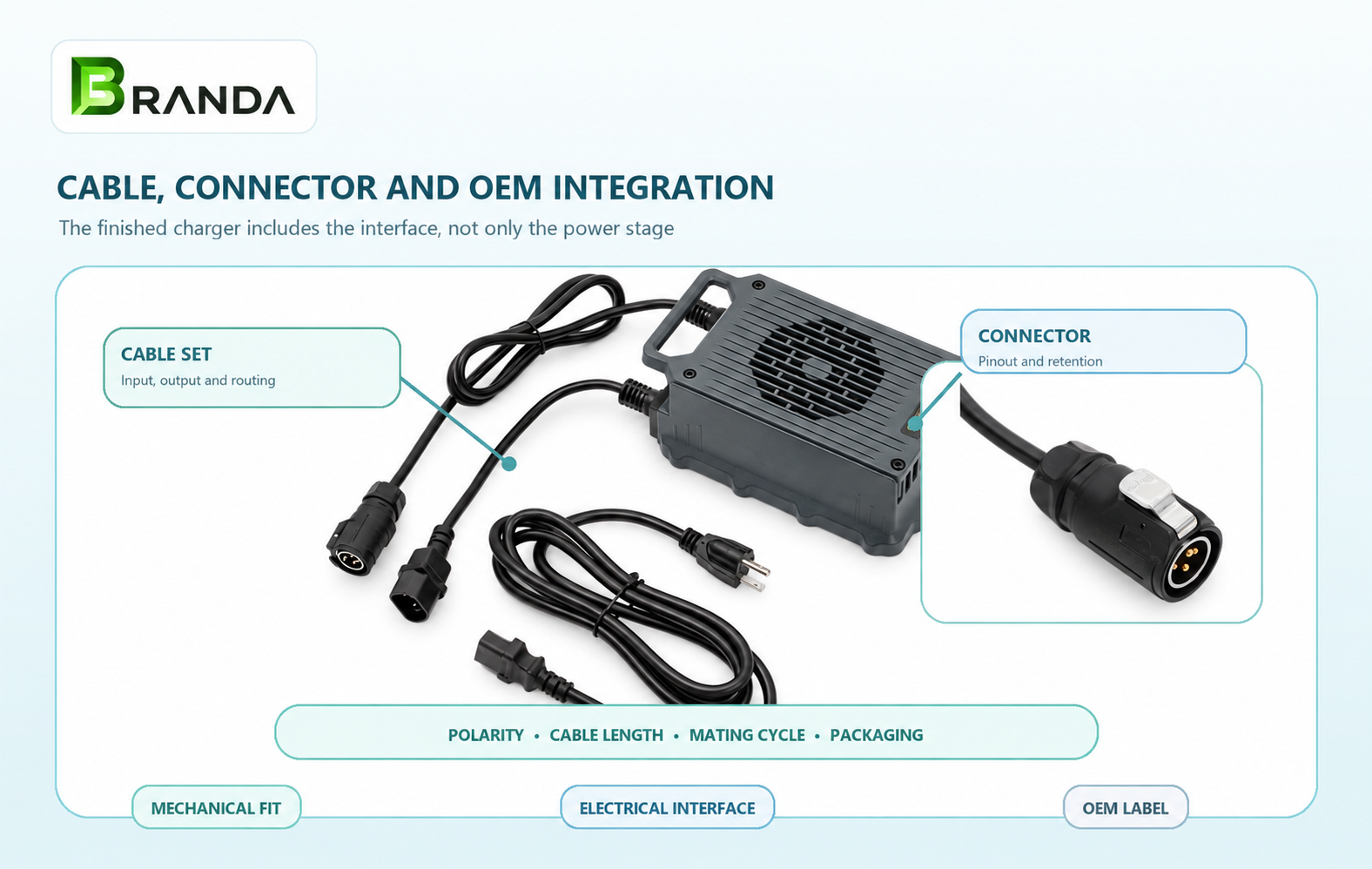
The blue clamp in the 321440002 reference should be defined as a controlled interface with an electrical side and a human side. The electrical side includes contact function, polarity, isolation, current path and any sense or control contact. The human side includes keying, insertion direction, clamp force, release access, cable pull and the ability to connect the product correctly in the field.
Start with the mating view. State which side of the connector drawing is shown and identify every contact. Add wire colors only as a secondary reference; color should not be the primary polarity control. If the interface has unused contacts, state whether they must remain isolated. If the battery has a detection or temperature contact, describe the expected behavior before the supplier designs a test.
The physical clamp also deserves a short operator study. Ask a technician to connect and release it using the actual battery position and normal hand protection. Watch whether the cable is pulled, whether the clamp touches adjacent parts, whether the keying is obvious and whether the release can be operated without excessive force. These observations are valuable even before the final electrical specification is complete.
| Blue-interface input | Procurement question | Acceptance evidence |
|---|---|---|
| Mating part | Which battery connector is approved or proposed? | Drawing, sample or controlled mating component. |
| Pin definition | What does each contact do in the finished cable? | Pinout, polarity test and connector view. |
| Mechanical retention | How does the clamp stay attached during use? | Repeated mating and handling observation. |
| Cable loading | What happens if the user pulls or bends the cable? | Strain-relief and bend-route review. |
| Service release | Can an operator disconnect it safely and consistently? | Technician or operator trial with the target equipment. |
A supplier should be able to explain how the connector is inspected at incoming, during assembly and at final test. If the buyer cannot trace the polarity and retention checks to a work instruction, the interface is not yet ready for scale-up. A good RFQ asks for the proposed control method rather than assuming that a familiar-looking connector needs no special attention.
3. Build a Battery Boundary for a Real Quotation
The battery boundary is the most important missing input in many charger requests. Provide the pack model, chemistry, cell arrangement, nominal voltage, maximum charge voltage, recommended current, maximum current, termination behavior, temperature window and protection behavior. If a BMS controls permission to charge, document its start, stop, inhibit and recovery behavior. If the BMS uses communication, explain whether the charger is expected to participate.
Do not let a product photograph turn an unknown into a specification. A clamp interface may be used across multiple battery programs, but the charging requirements can differ. Nominal voltage is not a substitute for the approved output window. A label from a legacy product is not a replacement for the battery owner's controlled file.
If the pack is not finalized, ask for a feasibility quote with a list of assumptions. The supplier can identify which points are safe to leave open and which points block a meaningful sample. This is more efficient than forcing a false final specification and restarting the project after the battery is released.
| Battery boundary | Why procurement needs it | Close-out record |
|---|---|---|
| Chemistry and cell count | Sets the charging method and final voltage boundary. | Battery owner's controlled specification. |
| Output window | Determines feasibility, test limits and label content. | Approved value, tolerance and measurement method. |
| Current range | Affects charge time, cable heating and power-stage loading. | Recommended and maximum value with conditions. |
| BMS interaction | Determines start, stop, fault and recovery behavior. | Signal table, protocol note or pack test. |
| Temperature limits | Changes field behavior and validation requirements. | Normal, inhibit and recovery boundary. |
4. Treat the Housing as a System-Level Constraint
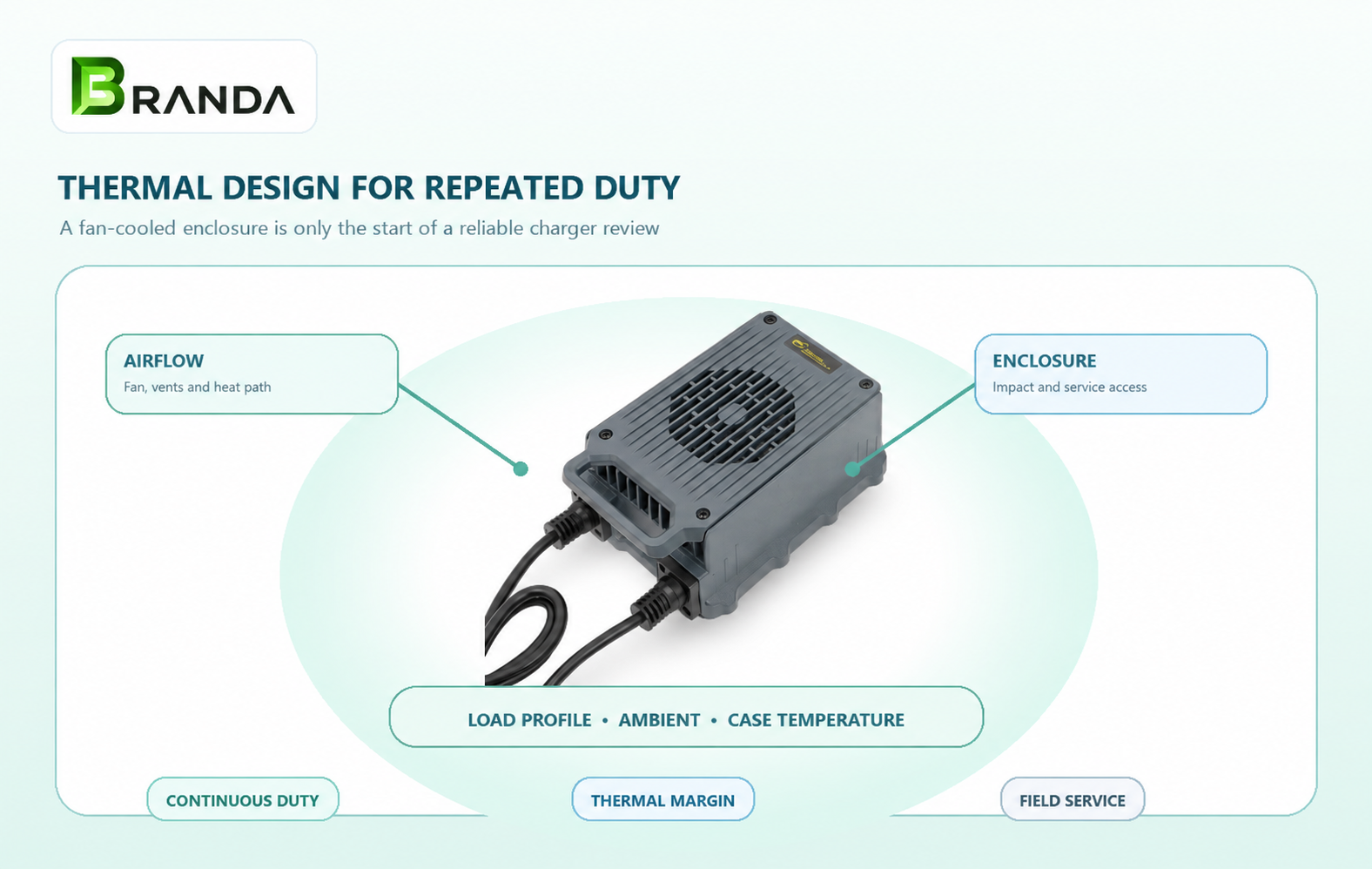
The black ribbed housing is more than an appearance choice. It sets the available internal volume, cable-exit geometry, ventilation path, service clearance and packaging footprint. The reference images do not establish the thermal or environmental performance, but they do show why the buyer should review the charger in its intended orientation and surrounding space.
Measure the installation area before asking for a final quotation. Record clearance around the housing, the surface on which it rests, the direction of both cable exits, nearby heat sources, dust exposure and the route the operator uses to connect the battery. A charger that is comfortable on a test bench may be difficult to service when the battery is inside a tray or under a vehicle seat.
For procurement, the key question is not simply whether the housing is available. It is whether the same housing can be produced, packed, inspected and supported across the expected order period. Ask whether the mold, housing supplier, label surface and cable-exit tooling are stable. If a housing revision is possible, define how the buyer will be notified and how samples will be compared.
| Housing review | Question to ask | Useful evidence |
|---|---|---|
| External envelope | Will the approved dimensions remain stable in production? | Drawing, tolerance and first-article record. |
| Ventilation | What clearance and orientation are required? | Installation sketch and thermal test position. |
| Cable exits | Can the exits tolerate the target routing and handling? | Relief detail, bend route and sample observation. |
| Service access | Can the unit be identified and replaced in the field? | Label location and service procedure. |
| Packaging footprint | Will the cable and clamp arrive without damage or kinks? | Pack-out sample, protection method and carton review. |
5. Review the Cable Through the Entire Supply Chain
The output cable affects product usability, shipping volume, electrical loss, connector life and field complaints. Procurement should therefore review it with engineering, operations and service rather than treating it as an accessory. A long cable may improve reach but increase the load on the clamp and the volume inside the package. A short cable may save cost but make the charger awkward to use.
For model 321440002, define total length, tolerance, conductor proposal, jacket, bend route, strain relief, termination process and packing fold. Ask the supplier to explain whether the wire proposal is driven by current, temperature rise, voltage drop or an existing design. The answer helps the buyer understand which changes are functional and which are merely cosmetic.
Review the input side separately. Regional mains cords, plugs, labels, manuals and packaging may create variants even when the charger body is shared. A global launch should use a variant matrix so that the correct cord and documentation are tied to the correct market. This reduces mixed-carton risk and makes replenishment easier.
| Cable decision | Cost and risk effect | What to freeze |
|---|---|---|
| Length | Changes material, package size and user reach. | Target length, tolerance and use position. |
| Conductor | Affects heating, voltage drop and supplier options. | Proposal basis, material and approval method. |
| Strain relief | Controls flexing and cable pull at the housing. | Geometry, bend route and sample test. |
| Clamp termination | Controls polarity, contact reliability and repair. | Process, inspection and service replacement. |
| Pack-out | Controls kinks, cosmetic marks and freight volume. | Fold pattern, tie, protection and carton. |
If the charger is shipped as a replacement part, the package should make the cable and blue interface easy to inspect without damaging them. If it is shipped with new equipment, the pack-out should support the line operator's installation sequence. Packaging is part of procurement because damage discovered at receiving becomes a cost even when the charger passed its factory test.
6. Create a Sample Evidence Pack That Survives Handoffs
A sample file should allow a person who was not present at the test to understand what was approved. Include the model reference, battery identity, blue clamp reference, cable length, label revision, photos, test equipment, test conditions, measurements, deviations and final disposition. If a value remains open, write the owner and due date.
Use a sample matrix rather than scattered messages. Each row should show the requirement, the result, the evidence location and the disposition. This is especially useful when an engineering sample is later reviewed by purchasing, quality, a contract manufacturer or an after-sales team. The matrix creates a common language for approval.
A feasibility sample should be labeled as feasibility-only if the battery or interface is not final. That label protects the buyer from treating a preliminary unit as a production reference. It also lets the supplier make a reasonable proposal without pretending that every design input is closed.
| Evidence area | Sample question | Disposition |
|---|---|---|
| Appearance | Does the housing, cable and label match the approved brief? | Approve, correct or document deviation. |
| Interface | Does the blue clamp mate, retain and release as intended? | Fit record and operator observation. |
| Battery behavior | Does charging follow the approved pack boundary? | Measured result with the named battery. |
| Thermal behavior | Does the unit remain within the agreed conditions? | Timed readings and test position. |
| Process readiness | Can production inspect and test the configuration? | Fixture, work instruction and retained sample. |
7. Compare Suppliers by Evidence, Not by Presentation
A polished quotation can still omit the items that determine whether the charger is usable. Request a common scope from every supplier: charger body, power stage, input cord, output cable, blue clamp, label, manual, packaging, sample, tooling, test, documentation and delivery assumptions. Require proposed alternatives to be shown on separate lines.
Ask for sample lead time, pilot quantity, MOQ, capacity assumption, production lead time, warranty boundary, payment terms, packaging responsibility, logistics assumptions and change-control process. These items affect the total program cost. A small unit-price advantage may disappear if the buyer must later fund a new fixture, a new carton or a second round of validation.
For a first supplier review, score evidence quality as well as price. Can the supplier explain the connector pinout? Can it show a functional test method? Can it identify which values remain open? Can it describe how a component or cable change would be communicated? Clear answers are signals of lower execution risk.
| Supplier comparison | Ask for | Why it changes the decision |
|---|---|---|
| Technical scope | Included charger, cable, clamp, label and package. | Makes quotations comparable. |
| Evidence | Sample report, test method and open-point list. | Shows how claims will be verified. |
| Production | Inspection, functional test and line records. | Shows whether approval can be repeated. |
| Commercial | MOQ, lead time, capacity and warranty boundary. | Shows the real supply commitment. |
| Change control | Notice route, risk review and affected-lot handling. | Protects the approved product after launch. |
8. Plan Private Label and ODM Work as Controlled Variants
A buyer may want the 321440002 platform with a private label, a new manual, a market-specific cord or a revised cable length. These requests should be separated into visible and functional variants. A logo or carton change may be handled through an artwork and first-article gate. A new battery profile, connector, housing or cable can change the functional risk and needs an engineering sample.
Provide brand artwork in a controlled format and identify the locations where it will appear: housing, label, cable tag, carton, manual or online page. Define the print finish and inspection method. Confirm who owns the artwork and how obsolete materials will be controlled after a revision. These details reduce the chance that the right charger ships with the wrong carton or an outdated instruction sheet.
For an ODM request, write the desired outcome and the acceptance method. For example, state that the blue clamp must be easier to release with gloves, that the cable must fit a specified tray or that the housing must maintain a defined clearance. Outcome-based requirements make the supplier's design proposal easier to evaluate and keep the buyer from approving a visual change that does not solve the real problem.
Use the OEM/ODM review page for model 321440002 when the project includes branding, cable changes, a new interface, packaging, tooling, a companion board or a production fixture. Include the target market and forecast so engineering work can be separated from recurring supply cost.
9. Check Thermal and Mechanical Use Without Inventing Ratings
The available images show a ribbed housing and a cable assembly, but they do not prove the product's thermal rating, ingress performance, noise level or continuous-duty capability. The buyer should describe the actual environment and ask for a test matched to that environment. Bench testing is useful, but it is not a substitute for testing in the intended position.
Record ambient condition, clearance, charge load, cable route, connector temperature, housing temperature, cycle time and recovery behavior. If the charger is used in a vehicle, fleet room, service bay or enclosed cabinet, include that context. If it is carried with a battery, review packing, bending and repeated movement. Evidence is more valuable when the buyer can explain what it represents.
Mechanical review should include cable pull, bend direction, clamp contact with nearby parts, release access and the effect of the battery's weight or position. The aim is to identify normal-use risk before production, not to create an unbounded test program. Agree the method and pass boundary with the supplier before the sample is tested.
| Use condition | Review question | Evidence to capture |
|---|---|---|
| Bench or workshop | Can the operator connect and store the cable naturally? | Handling observations and cable route. |
| Vehicle or fleet | Will vibration, space and repeated use change the interface? | Position, clearance and cycle observations. |
| Enclosed equipment | Does the surrounding structure change heat removal? | Thermal readings in the real position. |
| Service replacement | Can the unit be identified and removed without damage? | Technician procedure and replacement record. |
| Shipping and storage | Will the clamp or cable be damaged before use? | Pack-out sample and receiving inspection. |
10. Protect the Approved Configuration During Production
Scale-up risk often appears after the sample is approved. A supplier may change a component, cable source, connector batch, label material, PCB revision or test program to solve a supply problem. Some changes are minor; others alter compatibility or field behavior. The buyer needs a change-control process before the first purchase order.
The production control file should include the approved drawing, battery boundary, connector pinout, cable drawing, label artwork, functional test, inspection points, packaging method and retained sample. Define which checks are 100 percent and which are sampling checks. State how failures are recorded, contained and dispositioned.
A change notice should explain the reason, affected model and lots, risk assessment, evidence, sample requirement and proposed implementation date. The buyer should be able to accept, reject or request a new validation gate. This is especially important when the charger is sold as a spare part because field replacements may remain in the channel for years.
| Production-control item | Minimum content | Why it protects the buyer |
|---|---|---|
| Product drawing | Housing, cable, clamp, label placement and revision. | Keeps the visible configuration stable. |
| Electrical boundary | Battery, pinout, output window and test limits. | Prevents unapproved compatibility assumptions. |
| Line test | Fixture, sequence, limits, record and failure route. | Makes approval repeatable at the factory. |
| Packaging method | Fold, tie, protection, carton and receiving check. | Reduces transit and presentation defects. |
| Change notice | Reason, risk, lots, evidence and implementation date. | Prevents silent substitutions. |
11. Connect the Charger Program to the Wider Product Roadmap
Model 321440002 may be purchased as one charger, but many B2B buyers are building a wider power-electronics portfolio. The same supplier review may later include a different battery charger, adapter, driver, motor controller or companion PCBA. The buyer should keep the charger boundary clear while identifying adjacent work that can share engineering and quality processes.
For power tools, review proprietary battery keying and workshop handling. For e-bikes, review pack storage, regional packaging and user instructions. For electric motorcycles, add vibration, environmental exposure and duty cycle. For industrial applications, add shift pattern, repeated cycles, cleaning and spare strategy. For mobility devices, add user reach and service identification. Similar housings do not make these requirements interchangeable.
If the buyer needs a lighting power stage, the program may involve an LED driver manufacturer. If the equipment includes traction or fan control, a brushless motor controller manufacturer may need motor and feedback data. If a separate AC/DC stage is preferred, compare the integrated charger with an AC DC power adapter manufacturer scope. If a companion board is required, define the boundary for a power supply PCB assembly and its test fixture.
| Roadmap area | Add to the discussion | Keep separate until approved |
|---|---|---|
| Battery chargers | Battery boundary, interface and charging behavior. | Compatibility claims for unapproved packs. |
| Adapters | Integrated versus external power-stage architecture. | Assuming the adapter is a charger. |
| Drivers | Load profile, current regulation and thermal environment. | Reusing charger claims without evidence. |
| Motor control | Motor data, feedback and equipment duty cycle. | Treating a charger board as a controller. |
| Companion PCBA | BOM, SMT, test fixture, firmware and traceability. | Leaving board revision outside change control. |
12. Use Buyer-Friendly Claims in the Public Product Page
A public page should help a buyer decide whether to make an inquiry, not pretend that an image is a complete datasheet. For the visible reference, it is reasonable to describe the black ribbed housing, long cable assembly and blue clamp-style interface. It is not reasonable to publish an exact voltage, current, chemistry, certification or compatibility list without the controlled evidence for the selected project.
Create a claim register before publishing. Mark each statement as confirmed, proposed or restricted. When engineering closes an open value, update the product page, quotation, manual and service record together. This prevents a distributor from promising one configuration while the factory is producing another.
| Public-page topic | Buyer-safe wording | Required support |
|---|---|---|
| Product appearance | Black ribbed charger housing with a blue clamp-style cable. | Approved reference image or drawing. |
| Use case | For review with the specified battery and equipment. | Target-system sample validation. |
| Electrical data | To be confirmed for the selected battery program. | Controlled specification and measured result. |
| Market claim | Documentation and compliance evidence are configuration-specific. | Current file for the exact variant. |
| Compatibility | Compatibility requires interface and charging validation. | Mating and battery evidence. |
13. Audit Supplier Capability Before the Pilot Order
A supplier can present a convincing sample without yet having a stable pilot process. Before the first production-equivalent order, ask how the charger is received, assembled, tested, labeled, packed and released. The audit does not need to become a large certification exercise. It needs to answer whether the approved blue interface and cable assembly can be reproduced by more than one operator and recorded in a controlled way.
Review the incoming inspection for the housing, cable, connector and critical electronic parts. Ask which characteristics are checked before assembly and which are verified at final test. Look for a clear reaction when a part fails. Does the line stop, is the lot contained, and is the failure recorded? A buyer does not need to dictate every factory method, but should understand how the supplier prevents a known problem from moving to the next station.
Observe how the blue clamp is terminated and tested. The important question is not whether the operator can make one good cable. It is whether the process controls wire position, polarity, crimp or terminal quality, strain relief and final continuity across the order. Ask to see the fixture or work instruction that supports the check. If a test depends only on an experienced operator remembering the correct sequence, the process is difficult to scale.
Review the final inspection record and the retention method for samples. A good record identifies the model, revision, date, operator or station, test result and disposition of failures. It should be possible to connect a shipment back to a controlled configuration without requesting an individual operator's memory. These records are valuable when a buyer needs to investigate a field report months after shipment.
| Audit area | Question | Positive signal |
|---|---|---|
| Incoming parts | Are housing, cable and connector characteristics checked? | Defined inspection points and lot traceability. |
| Cable station | How are polarity, termination and relief controlled? | Fixture, work instruction and recorded result. |
| Functional test | Can every finished unit be tested consistently? | Named limits, calibration and failure disposition. |
| Label control | How are model and revision materials separated? | Controlled artwork and obsolete-stock handling. |
| Shipment release | Who reviews the lot before it ships? | Release record linked to the approved configuration. |
14. Define Launch Metrics Before the First Shipment
A buyer should decide how success will be measured before the first shipment arrives. Unit price is only one metric. Track sample approval time, open-point closure, first-pass yield, receiving defects, field returns, connector complaints, cable complaints and change-notice cycle time. These indicators show whether the supplier is supporting a program or only delivering individual units.
Use the first production lot as a learning opportunity. Record which inspection points found real defects, which packaging details caused damage, which questions delayed the release and which customer questions appeared after launch. Feed those lessons into the next order and the next RFQ. A small adjustment to the cable fold or receiving checklist can prevent a recurring service cost.
Metrics should be connected to action. If connector complaints rise, review the mating interface, cable pull, supplier lot and operator instructions. If receiving defects rise, review the pack-out and carton identification. If a change notice takes too long, agree on the owner and required evidence. The purpose is not to create a report for its own sake; it is to make the supply program easier to manage.
| Launch metric | What it tells the buyer | Possible action |
|---|---|---|
| Sample approval time | Whether requirements and evidence are clear. | Close inputs earlier or improve the sample matrix. |
| First-pass yield | Whether the production process repeats the sample result. | Review fixture, training or component variation. |
| Receiving defects | Whether packaging and shipment controls work. | Improve pack-out, carton ID or receiving checks. |
| Connector complaints | Whether fit, retention and handling match field use. | Review interface, cable route and instructions. |
| Change-notice time | Whether configuration control is practical. | Clarify owner, evidence and approval route. |
15. Prepare the After-Sales File Alongside the Product File
The product file supports production; the after-sales file supports the real customer. It should explain how the model is identified, which battery boundary applies, how the blue clamp is used, what the indicator states mean for the approved configuration and which symptoms require a service return. The exact instruction must follow the final product and market requirements, but the structure can be prepared early.
Give service teams a simple decision tree. First confirm the model and battery identity. Then inspect the input cord, cable, connector, visible damage and storage condition. If a controlled test fixture or known-good battery is available, use it according to the approved procedure. Do not ask an end user to open the charger or bypass a protection function. Clear service boundaries reduce unsafe troubleshooting and unnecessary returns.
Keep replacement information aligned with the production revision. If the housing, cable or blue clamp changes, update the service page, manual, carton, spare-parts record and distributor description. A technically correct replacement can still create a complaint if the customer receives a different cable route or connector without an explanation.
| After-sales file | Include | Business benefit |
|---|---|---|
| Model identification | Model, variant, label location and carton code. | Fewer incorrect replacement orders. |
| Use instructions | Approved battery, blue clamp use and storage guidance. | Clearer customer handling. |
| Service decision tree | Visible checks, safe test route and return boundary. | Faster and safer diagnosis. |
| Revision history | Housing, cable, interface, label and evidence changes. | Traceable support for older shipments. |
| Complaint feedback | Symptom, lot, environment and corrective action. | Continuous improvement after launch. |
15.5. Close the Internal Handoff Before Ordering
Before the pilot order is released, send the approved product brief to engineering, purchasing, quality, operations, marketing and service. Ask each team to confirm the one item that could block its work. This short handoff catches mismatched cable lengths, outdated labels, missing manuals and unclear test responsibilities before they become supplier expediting issues.
The order should point to the approved model and revision, the blue clamp configuration, cable definition, packaging scope, sample report and change-notice route. If the project is still a feasibility study, label the order accordingly. That gives the supplier room to propose a solution without allowing a preliminary unit to be mistaken for a frozen product.
For repeat orders, carry the same revision references into the forecast, purchase order and receiving checklist. If a new volume tier, second source or packaging change is proposed, treat it as a controlled change rather than an automatic purchasing adjustment. This keeps the blue interface and the approved customer experience stable as demand grows.
That simple record also helps the buyer compare future quotations without losing the original approval basis or the approved customer experience after the program enters regular replenishment.
16. A Practical RFQ Worksheet for Model 321440002
Send the following worksheet with the product reference images. It gives the supplier enough context to return a useful feasibility response while leaving space for engineering decisions that are not yet closed. A clear open-point list is a sign of a disciplined project, not a weakness.
| RFQ item | Buyer entry | Supplier response requested |
|---|---|---|
| Target battery | Chemistry, pack model, cells and owner. | Feasibility and missing inputs. |
| Blue interface | Mating part, pinout, keying and retention. | Confirmation, alternate or test proposal. |
| Installation | Equipment position, clearance and cable route. | Mechanical and thermal review. |
| Branding | Logo, label, manual, carton and market. | Artwork requirements, MOQ and cost. |
| Sample gate | Required tests, battery, instruments and report. | Lead time, responsibility and retest policy. |
| Supply plan | Pilot, MOQ, forecast, delivery and spare strategy. | Capacity, lead time and change control. |
Put 321440002 in the email subject and state that the blue clamp is a controlled interface requiring confirmation. Include the destination market and whether the product is an original-equipment component, a private-label item or a replacement part. The supplier can then separate engineering questions from commercial questions and prepare a more useful quotation.
17. Related B2B Power-Electronics Sourcing Paths
The charger may be the first step in a larger sourcing conversation. The following linked terms help buyers move from the immediate model review to related product and OEM routes without mixing unconfirmed technical claims into the charger specification.
| B2B search term | Buyer-side project conversation |
|---|---|
| power tool battery charger manufacturer | Battery interface, workshop handling and repeatable sample approval. |
| custom lithium battery charger manufacturer | Battery chemistry, BMS behavior, connector changes and private-label scope. |
| e bike charger manufacturer | Removable pack programs, cable reach, packaging and regional variants. |
| electric motorcycle charger manufacturer | Vehicle charging programs where vibration, service and duty cycle matter. |
| industrial lithium battery charger manufacturer | Repeated-duty charging, fleet service, thermal review and records. |
| LED driver manufacturer | A related constant-current or constant-voltage power work package. |
| brushless motor controller manufacturer | Adjacent motor, mobility or equipment control electronics. |
| AC DC power adapter manufacturer | External AC/DC power stage versus an integrated charger assembly. |
| power supply PCB assembly | Companion board, SMT, fixture, functional test and controlled assembly. |
| mobility scooter battery charger supplier | Mobility battery fit, user handling and replacement-market support. |
For model 321440002, include the target battery, blue clamp details, expected volume, destination market, branding scope and sample purpose when contacting BRANDA. Product-specific voltage, current, certification, MOQ, lead time and customization feasibility should be confirmed for the selected project rather than inferred from the reference photographs.
18. Final Buyer Decision: Approve the Evidence Chain
A charger is ready for a production decision when the evidence chain is complete enough for the buyer's risk level. The battery is identified, the blue interface is defined, the cable and housing fit the intended use, the sample result is documented, the quotation scope is comparable and the production controls are clear. If one of those points is open, write the open point instead of hiding it in a general approval.
This approach makes the next conversation faster. Purchasing can ask for a price without creating scope confusion. Engineering can review a sample against named requirements. Quality can define the line test. After-sales can identify the correct replacement. Marketing can describe the visible product without overpromising compatibility.
When the program is ready, send the model reference and the evidence needed for a project-specific response through the Contact Us page. A focused inquiry is more likely to receive a useful answer than a generic request for a charger price because it tells the supplier what must be confirmed before scale-up.


