

Opportunity charging for lithium forklifts: check the break first
The product file for Branda 321440001 shows 29.6V, 6A and 144W. It also shows a red clamp-style connector, a 200mm cable and a 100-120Vac input. Those details are useful, but they do not answer the question a warehouse supervisor usually asks: can the truck take some charge during the break?
I would start with the battery maker, not with a promise about fast charging. Repeated short charging may be fine for one lithium forklift battery and wrong for another. I would ask for the permitted current, temperature limits, charge profile and any rule about resting the battery. If a BMS controls acceptance, that needs to be part of the discussion too. A red clamp makes the connection easy to spot. It does not approve the charging method.
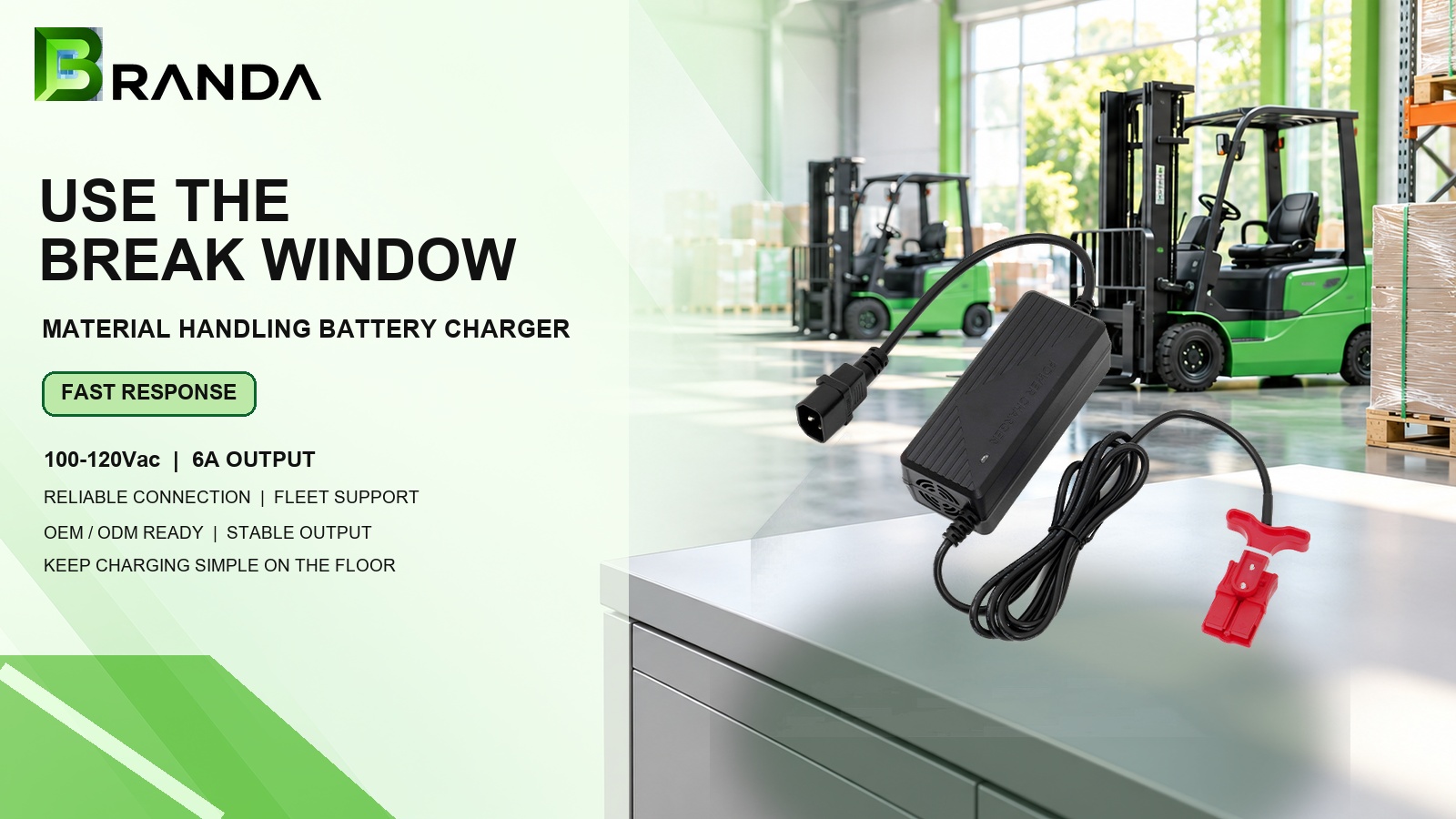
The numbers I would carry into the RFQ are simple:
| Product detail | 321440001 reference | Still to be checked |
|---|---|---|
| Output | 29.6V / 6A / 144W | Battery limit and test condition |
| Input | 100-120Vac, 50-60Hz | Warehouse outlet and plug |
| Connection | Red clamp-style | Polarity and operator sequence |
| Cable | 200mm shown | Station layout and movement |
The input line deserves a warning. If the warehouse outlet is 220-240Vac, I would stop and ask for the correct variant. Changing the plug is not the same as changing the input design. I would record the outlet voltage, frequency and plug before a sample is ordered. The label, input range and approval documents should describe the same finished unit.
Next I would time the break. A 15-minute break and a 45-minute break are different jobs. So are one truck and eight trucks. I would record the number of vehicles, their battery state when they arrive, the energy that has to be returned and how many connection events happen each day. The 144W value is a reference, not a promise that the battery receives 144W for the whole break. Current may taper and the battery may limit it.
A quick station note might look like this:
- Break: 30 minutes
- Trucks at the station: 3
- Battery state on arrival: to be measured
- Repeated partial charging: battery maker to approve
- Operator: trained maintenance staff
That is more useful than writing “fast opportunity charging” in a purchase request.
For the sample, I would ask one operator to park, inspect, connect the red clamp, start charging, stop and disconnect. I would watch the hands rather than stand behind the desk. Does the operator pull the cable? Is the positive side obvious? Can the clamp be placed without touching nearby metal? What happens when the battery cover closes? Those small observations are often where the final cable or work-instruction change comes from.
After repeated use, look at the clamp jaws, insulation and cable exit. In a dusty warehouse, include cleaning. Measure the case and connector after the planned cycle, not after two minutes on an open bench. If the charger will sit beside a warm battery or inside a shelf, test it there. “Industrial lithium battery charger manufacturer” describes the supplier category; it is not an environmental rating.
For acceptance, I would keep the record short: model and revision; 100-120Vac input; 29.6V/6A test condition; red clamp and polarity; cable route; operator step; thermal note; open action owner. A conditional pass is fine if it says who will change what and by when.
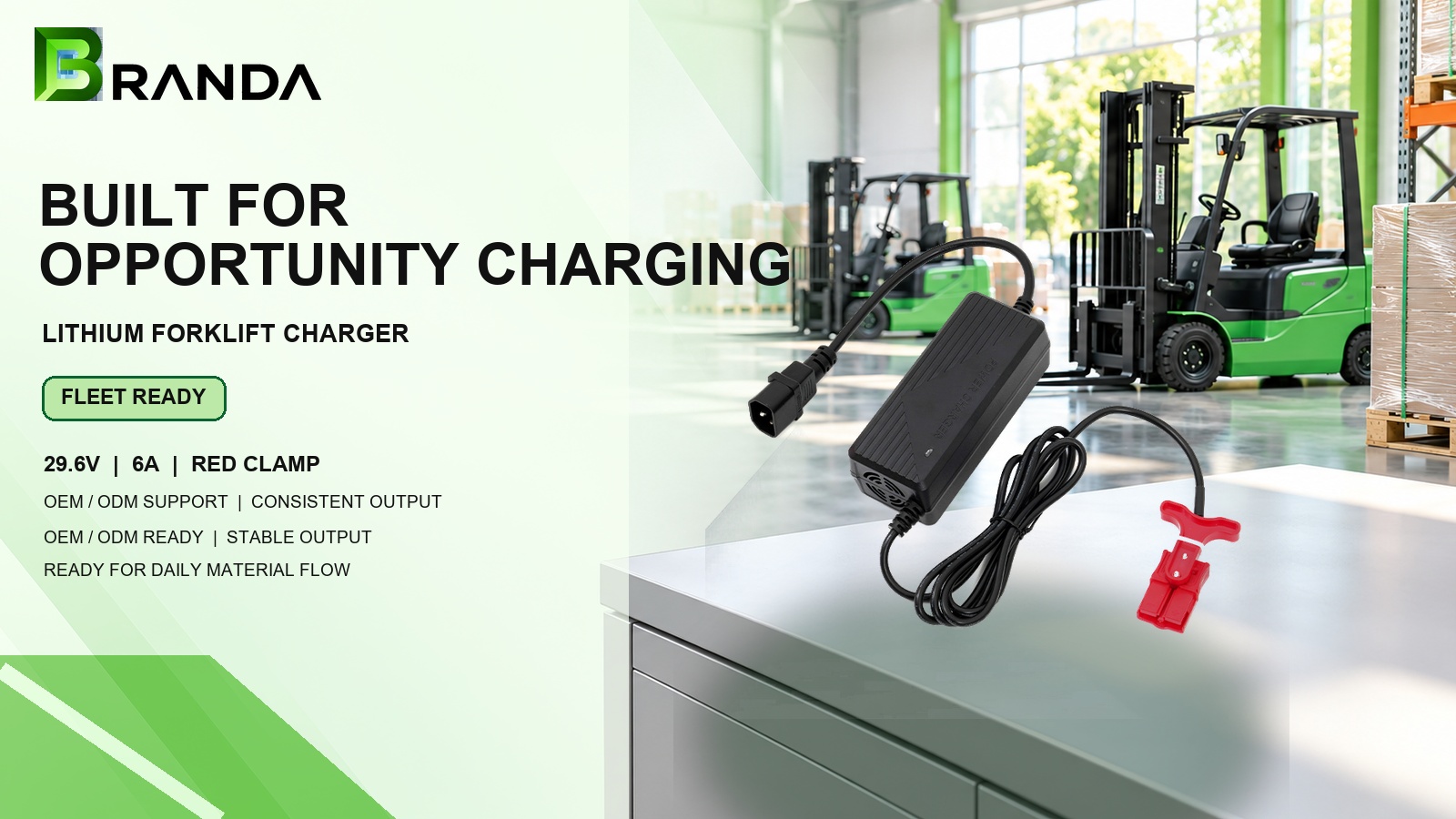
The quotation can include the input variant, red clamp, cable, label, packaging, sample and inspection record. If a fleet needs a custom harness or AGV battery charger OEM integration, list that separately. Automatic docking and charge-enable signals are not included just because a product is used around forklifts. The Bolanda OEM/ODM process and logistics lithium equipment charger category are useful starting points. Send the battery limits, break schedule, fleet count and site input through the inquiry page before production.
One thing I would not do is copy a competitor's charge-time claim into this RFQ. It may have been measured with a different battery, a different input and a different temperature. I would rather leave one line marked “to be measured” than promise a result that the maintenance team cannot reproduce. When the sample returns, the operator's comments belong beside the meter readings. If the clamp is easy to connect but hard to store, that is still a real finding.


