OEM manufacturing guide · Bolanda Electronics
A PCBA manufacturer should be evaluated on its ability to reproduce an approved assembly, not simply populate a board. For an OEM project, the practical starting point is a controlled bill of materials, matching fabrication and assembly data, a defined test plan, and a pilot build with written release criteria. These records connect the design you approve to the boards you receive.
This guide explains how to move an electronic assembly from an engineering file package into repeatable production. It is written for equipment brands, purchasing teams and engineers who buy control boards or power electronics. The emphasis is on decisions that affect a real order: who can approve a component substitution, which faults the production tests cover, what belongs in a pilot report, and when a quotation is ready to become a purchase order.
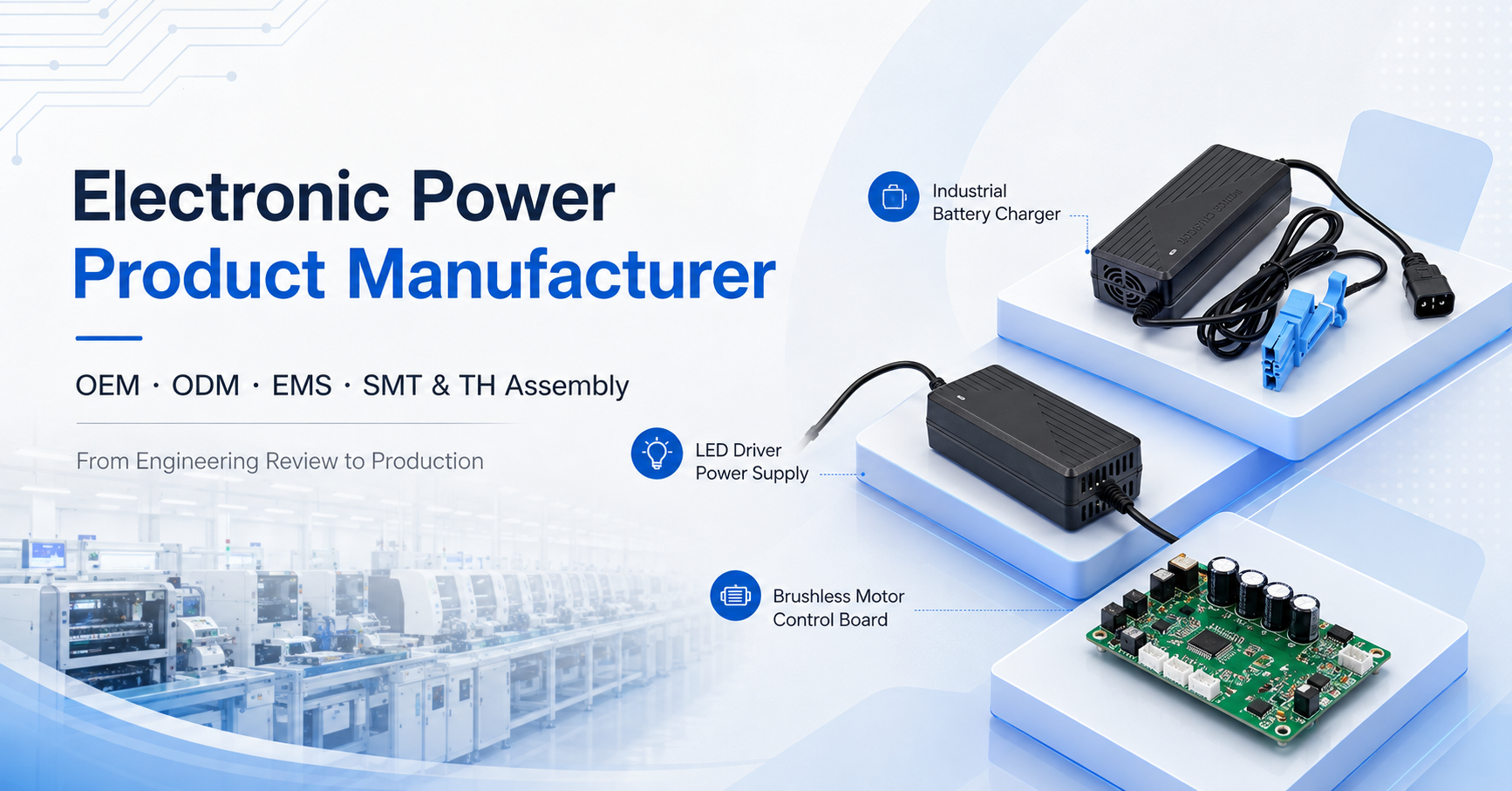
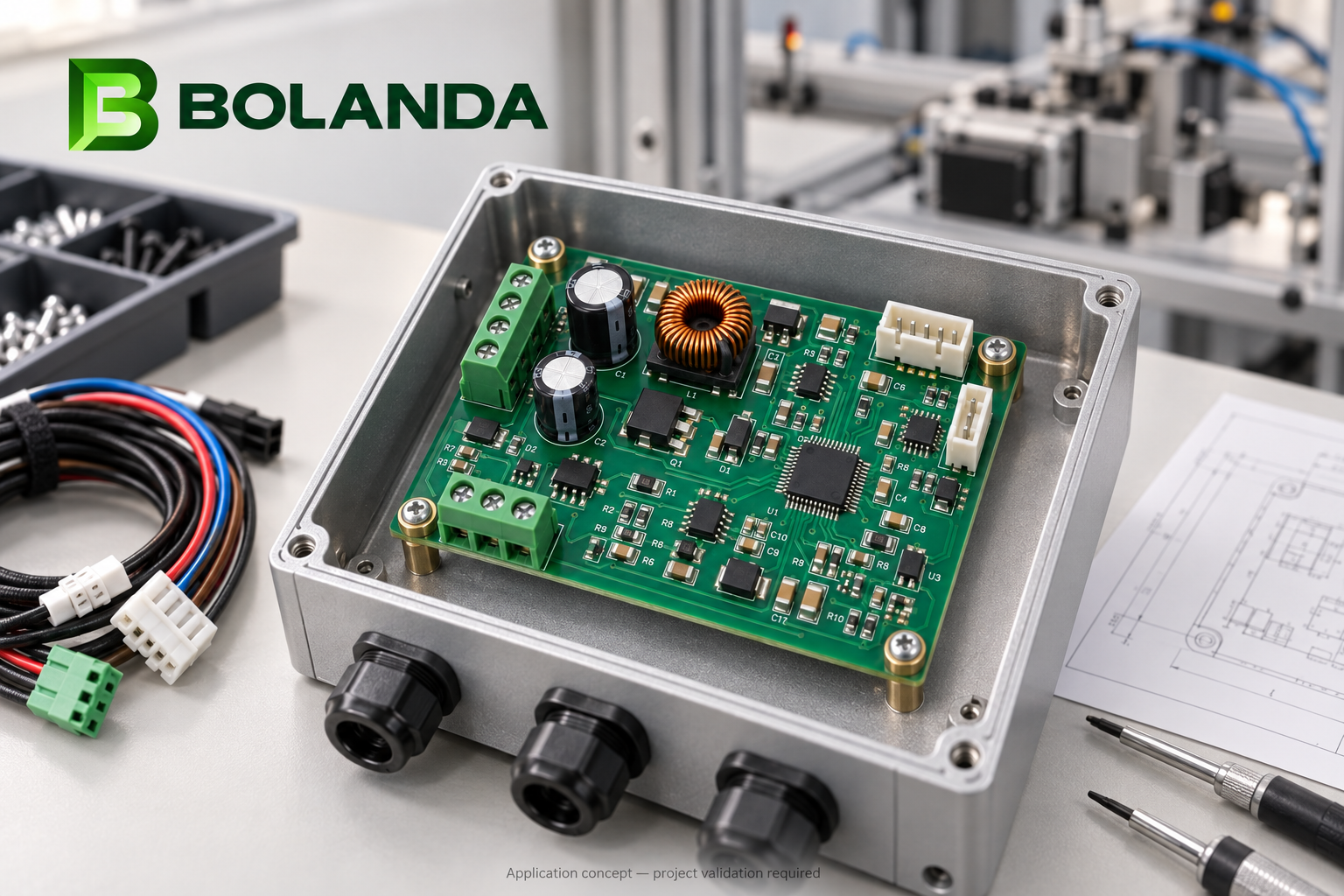
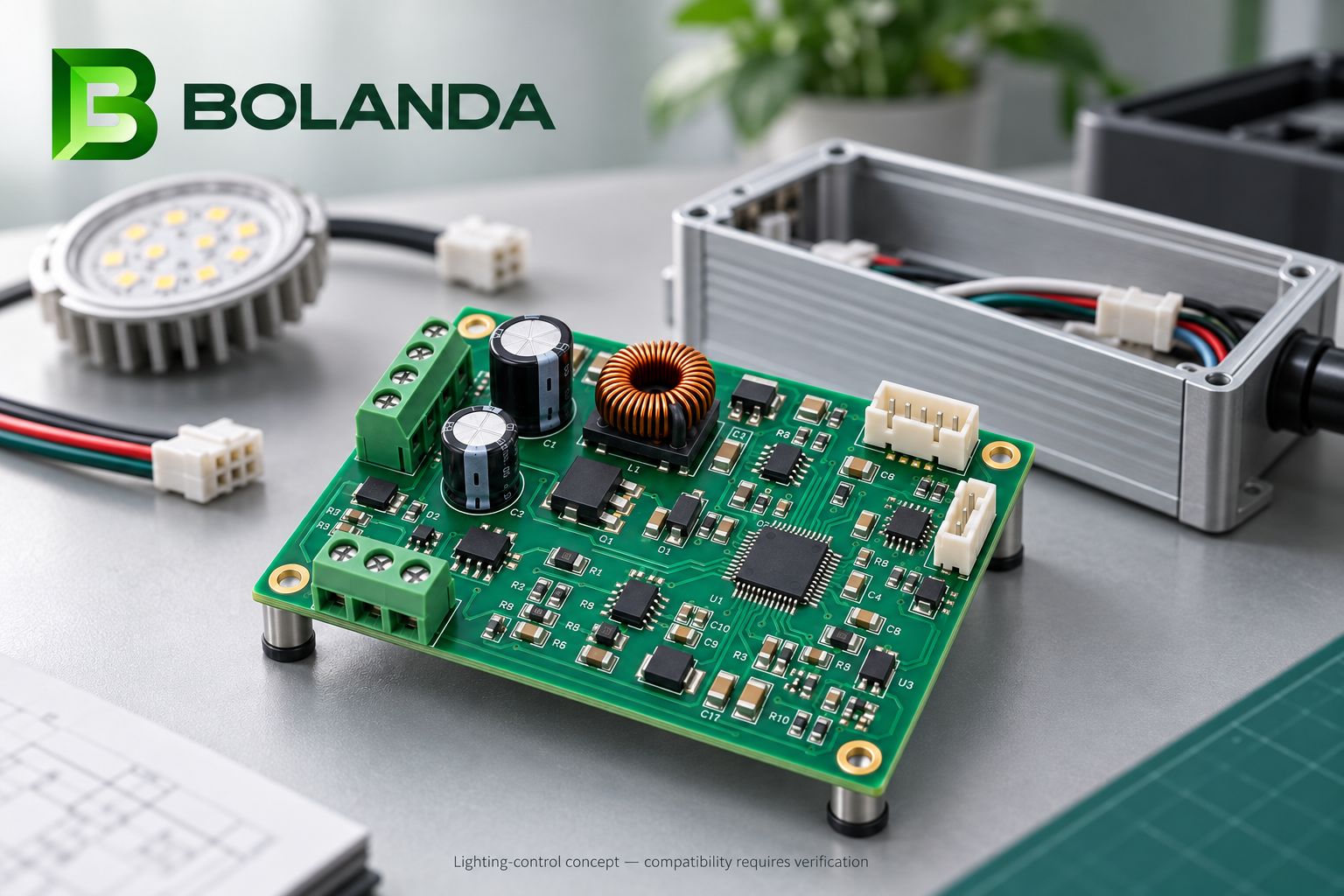
PCBA means printed circuit board assembly: the board with its installed components. Buying a bare PCB, buying an assembled board and buying a finished charger are different scopes. Clarifying that boundary early prevents a buyer from comparing a board-only offer with a complete product proposal. The illustrations here are conceptual PCBA visuals supplied for this article; they do not establish a particular model, circuit function or electrical rating.

What should an OEM expect from a PCBA manufacturer?
Expect a defined manufacturing scope and an evidence trail. At a minimum, the discussion should identify who supplies the bare boards and components, who controls the design files, which assembly operations are included, how the finished assembly is tested, and what happens when a requirement cannot be met. A supplier may provide some or all of these services. The quotation should say which ones.
The distinction matters when a board also needs programming, calibration or integration. A physically complete assembly can still be unusable if its firmware is missing or its connector pin assignments differ from the machine harness. A purchasing description such as “assemble according to the BOM” is therefore incomplete whenever the product depends on information outside that document.
Ask the PCBA manufacturer to walk through one proposed production route for your design. Follow a board from receiving inspection through component placement, soldering, inspection, programming, electrical testing and packing. Mark each operation as required, optional or outside the supplier's scope. This conversation reveals practical gaps much faster than a broad list of manufacturing capabilities.
For a Bolanda enquiry, describe whether you need assembly to your released design, support reviewing a power or control-board project, or a finished electronic power product. The appropriate route and available services should be confirmed against your documents. That keeps the first technical discussion focused on the deliverable your business actually needs.
Start with a controlled manufacturing file package
The file package is the production reference, not a collection of attachments from different stages of development. Give it an assembly part number, a revision and a release date. Include a short index showing the files that belong together. A supplier should be able to identify the approved configuration without guessing which email contains the newest drawing.
For most assembly reviews, the package includes the bill of materials, fabrication data, assembly drawings, component placement data and any special instructions. Depending on the agreed scope, it may also include a schematic, mechanical constraints, programming files and test requirements. The exact formats can be agreed with the manufacturer. Consistency across the files is more important than the name of the archive.
Resolve simple conflicts before purchasing material. If a component appears in the placement file but is marked “do not populate” on the BOM, which instruction wins? If the drawing calls for a different connector orientation, who approves the correction? Record the answer in the release package. An informal message can explain a change, but it should not become the only place where that change exists.
Keep confidential design information within the agreed document exchange process. An initial enquiry can describe the board, application, quantities and service needs without exposing the entire design. Once confidentiality and access requirements are settled, share the files needed for the actual engineering and commercial review.
| Document | Decision it supports | Check before release |
|---|---|---|
| BOM and approved alternatives | Which exact parts may be fitted | Manufacturer part numbers, quantities, reference designators and population options agree |
| Fabrication data and board specification | Which bare board is being assembled | Revision, dimensions, stack-up and specified materials match the design |
| Placement data and assembly drawing | Where parts go and how they are oriented | Origin, units, rotation, polarity and special mounting details are clear |
| Programming and configuration files | Which software state belongs to the unit | Release identifier, programming steps and verification method are stated |
| Test specification | What determines pass or fail | Conditions, limits, connections and record requirements are agreed |
| Packaging and labels | How boards are identified and delivered | Serial or lot marking, protection and shipping configuration are defined |
BOM review: separate a description from a purchasable part
A line reading “10 microfarad capacitor” is a description, not a complete purchasing instruction. Package, tolerance, voltage rating, dielectric and other characteristics can matter to the design. Similar issues occur with connectors, oscillators, switching devices and magnetic components. Use a specific manufacturer part number where the design requires a particular part, and identify the criteria for any proposed alternative.
Review reference designators as carefully as quantities. The manufacturer needs to know which positions share a part and which are intentionally left unpopulated. A board family with several variants should have a clear population matrix or separate released BOMs. Otherwise, a correct component can be installed on the wrong variant and still look entirely normal during a visual review.
Ask the supplier to return a list of unresolved BOM lines before you approve procurement. Typical questions concern incomplete part numbers, unavailable packaging, uncertain lifecycle status or a proposed substitution. Assign an owner to each question and preserve the answer. A clean question log is more useful than a quotation that quietly assumes every ambiguity has already been resolved.
Do not approve an alternative merely because its headline values match. The design owner should review the relevant electrical, mechanical and environmental differences. Some substitutions may need additional validation. Identify that work before treating the replacement as production-ready, especially where the component affects protection, timing, temperature behavior or a regulated product configuration.
Turnkey, consigned or mixed sourcing: choose ownership deliberately
In a turnkey arrangement, the agreed supplier purchases the materials within its scope. In a consigned arrangement, the customer supplies some or all materials for assembly. Many projects use a mixed model. None of these choices removes the need to define receiving checks, shortage handling, approved sources and responsibility for material problems.
Turnkey sourcing can reduce the number of purchasing activities the buyer manages directly. It also makes the approved source and substitution rules important. State whether the supplier may suggest alternatives, what evidence accompanies a suggestion, and who must approve it. An urgent delivery request should not silently change those rules.
With consigned parts, agree how materials will arrive. Loose parts, partial reels and opened moisture-sensitive packaging can require additional handling or investigation. The supplier should tell you what quantities and packaging it needs, including reasonable setup or process allowance where applicable. Avoid imposing a blanket allowance without reviewing the part, the process and the order size.
For either model, establish how excess stock is reported and owned. A component purchase may exceed the immediate build quantity because of its order increment. The commercial agreement should distinguish finished assemblies, unused inventory and noncancelable material commitments. These details are often more consequential to a small production run than a minor difference in placement cost.
DFM review should end with decisions, not a generic report
Design for manufacturing, or DFM, asks whether the proposed design can move through the intended process consistently. For an assembly project, useful questions include access around connectors, component spacing, board support, panel handling, fiducials, mounting hardware and the sequence of operations. Bare-board manufacturing questions may also need coordination with the PCB fabricator.
A useful DFM finding identifies a location, explains the process concern and proposes a decision. “Improve manufacturability” does not help an engineer close an issue. “Confirm clearance for the planned tool at connector J3 before approving the assembly sequence” is actionable. The team can accept a change, select another process or document why the existing arrangement is suitable.
Distinguish mandatory corrections from optional improvements. A missing orientation instruction may block a build. A proposed panel change may mainly affect efficiency. Treating every suggestion as equally urgent can delay a project unnecessarily; dismissing every suggestion as a supplier preference can leave an avoidable production problem unresolved.
Any accepted design change should return to the controlled package. Do not let manufacturing modifications create an undocumented version of the product. If the pilot build uses a temporary exception, name the affected units and state whether the exception may continue. DFM closes a loop between design and production; it should not create a second, unofficial design record.
Power electronics need layout and installation review together
Power boards place extra emphasis on how the circuit is arranged physically. Current paths, switching nodes, return paths and heat flow are part of the engineering review. A visually tidy assembly does not prove that its layout meets the application's electrical or thermal requirements. Equally, assembly inspection alone cannot validate a circuit design.
Texas Instruments' 2021 training, “PCB layout guidelines to optimize power supply performance,” discusses layout parameters and their influence on power supply behavior. It is a useful technical reference for understanding why component placement and interconnection belong in the design review. It does not certify the example boards shown in this article or describe Bolanda's production results.
The enclosure can change the operating conditions substantially. Identify the intended mounting position, nearby heat sources, available airflow, wiring space and mechanical support. If a component needs contact with a thermal interface or a housing, describe the assembly requirements and how they will be checked. Bench performance and installed performance should not be treated as interchangeable.
Leave application-specific limits to the approved engineering specification. Trace dimensions, separation distances and temperature limits cannot be selected from a photograph or a general blog. The buyer's role is to ensure that the responsible engineers have defined the requirements and that the manufacturing and verification plans refer to the same design.
Define soldering workmanship and acceptance before the pilot
The phrase “high quality soldering” is too broad to settle a production acceptance question. Agree the workmanship reference, applicable revision, product class where relevant, and any additional customer requirements. The agreement should also state how exceptions are reviewed. A reference standard is useful only when both parties understand how it applies to the supplied assembly.
IPC describes IPC J-STD-001 and IPC-A-610 in its announcement of the J revisions as addressing assembly process requirements and acceptance criteria. They serve related purposes and should be specified deliberately. Citing these publications here is technical context, not a claim that Bolanda, a particular operator or a pictured board holds an IPC qualification.
Discuss special materials and operations as part of the work instruction review. Components may have handling restrictions; some assemblies require cleaning, selective protection or additional mechanical retention. Each requirement needs a defined process and an inspection method. More process steps do not automatically mean a better product if their suitability has not been established.
When a workmanship issue appears during the pilot, record the location and the disposition. Decide whether the assembly can be accepted, requires approved rework or must be rejected. If rework is allowed, define how the repaired unit is reinspected and retested. The pilot should establish a repeatable decision process, not just produce a few acceptable-looking boards.
Build a test coverage map instead of asking for “100% testing”
“Every board is tested” describes how many boards enter a test step. It does not describe which faults that step can detect. Start by listing the important product requirements and then assign a verification method to each. Some requirements can be checked during manufacturing; others need design validation or evaluation in the finished equipment.
For example, an optical inspection can help identify visible placement or soldering issues within its configured coverage. It does not establish that a board executes its firmware correctly under load. A functional test can verify defined behavior through accessible interfaces, but it may not detect every assembly defect. Ask what remains outside the proposed test coverage instead of assuming that one machine covers the entire product.
Test limits should be explicit enough to produce the same decision on another day. Record the supply conditions, loads, connections, software versions and measurement method. A statement such as “output looks normal” is difficult to audit. A defined result with an agreed limit and a saved unit identifier is a production record.
Bolanda project discussions can start with the tests you already use. If your team has no production test procedure, identify that as a development task. Fixture design, programming, test software and validation have their own scope and schedule. They should be considered before a promised delivery date depends on them.
| Verification layer | Useful question | Important boundary |
|---|---|---|
| Incoming material checks | Do received parts and boards match the approved purchasing requirements? | Receiving checks do not prove the finished circuit works |
| Placement and solder inspection | Are the inspectable assembly features acceptable? | Coverage depends on access, process and inspection setup |
| Programming verification | Was the intended software or configuration written and checked? | Correct programming alone does not validate all product behavior |
| Electrical or functional test | Does this unit meet the agreed measurable conditions? | Only the specified modes, limits and conditions are covered |
| System validation | Does the design work in the intended equipment and environment? | Usually broader than a routine production screen |
| Final release review | Do records, identification and packing match the order? | Release relies on the agreed evidence being complete |
Request a PCBA Manufacturing Review
Programming, calibration and traceability belong in the build
A software-controlled assembly needs a software release process as well as a hardware release process. Specify the file to be loaded, the configuration settings and the verification method. Give the production team a clear way to tell a programming failure from a hardware failure. If different customers or markets use different configurations, include that distinction in the assembly identification.
Where calibration is required, define what is adjusted and where the result is stored. Identify the equipment and reference conditions needed for the agreed procedure. Calibration data may need to remain associated with an individual unit rather than only with a production lot. The retention and delivery requirements should reflect how the product will be serviced.
Traceability should answer a practical question: can the team determine what was built and which records apply to it? The necessary depth varies by project. It may involve assembly revision, production lot, material records, firmware version and test result. Collecting more fields is not helpful if the records cannot be connected reliably to the physical board.
Also decide what information must not appear on labels or in shared reports. Customer names, sensitive configuration details and proprietary file references may need controlled handling. A traceability plan should support investigation and service while respecting the agreed confidentiality requirements.
A pilot build is a production rehearsal with a release decision
The pilot is not merely a smaller purchase order. Its purpose is to test the proposed manufacturing route and reveal issues before volume increases. Build quantity should be chosen around the learning objectives, material constraints and project risk. There is no universal pilot quantity that proves every board is ready for production.
Write the pilot questions in advance. Can the parts be handled as planned? Are orientation instructions clear? Does the fixture make reliable contact? Is test time compatible with the production plan? Can failures be classified and investigated? Can packaging protect the finished assembly? A pilot report should answer these questions with observations from the actual build.
Separate defects from process interruptions. A component shortage, a fixture contact problem and a genuine electrical failure create different corrective actions. Combining them into a single failure count obscures the cause. Ask for a clear description of what happened, which units were affected and how each issue was resolved.
Release the next stage only after the designated owners accept the evidence. An unresolved item may be closed, assigned a controlled exception or held for additional work. What matters is that the decision is explicit. A successful demonstration of one board should not silently authorize a production lot with different material, firmware or process settings.
Read pilot yield numbers with their definitions attached
Yield figures are useful only when the counting rules are clear. First-pass yield usually concerns units that pass the defined process or test without rework, while a final yield may include units recovered after rework. The report should define the terms it uses, the denominator, the stage being measured and the treatment of retests.
Consider a hypothetical pilot of 100 boards. If 94 pass the agreed first test, four pass after approved rework and two remain unresolved, the first-pass result is 94 out of 100 and the accepted total at that point is 98 out of 100. Reporting only 98% hides the rework activity. This is an arithmetic example, not a Bolanda production result or a recommended acceptance threshold.
Look at the distribution of failures as well as the percentage. Several faults at the same component location may point toward a different investigation than unrelated failures scattered across the build. The sample size also matters: a small pilot can identify issues without establishing a precise long-term failure rate.
Agree the production release criteria before looking at the results. Otherwise, the pressure to ship can turn an observed number into an improvised target. A useful discussion combines yield definitions, defect categories, corrective actions and remaining risks, then decides whether the process is sufficiently understood for the next order.
Set change control before approving volume production
A production order does not freeze the outside world. Parts become unavailable, drawings are corrected and software changes. The question is how these changes enter the product. Define which changes require customer approval, what evidence accompanies the request and how affected inventory will be identified.
A practical change notice describes the existing condition, proposed condition, reason for the change, affected assemblies and planned implementation point. It also states the verification needed before release. Some changes may be limited to documentation; others may alter electrical behavior or the product's approval status. The responsible design and quality teams should make that assessment.
Pay attention to transition stock. Old and new revisions may coexist in component inventory, work in progress or finished goods. Decide whether they can be mixed within a shipment and how the receiver can distinguish them. A change that is controlled in the drawing system but invisible on the shipped product can still create service confusion.
Include replacement fixtures and test software in the control process. A changed test limit or fixture connection can alter the meaning of a pass result even when the board itself is unchanged. Production consistency depends on the approved product and the approved verification method moving together.
Compare PCBA cost using the complete manufacturing scope
An assembly price is meaningful only alongside the work it includes. Separate recurring unit cost from nonrecurring engineering, fixtures, tooling and setup charges. Identify the quantity basis and quotation validity. A low unit price may exclude programming, test development or material commitments that another supplier has included.
Do not compare a prototype quote directly with a volume quote without reviewing the assumptions. Procurement quantities, machine setup, manual operations, inspection and test time can be distributed differently. Request the relevant quantity breaks and ask which changes would make the price move. This gives purchasing a useful model rather than an unexplained headline number.
Testing should appear as a defined scope, not a vague surcharge. If the buyer wants a new functional fixture, establish who owns it, who maintains it and what happens if the product is transferred. The same questions apply to programs, stencils and other project-specific production assets where relevant.
Finally, include packaging, delivery terms and the treatment of unused materials. The least expensive quotation on a spreadsheet may become more costly if it creates avoidable inventory or requires extra work before boards can be used. Compare the cost of the agreed usable assembly, with the same acceptance and delivery assumptions.
| Commercial item | Question to resolve before ordering |
|---|---|
| Recurring assembly price | Which material, assembly, inspection, programming and test activities are included? |
| Engineering and test setup | Which one-time tasks need payment and what deliverables result? |
| Quantity and material commitments | What order increments, excess inventory or noncancelable commitments apply? |
| Fixtures and production assets | Who owns them, stores them, maintains them and may transfer them? |
| Packaging and shipment | What protection, identification, delivery point and shipping terms are quoted? |
| Change and repeat-order pricing | Which changes require requotation and how are repeat builds referenced? |
Plan lead time around the longest unresolved dependency
A quoted assembly duration is not the same as the time from the first enquiry to usable boards. File clarification, material availability, engineering changes, fixture development and sample approval may all sit before shipment. Ask the manufacturer to show the main dependencies and the event that starts each stage.
For a repeat build using an unchanged approved package, the planning discussion can be relatively direct. A new design requires more coordination. If test requirements are still open, a precise shipment promise may rest on an assumption that neither side has acknowledged. Resolve that assumption or state the schedule condition clearly.
The buyer can often help by naming approval owners and response dates. A pending connector decision can delay purchasing just as effectively as a supplier shortage. Keep one list of open questions, with the consequence of each delay visible. This is especially useful when engineering and purchasing work in different locations.
Ask what can proceed safely in parallel and what should wait. Ordering long-lead material before design release may reduce elapsed time, but it can also create unusable inventory after a change. The commercial and technical owners should understand that tradeoff before authorizing early procurement.
Packaging, incoming inspection and field feedback complete the loop
A board can leave assembly in acceptable condition and arrive damaged if packing does not match its handling needs. Agree suitable electrostatic protection, physical separation, cushioning and identification for the product. Tall components, exposed connectors and heavy parts may need particular attention. Packaging should be evaluated with the actual assembly rather than chosen solely from a generic catalogue.
Define the buyer's receiving checks in advance. Identify which documents travel with the shipment, how lots are marked and what the customer will inspect or test on arrival. If acceptance includes a system-level evaluation, distinguish that from the manufacturer's release checks. Both sides should know how a reported problem will be investigated.
When a field issue occurs, preserve the evidence. Assembly identifiers, software versions, installation conditions and the observed symptom can be more useful than a brief statement that a board failed. Avoid altering a returned unit before the responsible teams agree how to examine it, particularly when modifications could obscure the original condition.
Feed the conclusion back into the appropriate record. A design change belongs in the design release; a process correction belongs in the manufacturing controls; a missing test may require an updated verification plan. Treating every return as a replacement transaction loses the opportunity to prevent the same problem in later orders.
Choose the product route that matches your deliverable
PCBA procurement overlaps with several electronic power applications, but the responsibilities are not identical. A buyer who owns a released circuit design may need board assembly. A buyer who needs a complete charger may need a finished-product project, including enclosure, cable, charging behavior and market requirements. Use the links below to start at the relevant product or service route, then confirm the exact scope with Bolanda.
The categories are enquiry routes, not a claim that the illustrated board can serve every application. In particular, battery chemistry, charger settings, motor control requirements and lighting interfaces need their own engineering review. A similar-looking board is not evidence of electrical interchangeability.
| Relevant procurement route | Information that makes the enquiry useful |
|---|---|
| pcba manufacturer | Assembly or engineering-service discussion: specify who owns the design and supplies materials. |
| power supply PCB assembly | Power-board project review: include electrical, thermal, layout and verification requirements. |
| power tool battery charger manufacturer | Finished tool-charger enquiry: identify the battery platform and approved charging conditions. |
| custom lithium battery charger manufacturer | Custom charger review: provide the pack specification and required product configuration. |
| e bike charger manufacturer | E-bike charging project: confirm pack, interface and intended market. |
| electric motorcycle charger manufacturer | Vehicle-charger enquiry: clarify charging power, installation and system integration. |
| industrial lithium battery charger manufacturer | Industrial charging enquiry: describe duty cycle, environment and operational constraints. |
| LED driver manufacturer | Lighting supply project: identify load, output behavior and control requirements. |
| brushless motor controller manufacturer | Motor-control board enquiry: specify motor, sensors, operating modes and protection needs. |
| AC DC power adapter manufacturer | Adapter project: confirm input, output, connector and complete application requirements. |
| mobility scooter battery charger supplier | The linked example is a lead-acid charger; confirm chemistry and model suitability before selection. |
Finished-product context: supplied charger overview video
The supplied video below shows a finished charger as an example of the type of electronic power product a board project may ultimately support. It is not footage of PCBA assembly, inspection or testing. Use it to frame a discussion about the boundary between a board-level order and a complete product project; do not infer an internal circuit design or performance rating from the housing shown.
PCBA manufacturing questions buyers ask before ordering
Can I request a quote before the design is finished? Yes, an early discussion can identify likely scope and missing information. Describe the design status honestly. A preliminary estimate should be distinguished from a quotation based on a released package, and its assumptions should be revisited when the files change.
What is the minimum order quantity? It depends on the board, materials, setup and agreed service scope. Ask for sample, pilot and repeat-order quantities separately. A component purchasing constraint is not necessarily the same as an assembly minimum, so request that distinction in the proposal.
Can a lower-cost component be substituted? A proposed alternative needs review against the design requirements. Ask for the exact part, the reason for substitution and any additional validation needed. Written approval should precede production use where the agreed change-control process requires it.
Does a passed functional test prove long-term reliability? It proves only that the tested unit met the defined conditions at that stage. Design validation, environmental evaluation, process control and field performance address other questions. Match the evidence to the claim instead of treating one pass result as a universal guarantee.
Who owns my design files and test fixture? Agree ownership, permitted use, access and transfer terms before ordering. Confidentiality arrangements and production asset ownership are related but separate subjects. State both clearly, including what happens when a project ends or moves to another supplier.
How can I make repeat orders consistent? Reference the approved assembly revision and the applicable manufacturing package. Confirm the material and software configuration, accepted changes, test procedure and packaging requirements. Reusing an old purchase-order description alone may miss an important revision made since the previous shipment.
Can Bolanda quote a board and a complete product? Describe both requested deliverables and ask the team to confirm the applicable service route. A board assembly and a complete electronic power product require different information and may have different validation responsibilities. Do not assume one quotation automatically includes both.
Send a project brief that starts a productive technical review
For your first enquiry, state the application, whether you need an assembled board or a complete product, the design status, target market and expected quantities. List the manufacturing documents you can provide. Include your intended sample date and the main technical question you need answered. If confidential files are involved, request the agreed exchange process before sending them.
For a more detailed review, add the assembly revision, sourcing preference, proposed test coverage, programming requirements, mechanical constraints and any required acceptance reference. Identify open decisions instead of hiding them. The manufacturer can then explain what is ready to quote, what needs clarification and which development activities need a separate scope.
Use the contact form to send the project summary and ask how to share the supporting package. A useful enquiry is not necessarily the longest one. It gives the team enough context to identify the right service, the responsible technical questions and the next approval step. That is the foundation for a PCBA order that can be built, checked and repeated.