

Branda Buyer Guide / Electric Motorcycle Charging
A daily commuter notices charger quality in small, repeated details. The connector must be easy to reach in the parking position, the housing must sit securely while the rider prepares the motorcycle, and the cable must return to its storage point without becoming a trip hazard. For fleet buyers and independent riders alike, an electric motorcycle charger is not a generic accessory. It is part of the vehicle's operating routine.
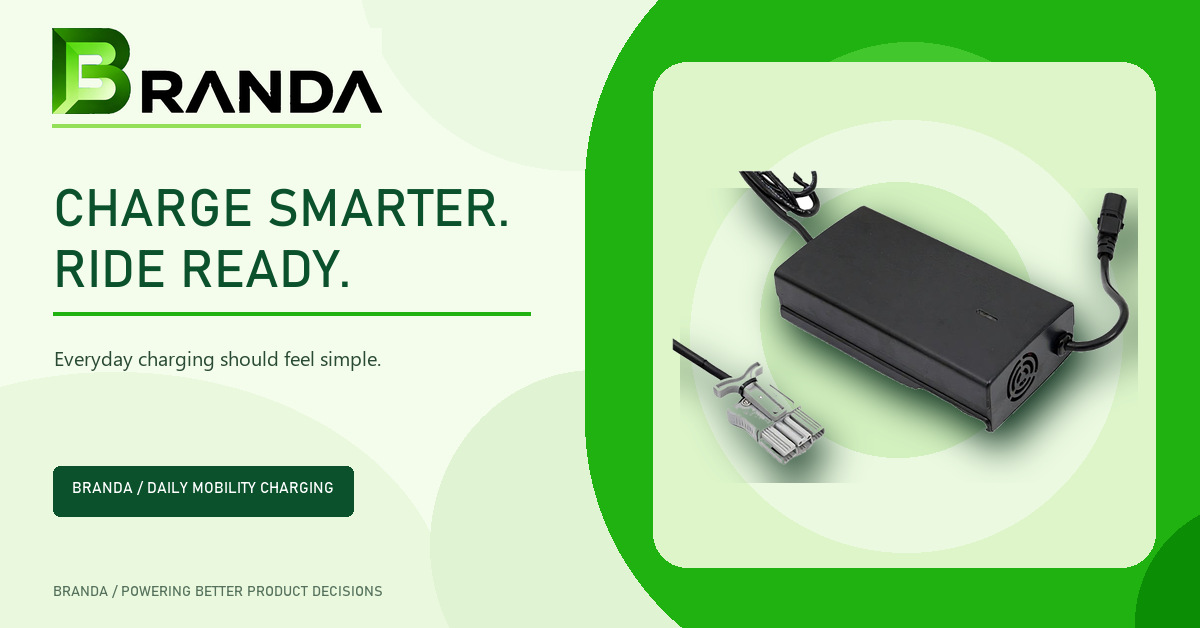
This guide explains how to evaluate a compact motorcycle battery charger without relying on appearance alone. It uses Branda 322880002 as the product reference because the supplied views show a slim charger body, a looped output cable and a compact connector. Those visible features help a buyer picture daily use, but they do not replace the battery record, mating drawing or project-specific approval.
Start with the commuting routine, not the product photo
The most useful buying question is not "which charger looks strongest?" It is "where will the rider stand, connect and disconnect this unit every day?" A home rider may charge beside a private parking space. A courier may rely on a staffed depot. A dealer may prepare several motorcycles in a workshop. Each setting creates different requirements for cable reach, connector access, ventilation clearance and storage.
Branda's electric vehicle charger category shows several product directions, but a shortlist should begin with the motorcycle battery. Record its chemistry, nominal pack information, BMS limits and the approved charging profile. Then record the physical charging space. A compact charger can solve a storage problem, yet no housing shape can compensate for a mismatched output or connector.
| Decision area | Question for the buyer | Useful evidence |
|---|---|---|
| Battery | Which charging profile and limits are approved? | Battery specification and BMS note |
| Connector | Which mating part is fitted to the motorcycle? | Drawing, photo and sample fit |
| Parking space | Is there a stable, dry resting point? | Site photo with normal vehicle position |
| Cable route | Will the cable touch wheels, heat or sharp edges? | Measured cable path |
| Market | Which input plug and label variant is required? | Destination and approval scope |
What the Branda product reference contributes
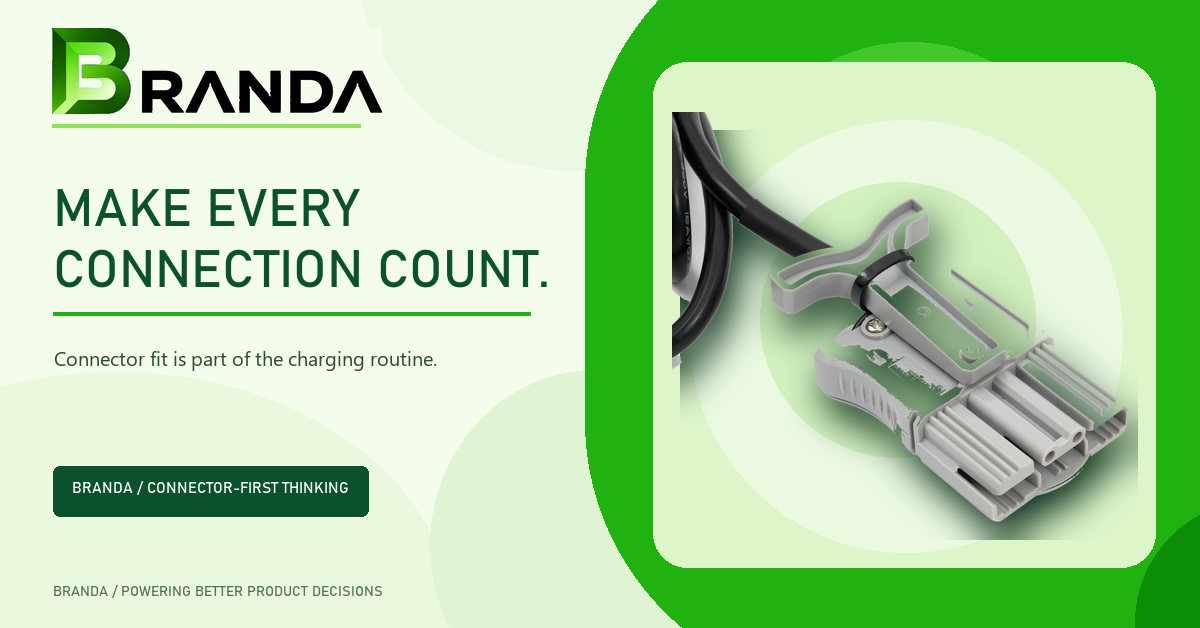
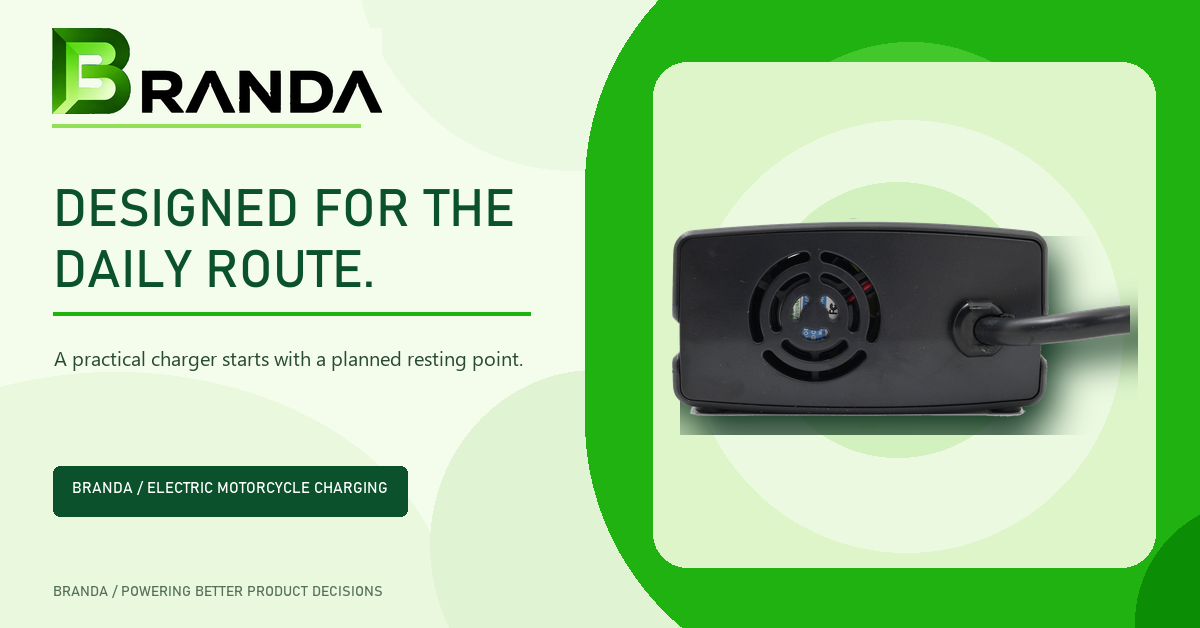
Branda 322880002 presents a very specific design direction. The housing is relatively slim, the cable creates an intentional loop around the body in the supplied product view, and the visible connector is compact enough to handle in a tight parking area. The vented end shown in another supplied view makes it clear that placement should leave room around the charger, even though the exact installation guidance still belongs in the final project documents.
For a commuter, those features matter because they reduce the number of decisions at the end of a ride. A flat body is easier to place on a shelf. A visible cable loop is easier to inventory after charging. A connector that can be gripped deliberately is easier to mate than an assembly that disappears under a fairing. These are practical observations from the product views, not claims about electrical compatibility or ingress protection.
How to compare daily commuter charger options
Price is only one part of the comparison. Buyers should separate visible product features from project evidence. A neat enclosure and a coiled cable are easy to see. A verified connector interface, controlled output, temperature behavior, documentation pack and market-specific input arrangement require technical review. The right scorecard therefore combines usability with traceability.
Usability review
Ask a rider to place the charger, connect it and store it after a short demonstration. Watch whether they need to move the motorcycle, stretch the cable or balance the unit on an unstable surface. If the rider must invent a new routine each time, the site or interface needs improvement. For an EV motorcycle charger, repeatability is a strong quality signal.
Data review
Confirm the required input and output information with the battery team. Avoid copying values from unrelated vehicles. It is also important to distinguish charger output from battery nominal voltage. A charger is matched to the approved charging requirement, not simply to a similar-sounding motorcycle category.
| Criterion | What to request | Why it matters |
|---|---|---|
| Battery compatibility | Approved profile and limits | Prevents an appearance-only decision |
| Connector interface | Mating part, polarity and keying | Reduces connection uncertainty |
| Physical fit | Housing size and cable reach | Matches the actual parking space |
| Thermal placement | Clearance guidance | Supports a repeatable installation |
| Documentation | Label, drawing and revision | Keeps the approved build traceable |
Connector fit deserves its own approval step
The connector is where the charger meets the motorcycle, so small interface differences become daily problems. Inspect the latch, pull direction, terminal arrangement and available finger space. A connector may look familiar while still differing in keying or polarity. Never infer these details from color alone.
The Branda quick-disconnect connector selection guide provides a useful framework for documenting the mating connection. For a portable electric motorcycle charger, the review should also include repeated connect and disconnect actions, visual inspection points and a clear way to identify the correct charger.
Build a specification sheet that survives quotation
Procurement teams often receive attractive brochures with too little usable data. A better information request is concise but complete. Ask the supplier to repeat the buyer's request, list open questions and mark assumptions. This turns the quotation into a controlled document instead of a price-only message.
A useful custom lithium battery charger specification worksheet should identify who owns each item. Engineering approves the electrical interface. Quality approves drawings and inspection points. The commercial team records packaging, quantity, destination and label requirements. Operations confirms the cable and storage routine.
| Record | Minimum content | Owner |
|---|---|---|
| Battery profile | Chemistry, BMS limits and approved values | Battery engineering |
| Connector file | Mating part, pinout, keying and photos | Electrical engineering |
| Use environment | Parking position, surface and cable path | Product or operations |
| Market build | Input plug, language and destination | Compliance and sales |
| Sample record | Version, test date and open actions | Project lead |
Validate the sample in the real parking space
A bench test cannot reveal every daily problem. Place the sample where the commuter normally parks. Route the cable naturally. Ask for the charger to be connected by someone who has not practiced the task. Then repeat the action with gloves if seasonal riding makes that necessary. These observations are inexpensive and reveal interface issues earlier than a post-launch complaint.
Prepare a short acceptance record
Photograph the charging position, the mated connector and the cable route. Record the charger revision and the motorcycle variant. Note any uncertainty separately from the approved items. If the sample cannot be repeated safely by the intended user, keep it in review instead of moving it into a pilot.
| Test | Method | Pass condition |
|---|---|---|
| Placement | Use the normal parking position | Stable position without improvisation |
| Connection | Mate the actual connector | No forced alignment or hidden release |
| Cable handling | Route and store after use | No rubbing, tension or trip loop |
| Identification | Ask another person to select it | Correct charger is obvious |
| Record | Photograph and label the sample | Build can be traced |
Routine checks that protect long-term use
A charger should be checked as part of normal motorcycle maintenance. The operator can look for cable damage, damaged connector parts, blocked ventilation openings or a label that has become unreadable. Any suspected fault should be handled under the manufacturer's instructions and local electrical safety rules; this article does not replace those instructions.
For B2B buyers, the maintenance record should connect the motorcycle, charger and connector variant. Branda's charger reliability engineering guide is relevant here because reliability is not only a component claim. It is the combination of a defined use case, approved interface, repeatable handling and a feedback loop.
| Checkpoint | Look for | Action |
|---|---|---|
| Housing | Cracks, looseness or blocked openings | Stop use and follow support guidance |
| Cable | Cuts, abrasion or exposed conductors | Isolate and arrange inspection |
| Connector | Damaged keying, latch or terminals | Do not force a connection |
| Label | Unreadable identity or mismatch | Replace under controlled process |
| Storage point | Heat, water exposure or trip risk | Improve the charging location |
Common mistakes in electric motorcycle charger selection
The first mistake is approving a charger from a photograph. The second is treating a familiar connector shape as proof of compatibility. A third is ignoring the user's normal parking space and relying on a clean demonstration area. These errors often appear before a charger is even connected because the approval process never asked for the right evidence.
For OEM programs, another risk is allowing connector, cable or label changes without revision control. A pilot charger that works is not enough if the production unit quietly changes. Put the approved sample, drawing and label in one file. When a request for change arrives, record the reason and recheck the affected interface.
| Risk | Weak approach | Better evidence |
|---|---|---|
| Wrong interface | Match by photos | Mating sample and controlled drawing |
| Poor placement | Copy a generic rule | Site-specific charging plan |
| Unclear identity | Rely on memory | Durable label and asset record |
| Untraced revisions | Keep a sales email | Approved build file |
| Unsafe handling | Use a trip hazard daily | Correct cable route and storage |
OEM and B2B considerations
A distributor evaluating a motorcycle charging equipment program should ask how the product will be described, packaged and supported, not only how it looks. Request label artwork approval, sample traceability and a clear route for technical questions. Confirm what is standard, what is optional and what requires new engineering work.
Branda's battery charger manufacturer service, OEM and ODM support, and Branda company profile provide routes into that discussion. A useful RFQ will identify the motorcycle platform, market and annual planning assumptions so the supplier can respond with relevant questions.
| Item | Include in project file | Review point |
|---|---|---|
| Product version | Housing, cable and connector revision | Before sample approval |
| Electrical request | Battery profile and protection assumptions | Engineering sign-off |
| Commercial scope | Forecast, packaging and destination | Quote comparison |
| Quality record | Inspection plan and sample result | Pilot release |
| After-sales route | Contact, documents and replacement process | Channel readiness |
Frequently asked questions
| Question | Short answer |
|---|---|
| Can a compact charger be used without checking the battery? | No. Match the charger to the approved battery and BMS charging profile. |
| Is a familiar connector enough? | No. Verify keying, polarity, terminals and the physical mating part. |
| Should the charger sit on the motorcycle? | Use the location and installation guidance approved for the exact product and project. |
| Why photograph the parking space? | It reveals cable reach, resting surface, obstacles and ventilation constraints. |
| What should a sample review record? | The tested build, motorcycle variant, photos, owner and open actions. |
| How should a B2B buyer compare prices? | Compare the same specification, documentation, sample scope and change-control process. |
| Can one charger serve several motorcycle models? | Only after each battery, connector and charging requirement is approved. |
Reference framework and next action
Charging-system decisions should be checked against the standards and regulations that apply in the destination market. IEC 61851-1 provides a general framework for conductive charging systems, while IEC 62196-1 and IEC 62196-2 address relevant connector topics. Mentioning a standard does not certify a product. The exact product scope, declarations and test evidence must be confirmed for the project.
A reliable daily electric motorcycle charger is the result of a disciplined comparison: approved battery data, confirmed connector fit, a sensible charging location and a traceable sample. Use Branda's charger product range and contact page to continue the review with a specific motorcycle platform and charging routine.
Make the next charger decision easier to prove
Send your motorcycle platform, battery information and charging-space photos to the Branda team. We will turn them into a focused charger review.
Request a charger reviewProduct images are Branda reference visuals. Electrical compatibility, connector approval, certification, packaging, MOQ and delivery must be confirmed for the exact project. This article is an editorial buying guide, not a substitute for the approved product instructions.


