

Branda Buyer Guide / Electric Motorcycle Charging
Sourcing an OEM electric motorcycle charger is a specification and validation exercise before it is a purchasing transaction. Two quotations can look comparable while one includes a controlled connector, documented sample and revision process and the other is based on broad assumptions. B2B buyers need to make those differences visible before they reach a purchase order.
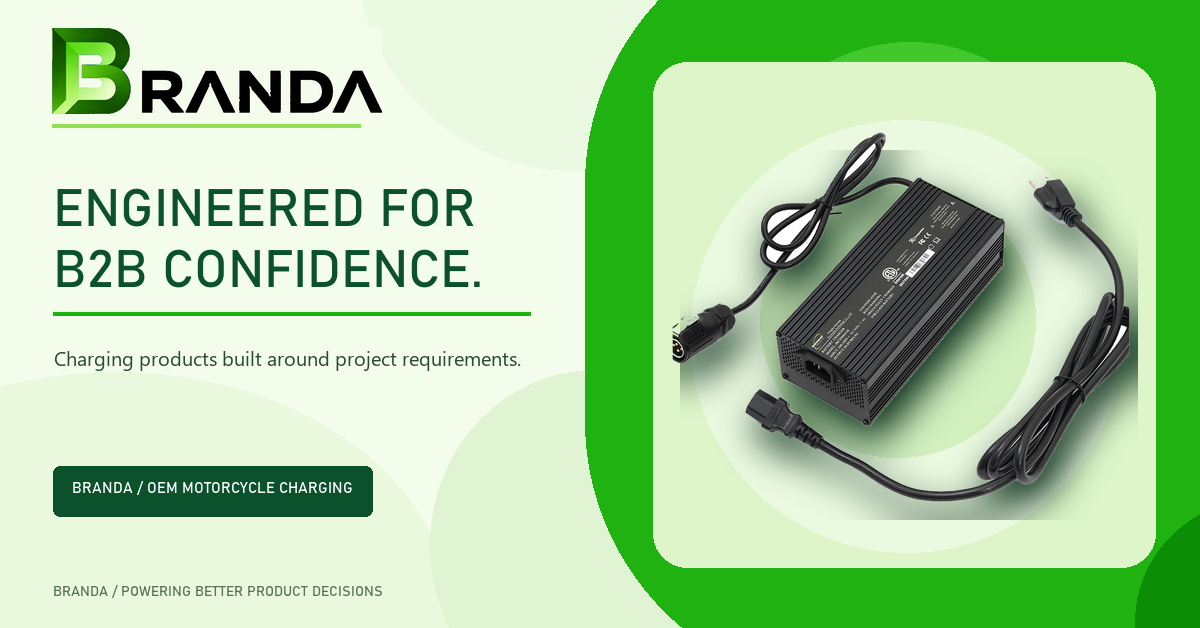
This guide uses Branda 324800002 as a reference for a product-led sourcing discussion. The supplied views show a ribbed charger body, visible ventilation at one end and a round connector assembly. The images indicate what should be examined physically, but they do not replace a controlled drawing, approved output profile or project-specific compliance review.
Define the project before asking for a price
A useful charger RFQ starts with the motorcycle platform and battery architecture. Record whether the program is a new model, an accessory line or a replacement product. State the market, expected use and whether the charger is sold with the vehicle or as a separate item. These details affect drawings, labels, packaging and the evidence required for approval.
For an OEM motorcycle battery charger, the buyer should also define which items are fixed and which may be adapted. Connector, cable exit, label, input plug and enclosure markings all need an owner. The supplier should not silently choose any of them.
| Brief item | Buyer decision | Supplier response |
|---|---|---|
| Vehicle platform | Motorcycle family and variants | Compatibility assumptions |
| Battery architecture | Approved charging profile and BMS data | Controlled electrical proposal |
| Connector | Mating part and cable direction | Exact charger-side assembly |
| Market | Destination, plug and label language | Build variant |
| Program scope | Vehicle-fit, accessory or aftermarket | Documentation plan |
Read the Branda product form as an engineering starting point
Branda 324800002 presents a long ribbed housing with a visible cooling end and a round connector. This shape invites questions that belong in an OEM review: how the charger is positioned, how the cable exits, what clearance is required and how the connector is keyed. The visible design does not by itself establish output values, protection ratings or certification.
The ribbed body and end-mounted fan are useful prompts for the installation drawing. A buyer should ask where the airflow openings will sit in the finished application and how the cable will be supported. These questions are often more valuable than a generic statement that a charger is "high power" or "durable."
Turn the battery requirement into a controlled specification
The electrical requirement should be written in a form that engineering and procurement can both read. Include the battery chemistry, approved charging limits, any communication assumptions and the required source arrangement for the target markets. Ask the supplier to identify what is standard, what is configurable and what remains open.
Branda's custom lithium battery charger specification worksheet is a useful way to structure the request. A precise worksheet reduces the chance that a low quote is based on a different electrical interpretation.
| Category | Required input | Expected output |
|---|---|---|
| Battery interface | Chemistry, limits and BMS requirement | Compatible proposal and assumptions |
| Charger output | Approved target profile | Controlled product specification |
| Protection | Vehicle and project risk review | Documented protection approach |
| Connector | Mating drawing and sample | Approved interface drawing |
| Compliance | Destination and product scope |
Applicable evidence list |

Control the connector as a separate engineering item
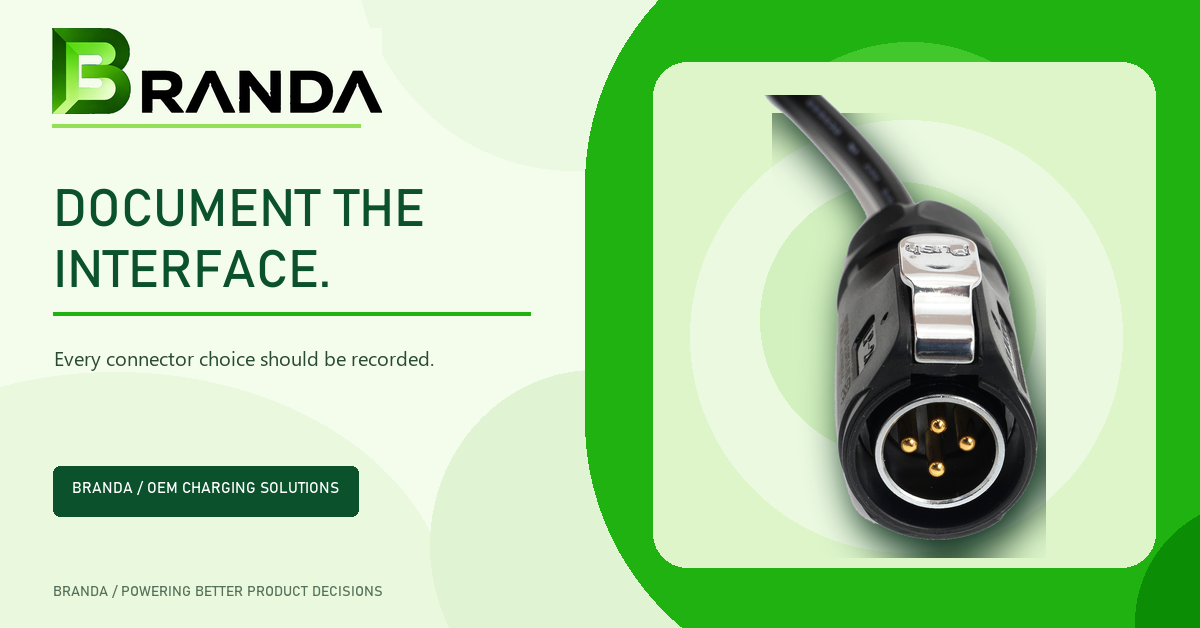
A charger drawing that shows the connector as a small note is not enough for a production program. The connector needs its own interface record, including terminal arrangement, keying, latch action and cable direction. Buyers should compare the physical sample with that record and keep the revision in the approved build file.
The Branda quick-disconnect connector selection guide can support the evidence structure. For an EV motorcycle charger, connector handling should also be evaluated with the vehicle bodywork and rider posture. A connector that works on a bench may be hard to reach after final assembly.
Plan thermal and mechanical integration early
The installation location should be part of the charger design conversation. Airflow, heat exposure, vibration, cable support and service access may all be affected by where the charger sits. Do not wait until a pilot review to ask whether the charger can be mounted or stored in the proposed vehicle location.
A final product drawing should distinguish the charger from the mounting or storage concept. If a bracket, tray or compartment is part of the system, its ownership and approval path should be clear. The vehicle team should not assume that a generic resting position is acceptable for the exact product.
| Question | Risk being reviewed | Evidence |
|---|---|---|
| Where will the charger rest or mount? | Airflow and cable routing | Installation concept |
| Which openings must remain clear? | Thermal placement | Product drawing |
| How is the cable supported? | Strain at body and connector | Routing plan |
| How will service access work? | Maintenance reach | Vehicle layout |
| What changes during the model year? | Build traceability | Revision process |
Build a sample approval file that can survive production
A sample should be linked to a specific request and revision. Record the date, product version, connector variant, label artwork and any open deviations. When the sample is tested, store photos and observations with it. This gives quality, engineering and purchasing one common record instead of several disconnected messages.
The Branda OEM charger selection guide and reliability engineering guide can help the project team frame the evidence. Approve the sample only when the battery, connector, charging routine and documentation have all been reviewed.
| Item | Record | Release condition |
|---|---|---|
| Product build | Drawing revision and sample ID | Matches the RFQ |
| Battery | Approved profile and limits | Engineering approval |
| Connector | Mating part and release test | Physical fit confirmed |
| Label | Artwork and language | Controlled version |
| Open issues | Owner and due date | Accepted or closed |
Ask for a change-control process
Many sourcing problems appear after the first approved sample. A connector substitute, cable change or label revision can alter the delivered product without an obvious change in the purchase order. The supplier and buyer should agree on which changes require notification, re-testing and documented approval.
A battery charger manufacturer service should be able to explain its route for engineering questions and approvals. For Branda product programs, the OEM and ODM page provides a useful overview of the conversation.
| Change | Notify buyer | Re-test or approve |
|---|---|---|
| Connector part | Yes | Mating and sample review |
| Cable length or direction | Yes | Routing and strain review |
| Output configuration | Yes | Battery engineering approval |
| Label or artwork | Yes | Document and packaging approval |
| Packaging method | Yes | Transit and identification review |
Evaluate commercial offers on the same basis
A charger price is difficult to compare when each offer includes different engineering work, samples or documentation. Create a quotation matrix that records the proposed product version, included tests, label work, packaging and assumptions. Ask each supplier to state exclusions and timing assumptions in writing.
The commercial review should also identify the person responsible for the charger after launch. A B2B buyer needs a technical contact, a sample route and a documented answer process. The lowest initial quote may not be the lowest total project cost if important approval work is left unresolved.
| Offer item | Why compare it | Record |
|---|---|---|
| Product version | Prevents hidden build differences | Drawing revision |
| Sample scope | Shows what is actually supplied | Sample list |
| Documentation | Supports approval and after-sales | File index |
| Label and packaging | Affects channel readiness | Artwork status |
| Assumptions | Exposes unresolved requirements | Open-items list |
Common OEM sourcing mistakes
One mistake is starting with a housing photo and searching for a battery explanation later. Another is treating a connector sample as a universal interface. A third is allowing a supplier to treat a pilot sample as a final production definition without a revision process.
Other common gaps include unclear input-plug requirements, unowned mounting details and missing after-sales labels. These are not minor administrative items. They influence whether a charger can be installed, identified and supported consistently across markets.
| Risk | Weak signal | Strong control |
|---|---|---|
| Undefined interface | Only a product photo | Mating drawing and sample |
| Unclear output request | Generic power language | Battery-approved profile |
| Integration surprise | No placement review | Vehicle layout and airflow review |
| Uncontrolled changes | Verbal approval | Written revision record |
| Weak launch support | No named contact | Documented service route |
Frequently asked questions
| Question | Answer |
|---|---|
| What starts an OEM charger RFQ? | A defined vehicle platform, battery requirement, connector and target market. |
| Can the supplier select the connector? | The supplier can propose it, but the vehicle interface must be approved by the responsible engineering team. |
| Is a product photo enough for integration? | No. Request a drawing, clearance information and an installation review. |
| Why define market requirements early? | They affect plugs, labels, documentation and the applicable compliance scope. |
| What should be included in a sample record? | Revision, date, connector, label, test results and open issues. |
| How should price offers be compared? | Use the same technical scope, sample deliverables and documentation assumptions. |
| What happens after pilot approval? | Changes should follow a documented notification and re-approval process. |
Reference framework and next action
OEM teams should verify the standards and regulatory scope that apply to the destination market. IEC 61851-1 provides a general framework for conductive charging systems; IEC 62196-1 and IEC 62196-2 cover relevant connector topics; ISO 9001 provides a quality-management reference. None of these references alone certifies a charger. Product-specific evidence and a competent certification review remain necessary.
Branda's charger product range, electric vehicle charger category and contact page are practical next stops for an OEM project. A clear technical brief is the fastest route to a useful response.
Give the next OEM charger RFQ a stronger technical base
Branda can review the motorcycle platform, battery requirements, connector interface and target-market assumptions with your project team.
Send an OEM charger briefProduct images are Branda reference visuals. Electrical compatibility, connector approval, certification, packaging, MOQ and delivery must be confirmed for the exact project. This article is an editorial buying guide, not a substitute for the approved product instructions.


