

Branda Buyer Guide / Electric Motorcycle Charging
A portable electric motorcycle charger earns its place by fitting the way a rider moves through the day. It should be easy to identify, practical to place and simple to store after charging. Portability, however, is not a complete specification. A compact housing still has to match the battery, the motorcycle connector and the conditions of use.
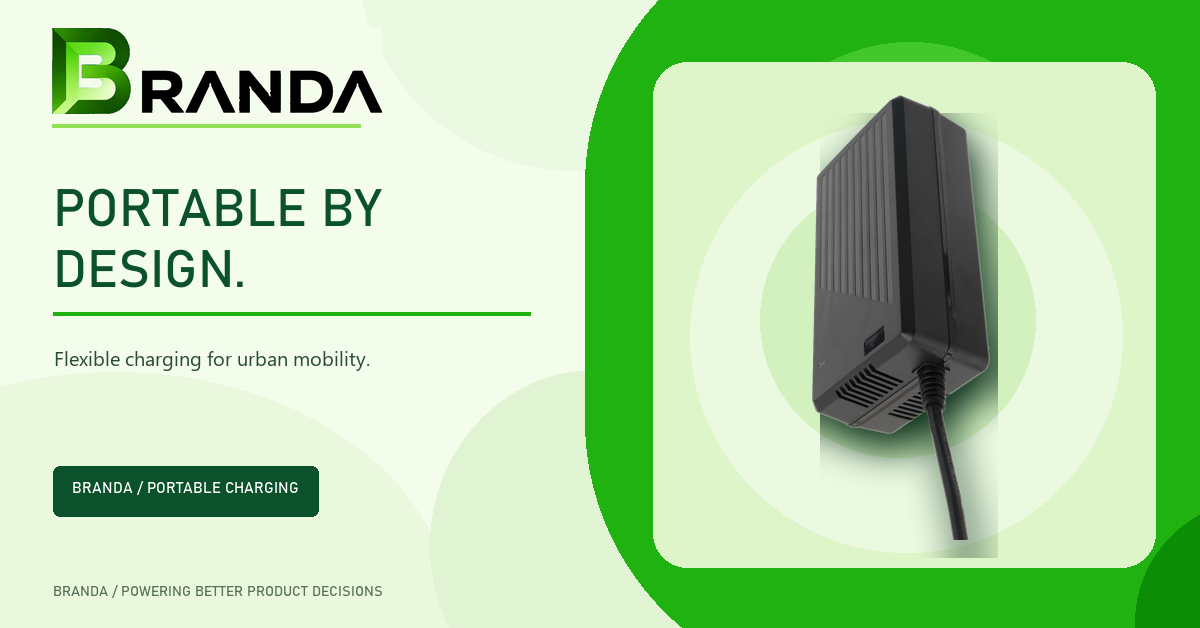
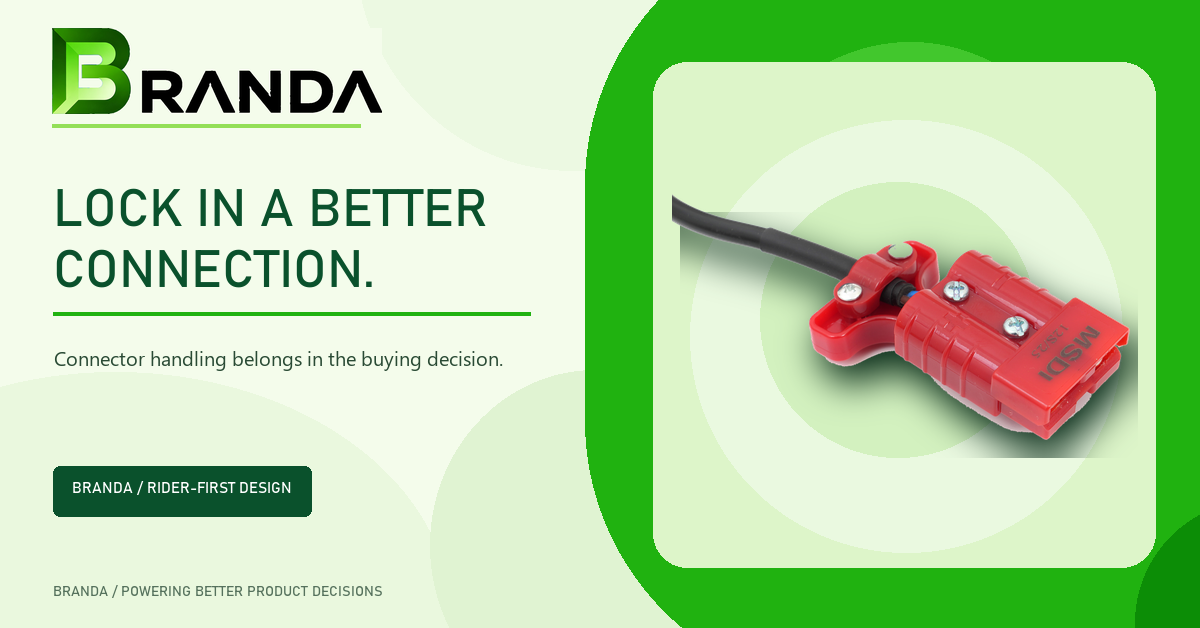
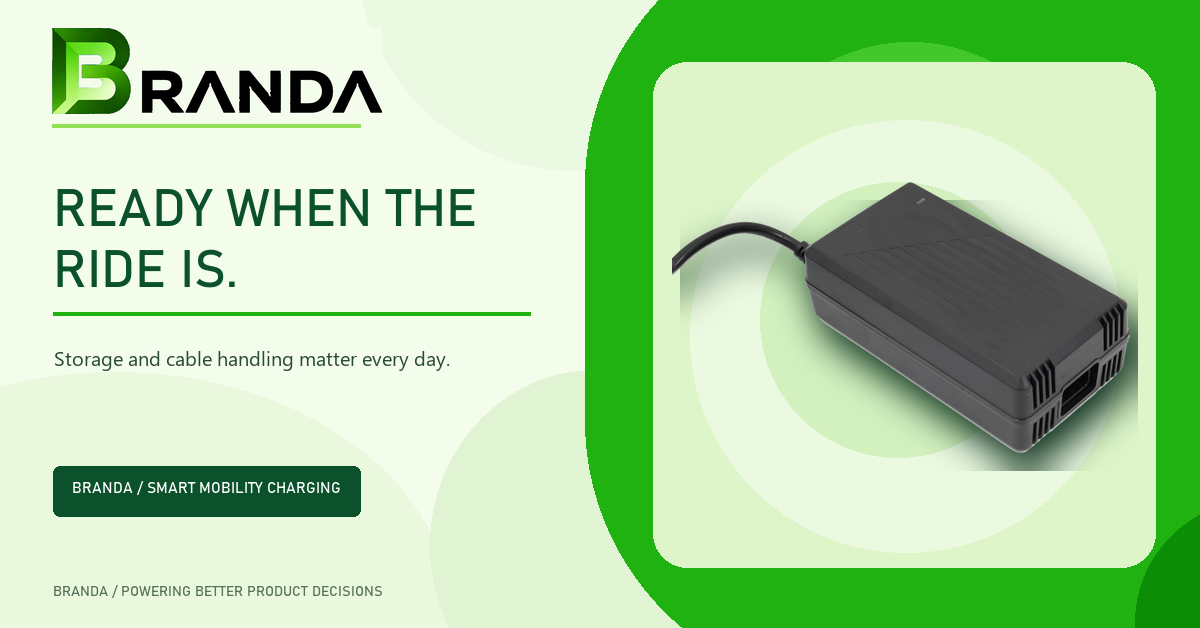
This guide uses Branda 323300002 as a reference for a portable product review. The supplied views show a slim charger body, a bundled cable and a red connector. These are useful visual markers for a buyer, but they do not establish electrical compatibility, ingress protection or a universal motorcycle fit. The real decision requires battery data and a controlled connector review.
What portability should mean in practice
Portability is often described as a low-weight or compact format. For a rider, it also means a predictable place to grip the unit, a cable that can be returned without tangling and a connector that can be reached without disturbing the motorcycle. If those actions are awkward, a small charger can still feel burdensome.
Look beyond the product outline. Measure the cable bundle as it will actually be stored. Check whether the charger has a clear resting surface and enough clearance around its openings. Then test the connector with the real vehicle interface. The practical routine is a stronger buying signal than a marketing phrase.
| Use case | Main priority | Evidence to request |
|---|---|---|
| Home-to-office rider | Repeated handling and storage | Cable bundle, housing size and label |
| Shared apartment parking | Clear identity and safe placement | Charging-space photos and labels |
| Dealer demonstration | Fast identification among units | Variant matrix and packaging |
| Rental or delivery operation | Repeatable handover | Asset record and inspection routine |
| OEM accessory program | Controlled product configuration | Drawing, label and sample file |
Branda 323300002 at a glance
Branda 323300002 has a flat, compact form that suits a planned storage position. The product views show a visible cable bundle and a red connector that is easy to recognize in a bag or charging area. The charger appears suitable for a user who needs to bring charging equipment to the vehicle rather than relying on fixed equipment.
The product should be evaluated for the complete routine: remove the charger, uncoil the cable, position the body, connect the motorcycle, disconnect and repack. Every step creates a chance for cable strain or connector damage if the design and storage plan are not considered together. Portability therefore includes cable management, not only the charger block.
Review battery and connector requirements first
The battery remains the technical starting point. Record the approved charging profile and BMS limits, then compare them with the exact charger specification. A portable package does not create freedom to use an unverified voltage or current setting. The product documentation should be clear about what the quoted version delivers and what has been assumed.
The connector review follows the electrical request. Confirm the physical mating part, keying, polarity and release action. The Branda quick-disconnect connector guide can be used to structure that evidence. For a motorcycle battery charger that moves between locations, the check should be repeated with the storage bag or case the rider will use.
| Field | What the buyer should record | Why it matters |
|---|---|---|
| Battery | Chemistry and BMS-approved charging requirement | Defines the electrical target |
| Connector | Mating part, keying and polarity | Prevents appearance-based matching |
| Cable length | Required reach in the real parking position | Avoids tension and extension practices |
| Storage | Bag or shelf size and condition | Keeps the portable routine practical |
| Market | Input plug, label and destination | Defines the correct product variant |
Placement and cable management
A portable charger needs a stable, dry resting point and the ventilation clearance defined for that exact product. Do not place it where the cable crosses a walkway or where a motorcycle can roll against it. The best time to inspect these conditions is during a normal charging cycle, not in a showroom.
Cable coiling deserves similar attention. A tight loop can put stress on the charger exit or connector. Train users to follow the manufacturer's handling instructions and to inspect the cable before each use. If the intended storage bag forces sharp bends, choose a different storage method.
| Checkpoint | Acceptable approach | Issue to correct |
|---|---|---|
| Resting surface | Stable and suitable for the charger | Balanced on the seat or a narrow rail |
| Cable route | Clear of wheels, traffic and sharp edges | Loop across a walking path |
| Ventilation | Clear space around openings | Covered by clothing or luggage |
| Environment | Follow product and site instructions | Exposed to uncontrolled water or heat |
| Storage | Dry, clean and dedicated | Loose among tools and metal parts |
Five tests for a portable charger sample
A portable charger should be tested as an object that is packed, moved and unpacked. Begin with a clean bench test for documentation and inspection. Then repeat the sequence in the normal charging position. Ask someone who did not prepare the product to use it. A simple test can reveal whether the cable bundle, connector release and charger placement are intuitive.
Document the sample by revision and photograph the mated connector. Keep unresolved questions open. If the intended storage point is too small or the cable cannot be routed without tension, do not hide the issue in a training note. Adjust the product or the charging plan before the pilot.
| Test | Method | Evidence |
|---|---|---|
| Pack and unpack | Use the intended bag or storage point | Time, handling notes and photos |
| Placement | Set the charger in the normal parking position | Stable-point photo |
| Connect | Use the actual motorcycle interface | Connector and cable-route photo |
| Disconnect | Release without pulling the cable | Operator observation |
| Repack | Return cable and charger to storage | Photo of stored configuration |
What a rider should keep in the charger kit
A portable kit is easier to manage when the charger, cable and label have a dedicated place. The rider should be able to confirm that the charger belongs to the correct motorcycle or battery system without relying on memory. If several people use the same vehicle, the check should be even more explicit.
Keep the storage area clean and inspect the cable and connector before use. A tidy kit is not merely aesthetic; it reduces the chance that a connector is damaged by loose tools or that a cable is forced into a sharp bend. The correct handling procedure is the one supplied for the exact charger and motorcycle system.
| Item | Purpose | Control |
|---|---|---|
| Charger | Approved charging device | Product identity and revision |
| Cable | Reach from charger to motorcycle | Inspection before use |
| Connector | Vehicle interface | Mating record and condition |
| Storage bag or point | Protects the assembly during transport | Clean and dedicated space |
| Quick guide | Records the approved routine |
Current version only |
OEM and distributor considerations
For a distributor, portability can support accessory sales, replacement demand and service kits. The packaging and label must still make compatibility clear. A portable charger is easily moved between vehicles, so the risk of selecting the wrong unit increases when several variants look alike.
Branda's electric vehicle charger category, OEM and ODM support and charger product range can help a buyer start a focused shortlist. Provide the expected motorcycle families, connector variants, packaging language and annual planning range so the discussion remains practical.
| Question | Use it to define | Output |
|---|---|---|
| Will the charger travel every day? | Handling and storage priority | Use-case statement |
| How many motorcycle variants are covered? | Connector and label matrix | Compatibility plan |
| How is a charger identified? | Asset and packaging design | Label requirement |
| What does the rider receive? | Documentation and service route | Kit scope |
| What changes after the pilot? | Revision control | Approval process |
Common mistakes to avoid
Buyers sometimes choose a portable charger because it is the smallest product on the page, then discover that the cable bundle is awkward or that the connector is difficult to reach. Others assume that a portable unit can be placed anywhere because it can be moved. Movement is not a substitute for a safe charging position.
Another mistake is allowing several similar chargers into a shared location without a consistent label. Users can connect the wrong device under time pressure. The label, connector and packaging need to work together so the correct choice is obvious.
| Risk | Warning sign | Control |
|---|---|---|
| Cable strain | Tight bend near the body or connector | Change cable length or storage method |
| Wrong unit | Similar chargers without clear labels | Variant matrix and distinctive label |
| Poor placement | Charger balanced on an unsafe surface | Define a dedicated charging point |
| Connector damage | Loose storage with tools | Use a clean, dedicated kit |
| Incomplete quote | Portability discussed without battery data | Require a specification worksheet |
Frequently asked questions
| Question | Answer |
|---|---|
| Does a smaller charger fit every motorcycle? | No. The battery and connector must be approved for the exact product. |
| Is a portable charger safe to place anywhere? | Use the approved installation and handling guidance for the product and site. |
| How should the cable be stored? | Follow the manufacturer's instructions and avoid tight bends or loose sharp objects. |
| Can several riders share one charger? | Only with a clear compatibility and identification process. |
| What is the best sample test? | Pack, place, connect, disconnect and repack in the real routine. |
| Why ask for a specification worksheet? | It prevents visual features from replacing the battery and interface requirements. |
| What should distributors include in an RFQ? | Motorcycle families, connector variants, packaging, market and forecast. |
Reference framework and next action
Portable charging equipment should be reviewed against the applicable standards and local requirements for the destination market. IEC 61851-1 offers a general conductive charging framework, and IEC 62196 series documents address connector topics. These references help define questions; the exact charger and vehicle system need their own approved evidence.
A strong electric motorcycle charging solution makes the charger easy to handle without weakening the controls around compatibility and traceability. Compare the complete kit, not only the housing. Branda's portable motorcycle charger product page and contact team can support the next review.
Turn your portable charging idea into a defined kit
Share the motorcycle platform, battery profile, connector photos and storage constraints with Branda for a practical evaluation.
Discuss a portable chargerProduct images are Branda reference visuals. Electrical compatibility, connector approval, certification, packaging, MOQ and delivery must be confirmed for the exact project. This article is an editorial buying guide, not a substitute for the approved product instructions.


